 Ban dino nga? Kiis
 Xeexu dino
 Rawante dino
 Fo yu ndaw yu dino
 Albomu sitikeer
 Limu TOP yu dino
 Bett ma!
Isisaurus
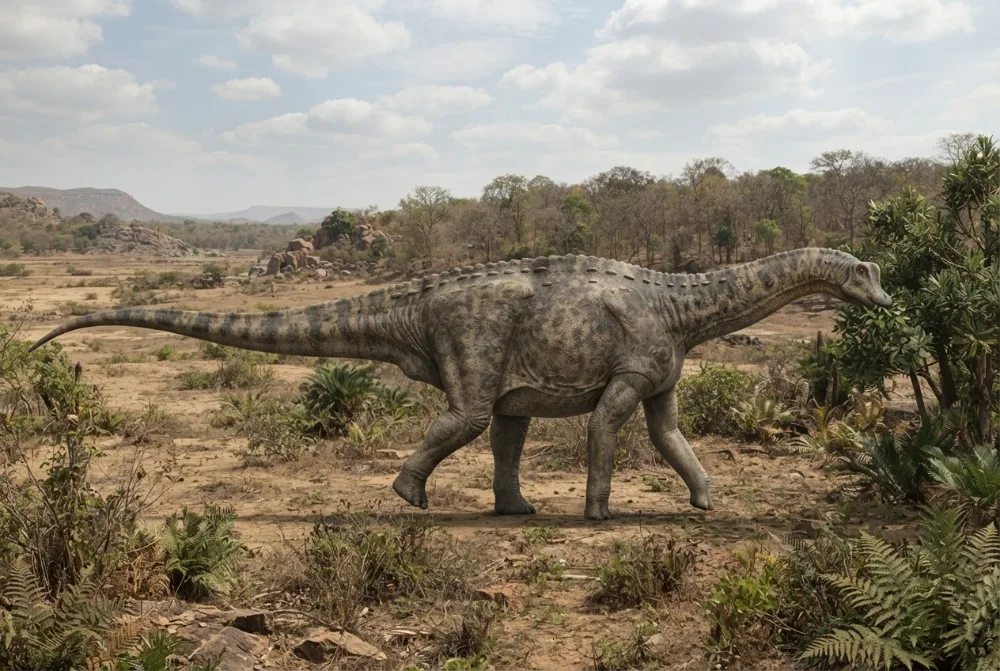
Isisaurus was a big, long-necked dinosaur that lived in what is now India and Pakistan. It had a short neck and long front legs, which made it look different from other long-necked dinosaurs. It munched on leaves from trees and was one of the most complete dinosaurs found in that part of the world.1
Kañ la dundoon?
Naka la réyoon?
Naka la guddoon?
Naka la kawewoon?
Naka la diisoon?

 gudd ni 4 oto yu ñu taxawal ci benn rëdd🍌gudd ni 100 banaana yu ñu topp-toppalediis ni 10 oto🍉diis ni 3000 xaal🎒diis ni 19 klaas yu mat yu xale yu lekkool🐻❄️diis ni 33 uurs yu weex🏢kawe ba mën a xool ci palanteer bu nekk ci eta 3🏃mënoon na daw 100 meetar ci 28 segond (nit ki gën a gaaw dafay soxla 9,6)
Naka la Isisaurus réyoon, bu ñu ko méngalee ak YAW?
Ay kalkil rekk ci sa navigatëer. Dara du ñu denc, dara du ñu yónne fenn.
Naka la gaawoon?


Xibaar yu neex
Isisaurus had a short, upright neck and long front legs, which was very unusual for a sauropod.1
Its upper arm bone, the humerus, was 148 centimeters (about 4.9 feet) long.1
Scientists found fungus in coprolites (fossil poop) that they think came from Isisaurus. The fungus shows that it ate leaves from trees that were sick with disease.1
Isisaurus is known from many bones, including neck, back, and tail vertebrae, ribs, pelvis, shoulder bones, and a left front leg. No skull or foot bones have been found.1
It lived during the very end of the Cretaceous Period, about 70 to 66 million years ago, alongside meat-eating dinosaurs like Rajasaurus.14
The angle between the back of the skull and the neck joint in Isisaurus was 120 degrees, similar to the skulls of Diplodocus and Apatosaurus.1
Laaj yi ñu gën a laaj ci Isisaurus
?How big was Isisaurus?
Isisaurus was a medium sized sauropod, with some estimates of its body length up to 18 metres (59 feet) long and weighing 15 metric tons (17 short tons).1
?What did Isisaurus eat?
Isisaurus was herbivorous, eating leaves from trees. Fungus found in its fossilized poop shows it ate leaves from several species of tree.13
?When did Isisaurus live?
Isisaurus lived during the Late Cretaceous period, about 70 to 66 million years ago.13
?Where was Isisaurus found?
Isisaurus fossils have been found in India and Pakistan, in the Lameta Formation of India and the Pab Formation of Pakistan.1
?Why is it called Isisaurus?
Isisaurus is named after the Indian Statistical Institute (ISI), because its fossils were studied there. The name combines 'ISI' with the Greek word 'saurus' meaning 'lizard'.13
?Was Isisaurus bigger than T. rex?
Isisaurus was about 18 metres (59 feet) long, which is longer than a T. rex.1
Ngir ñi xam dino lool
- Turu xam-xam
- Isisaurus
- Ku ko tudde
- Wilson and Upchurch 20034
- Kurél
- Baat yu gudd
- Njaboot / klad
- Saltasauroidea4
- Klasifikasiyoŋ
- Sauropodomorpha > Sauropoda > Titanosauria > Macronaria4
- Màggaayu doj yi
- 72 ba 66 milyoŋ at (Maastrichtian)4
- Formasiyoŋi doj
- Lameta, Vitakri4
- Réew yi
- End, Pakistaan4
- Fosil yu ñu gis
- 7 ci The Paleobiology Database4
- Gisees
- The fossils were first named Titanosaurus colberti by Sohan Lal Jain and Saswati Bandyopadhyay in 1997. In 2003, Wilson and Upchurch gave them their own genus, Isisaurus, named after the Indian Statistical Institute.1
- Ñu ngi koy werante ba tey
- Scientists are not sure exactly where Isisaurus fits in the titanosaur family tree. Some studies place it close to Rapetosaurus, others near Saltasauridae, and some with Tapuiasaurus.1
Fa xibaar yi jóge
- Isisaurus (en.wikipedia.org)
- Isissauro - Isisaurus colberti - Atlas Virtual da Pré-História (atlasvirtual.com.br)
- Isisaurus | Natural History Museum (nhm.ac.uk)
- Isisaurus in The Paleobiology Database (CC BY 4.0): at, béréb yi, formasiyoŋi doj, klasifikasiyoŋ.
Bépp xibaar ci xët wii am na lim bu wone fa mu jóge. Su nu juumee, baal nu, nun ñu bëgg dino lanu, du ab sërnaalu xam-xam. Wax nu ko ci [email protected] nu defar ko.
 Rex xiif na! Dino Wiki, mbiru ab baay la ngir doomam ju góor ju bëgg dinosoor, ci neen te amul kaamuñaate, amul tracker. Mag ñi mën nañu jox Rex tuuti ñam ngir dimbali ko mu des ci internet.Dundal Rex
 Brachiosaurus
 Diplodocus
 Brontosaurus
 Argentinosaurus
 Camarasaurus
 Morosaurus
 Tyrannosaurus
 Triceratops
 Velociraptor
 Spinosaurus
 Ankylosaurus
 Parasaurolophus