 Ban dino nga? Kiis
 Xeexu dino
 Rawante dino
 Fo yu ndaw yu dino
 Albomu sitikeer
 Limu TOP yu dino
 Bett ma!
Kañ la dundoon?

Naka la réyoon?
Naka la guddoon?
Naka la kawewoon?
jortu
Naka la diisoon?
 gudd ni 2,5 oto yu ñu taxawal ci benn rëdd🍌gudd ni 61 banaana yu ñu topp-toppale
 diis ni 120 xaj🍉diis ni 500 xaal🎒diis ni 3 klaas yu mat yu xale yu lekkool🐻❄️diis ni 6 uurs yu weex🏃mënoon na daw 100 meetar ci 16 segond (nit ki gën a gaaw dafay soxla 9,6)
Naka la Jiangshanosaurus réyoon, bu ñu ko méngalee ak YAW?
Ay kalkil rekk ci sa navigatëer. Dara du ñu denc, dara du ñu yónne fenn.
Naka la gaawoon?


Xibaar yu neex
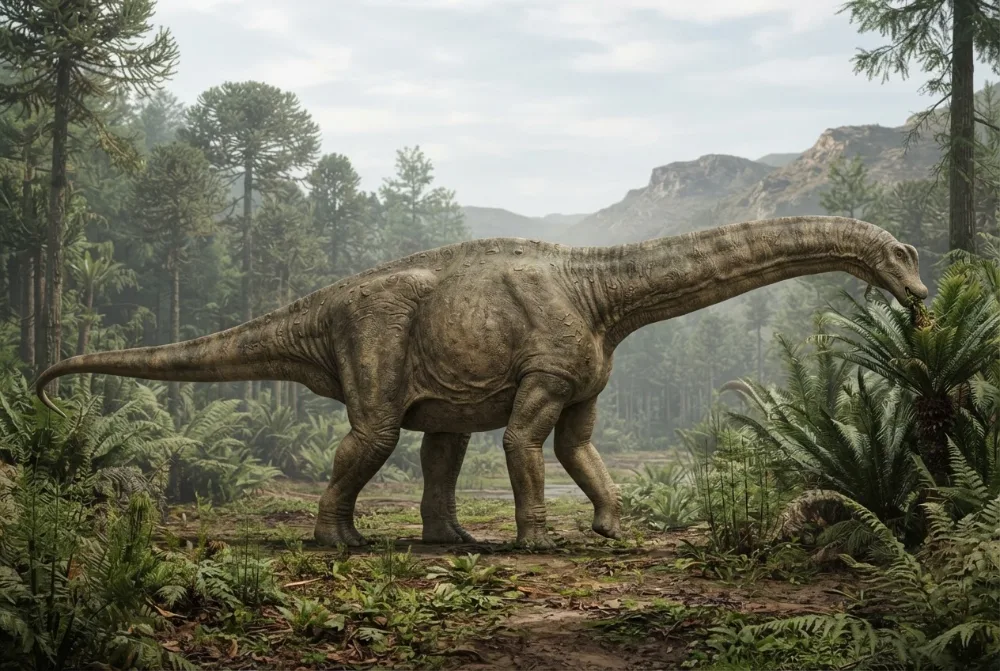
Jiangshanosaurus was first described in 2001 from a partial skeleton including shoulder bones, back and tail vertebrae, and a leg bone.1
It lived about 92 to 88 million years ago, during the Turonian and Coniacian stages of the Late Cretaceous.1
Scientists think Jiangshanosaurus was a titanosauriform, a group of huge sauropods that included some of the largest land animals ever.1
A 2019 study placed Jiangshanosaurus in a group called Somphospondyli, which is just outside the true titanosaurs.1
The exact size of Jiangshanosaurus is hard to determine, but Gregory S. Paul estimated it was about 11 meters (36 feet) long and weighed 2,500 kilograms (5,500 pounds).1
Jiangshanosaurus had unique features in its tail vertebrae and hip bones that help scientists tell it apart from other sauropods.1
Laaj yi ñu gën a laaj ci Jiangshanosaurus
?How big was Jiangshanosaurus?
Its exact size is unknown, but Gregory S. Paul estimated it was about 11 metres (36 feet) long and weighed 2,500 kilograms (5,500 pounds).1
?What did Jiangshanosaurus eat?
It was a herbivore, meaning it ate plants. It used its long neck to reach leaves high in the trees.1
?When did Jiangshanosaurus live?
It lived about 92 to 88 million years ago, during the Turonian and Coniacian stages of the Late Cretaceous.1
Ngir ñi xam dino lool
- Turu xam-xam
- Jiangshanosaurus
- Ku ko tudde
- Tang et al. 20012
- Kurél
- Baat yu gudd
- Njaboot / klad
- Somphospondyli2
- Klasifikasiyoŋ
- Sauropodomorpha > Sauropoda > Macronaria2
- Màggaayu doj yi
- 100 ba 90 milyoŋ at (Cenomanian / Turonian)2
- Formasiyoŋi doj
- Jinhua2
- Réew yi
- Siin2
- Fosil yu ñu gis
- 1 ci The Paleobiology Database2
- Gisees
- The skeleton was dug up in 1977 and 1978 by paleontologists Wei Feng, Wu Weitang and Kang Ximin in the Jinhua Formation of Zhejiang, China. It was named Jiangshanosaurus lixianensis by Tang Feng and colleagues in 2001.1
- Ñu ngi koy werante ba tey
- Scientists are not sure whether Jiangshanosaurus was a true titanosaur or a more primitive relative, because different studies have placed it in different groups.1
Fa xibaar yi jóge
- Jiangshanosaurus (en.wikipedia.org)
- Jiangshanosaurus in The Paleobiology Database (CC BY 4.0): at, béréb yi, formasiyoŋi doj, klasifikasiyoŋ.
Bépp xibaar ci xët wii am na lim bu wone fa mu jóge. Su nu juumee, baal nu, nun ñu bëgg dino lanu, du ab sërnaalu xam-xam. Wax nu ko ci [email protected] nu defar ko.
 Rex xiif na! Dino Wiki, mbiru ab baay la ngir doomam ju góor ju bëgg dinosoor, ci neen te amul kaamuñaate, amul tracker. Mag ñi mën nañu jox Rex tuuti ñam ngir dimbali ko mu des ci internet.Dundal Rex
 Brachiosaurus
 Diplodocus
 Brontosaurus
 Argentinosaurus
 Camarasaurus
 Morosaurus
 Tyrannosaurus
 Triceratops
 Velociraptor
 Spinosaurus
 Ankylosaurus
 Parasaurolophus