 Ban dino nga? Kiis
 Xeexu dino
 Rawante dino
 Fo yu ndaw yu dino
 Albomu sitikeer
 Limu TOP yu dino
 Bett ma!
Leptoceratops
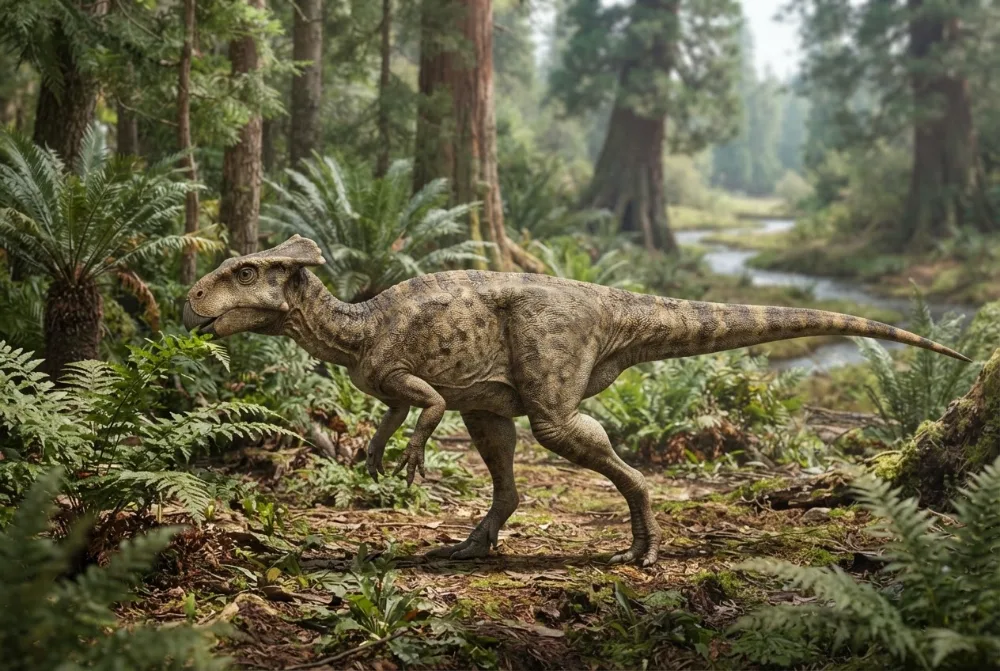
Leptoceratops was a tiny horned dinosaur that lived at the very end of the Age of Dinosaurs. It had a small frill on its head and no horns, and it walked on two legs. Even though it was small, it was a tough plant-eater that lived alongside giants like Triceratops and Tyrannosaurus.1
Kañ la dundoon?
Naka la réyoon?
Naka la guddoon?
Naka la kawewoon?
Naka la diisoon?
 gudd ni 3 xaj, bakkan ba geen🍌gudd ni 17 banaana yu ñu topp-toppale🍉diis ni 40 xaal🧸diis ni 11 xale yu maternel🎒diis ni 6 xale yu lekkool🏃mënoon na daw 100 meetar ci 9,7 segond (nit ki gën a gaaw dafay soxla 9,6)
Naka la Leptoceratops réyoon, bu ñu ko méngalee ak YAW?
Ay kalkil rekk ci sa navigatëer. Dara du ñu denc, dara du ñu yónne fenn.
Naka la gaawoon?


Xibaar yu neex
Leptoceratops is one of the smallest horned dinosaurs ever found, only about the size of a large dog.1
Unlike its big cousin Triceratops, Leptoceratops had no horns and only a tiny frill at the back of its skull.1
The first Leptoceratops fossils were discovered in 1910 by Barnum Brown along the Red Deer River in Alberta, Canada.13
Scientists have found at least eight Leptoceratops specimens, including several nearly complete skeletons.2
Leptoceratops lived right at the end of the Cretaceous Period, about 66 to 72 million years ago.6
Some bonebeds in Montana suggest that Leptoceratops may have dug burrows and lived in groups.3
Leptoceratops had a deep, pointed beak and teeth with simple roots, perfect for chewing tough plants.2
Laaj yi ñu gën a laaj ci Leptoceratops
?How big was Leptoceratops?
About 2 metres (6.6 feet) long and 0.6 to 0.9 metres (2 to 3 feet) tall at the hips, roughly the size of a large dog.14
?Did Leptoceratops have horns?
No, Leptoceratops had no horns, only a small frill on its head, unlike its big cousin Triceratops.14
?What did Leptoceratops eat?
It was a plant-eater that ate tough plants like angiosperms, conifers, and cycads, using its beak and special teeth to chew.1
?Could Leptoceratops walk on two legs?
Yes, it likely walked on two legs when moving fast and on all fours when moving slowly.14
Ku tas léeb yu dul dëgg
Léeb: Leptoceratops is often thought to be a baby Triceratops because of its small size and simple frill.
Dëgg: Leptoceratops is a separate, smaller species of horned dinosaur that lived at the same time as Triceratops. It had its own unique features like a tiny frill and no horns.1
Ngir ñi xam dino lool
- Turu xam-xam
- Leptoceratops
- Ku ko tudde
- Brown 19146
- Kurél
- Dino yu am béjjén
- Njaboot / klad
- Leptoceratopsidae6
- Klasifikasiyoŋ
- Ornithischia > Ceratopsia6
- Màggaayu doj yi
- 72 ba 66 milyoŋ at (Maastrichtian)6
- Formasiyoŋi doj
- Scollard, Hell Creek, "Lance"6
- Réew yi
- Amerig, Kanadaa6
- Fosil yu ñu gis
- 8 ci The Paleobiology Database6
- Gisees
- Leptoceratops was named by American paleontologist Barnum Brown in 1914, based on a partial skull and skeleton found in 1910 in Alberta, Canada.13
- Ñu ngi koy werante ba tey
- Scientists still debate whether some fossils from Montana belong to Leptoceratops or to its close relatives Montanoceratops and Cerasinops.1
Fa xibaar yi jóge
- Leptoceratops - Wikipedia (en.wikipedia.org)
- A NEW PARTIAL SKELETON OF LEPTOCERATOPS GRACILIS FROM (experiment-uploads.s3.amazonaws.com)
- LEPTOCERATOPS - DinoChecker dinosaur archive (dinochecker.com)
- Leptoceratops Gracilis, Dinosaur Pictures, Dinosaur Facts - National Geographic | National Geographic (nationalgeographic.com)
- Leptoceratops | Natural History Museum (nhm.ac.uk)
- Leptoceratops in The Paleobiology Database (CC BY 4.0): at, béréb yi, formasiyoŋi doj, klasifikasiyoŋ.
Bépp xibaar ci xët wii am na lim bu wone fa mu jóge. Su nu juumee, baal nu, nun ñu bëgg dino lanu, du ab sërnaalu xam-xam. Wax nu ko ci [email protected] nu defar ko.
 Rex xiif na! Dino Wiki, mbiru ab baay la ngir doomam ju góor ju bëgg dinosoor, ci neen te amul kaamuñaate, amul tracker. Mag ñi mën nañu jox Rex tuuti ñam ngir dimbali ko mu des ci internet.Dundal Rex
 Triceratops
 Protoceratops
 Ojoceratops
 Tatankaceratops
 Psittacosaurus
 Centrosaurus
 Tyrannosaurus
 Velociraptor
 Spinosaurus
 Ankylosaurus
 Parasaurolophus
 Pteranodon