 Ban dino nga? Kiis
 Xeexu dino
 Rawante dino
 Fo yu ndaw yu dino
 Albomu sitikeer
 Limu TOP yu dino
 Bett ma!
Parahenodus
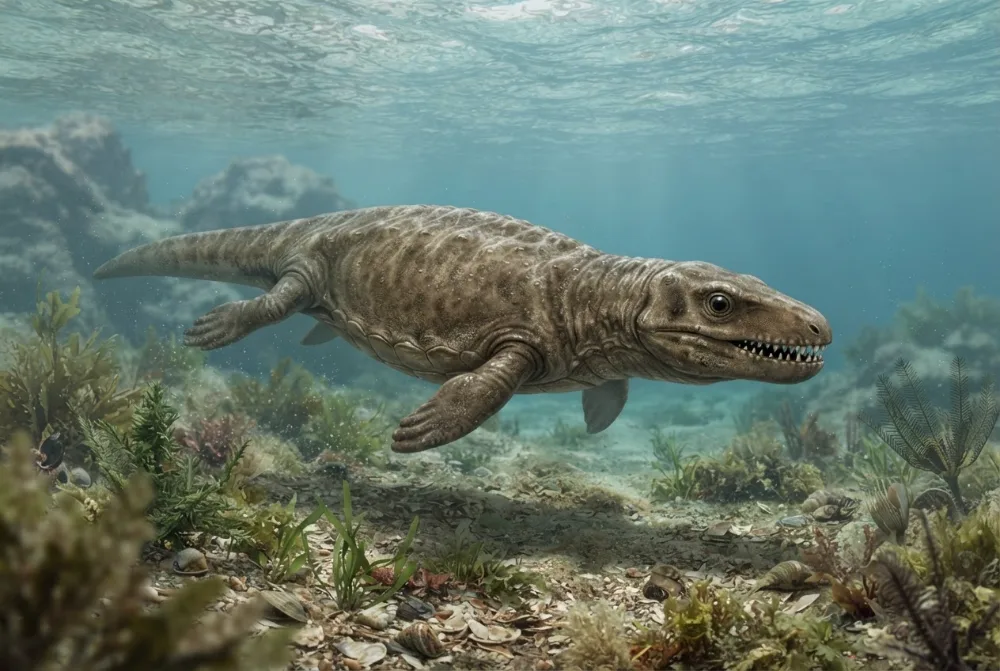
Parahenodus was a strange, shell-crushing marine reptile that lived in the Late Triassic. It looked a bit like a turtle but was actually a placodont, a group of reptiles that ate hard-shelled animals. Only its skull has been found so far!12
Kañ la dundoon?
Naka la gaawoon?


Xibaar yu neex
Parahenodus is known from just one partial skull, discovered between 2008 and 2015 in Spain.1
It was a close relative of Henodus, another placodont from Germany, and together they form the family Henodontidae.12
Parahenodus lived during the Late Triassic, about 237 to 205 million years ago, in the Carnian and Norian ages.31
Its name means 'near Henodus', because it looks very similar to Henodus but has some more primitive features.1
The discovery of Parahenodus helped scientists understand how the unusual skull of Henodontidae evolved over time.2
Ngir ñi xam dino lool
- Turu xam-xam
- Parahenodus
- Ku ko tudde
- Miguel Chaves et al. 20183
- Kurél
- Reptil yu géej
- Njaboot / klad
- Henodontidae3
- Klasifikasiyoŋ
- Placodontia > Sauropterygia3
- Màggaayu doj yi
- 237 ba 206 milyoŋ at (Carnian / Norian)3
- Formasiyoŋi doj
- Keuper3
- Réew yi
- Españ3
- Fosil yu ñu gis
- 1 ci The Paleobiology Database3
- Gisees
- Parahenodus was named and described in 2018 by Carlos de Miguel Chaves, Francisco Ortega, and Adán Pérez-García based on a partial skull found in the Keuper Facies of El Atance, Spain.13
Fa xibaar yi jóge
- Parahenodus (en.wikipedia.org)
- A new placodont from the Upper Triassic of Spain provides new insights on the acquisition of the specialized skull of Henodontidae (onlinelibrary.wiley.com)
- Parahenodus in The Paleobiology Database (CC BY 4.0): at, béréb yi, formasiyoŋi doj, klasifikasiyoŋ.
Bépp xibaar ci xët wii am na lim bu wone fa mu jóge. Su nu juumee, baal nu, nun ñu bëgg dino lanu, du ab sërnaalu xam-xam. Wax nu ko ci [email protected] nu defar ko.
 Rex xiif na! Dino Wiki, mbiru ab baay la ngir doomam ju góor ju bëgg dinosoor, ci neen te amul kaamuñaate, amul tracker. Mag ñi mën nañu jox Rex tuuti ñam ngir dimbali ko mu des ci internet.Dundal Rex
 Nothosaurus
 Placodus
 Lariosaurus
 Cyamodus
 Cymatosaurus
 Proneusticosaurus
 Massospondylus
 Plateosaurus
 Coelophysis
 Podokesaurus
 Thecodontosaurus
 Eudimorphodon