 Ban dino nga? Kiis
 Xeexu dino
 Rawante dino
 Fo yu ndaw yu dino
 Albomu sitikeer
 Limu TOP yu dino
 Bett ma!
Pentaceratops
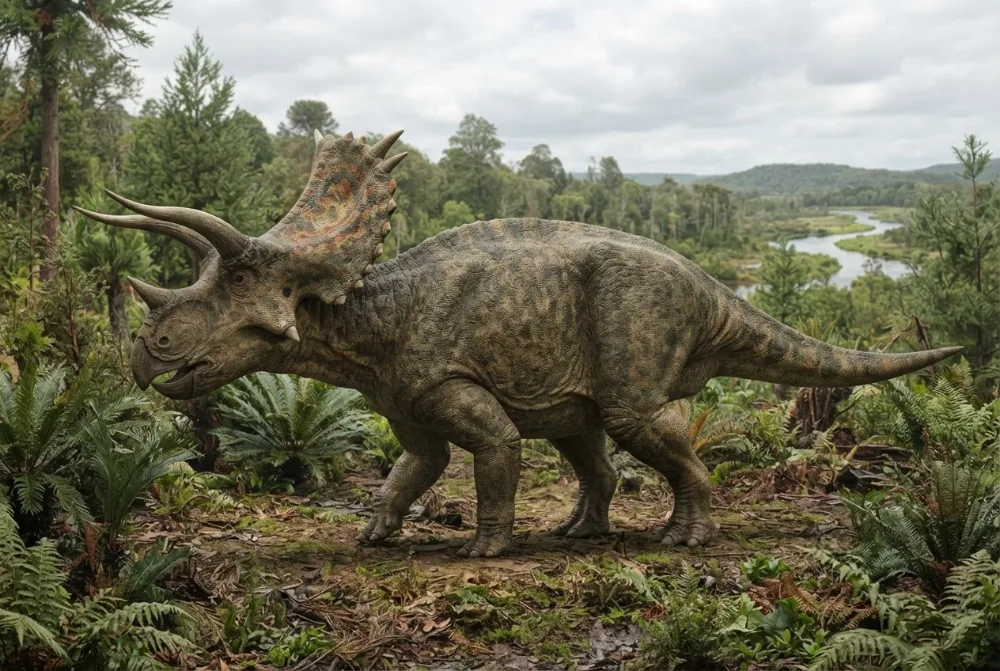
Pentaceratops was a plant-eating dinosaur that lived about 76 to 73 million years ago. It had a huge skull with five horns: two long ones above its eyes, a short one on its nose, and two long spikes sticking out from its cheeks. Its head frill was very long and had small triangular hornlets along the edge.1
Kañ la dundoon?
Naka la réyoon?
Naka la guddoon?
Naka la kawewoon?
jortu
Naka la diisoon?

 gudd ni 6 xaj, bakkan ba geen🍌gudd ni 33 banaana yu ñu topp-toppalediis ni 120 xaj🍉diis ni 500 xaal🎒diis ni 3 klaas yu mat yu xale yu lekkool🐻❄️diis ni 6 uurs yu weex🏃mënoon na daw 100 meetar ci 12 segond (nit ki gën a gaaw dafay soxla 9,6)
Naka la Pentaceratops réyoon, bu ñu ko méngalee ak YAW?
Ay kalkil rekk ci sa navigatëer. Dara du ñu denc, dara du ñu yónne fenn.
Naka la gaawoon?


Xibaar yu neex
Pentaceratops means 'five-horned face' because it had five horns: two brow horns, one nose horn, and two long spikes on its cheekbones.1
Its skull could be over 2.3 meters (7.5 feet) long, making it one of the largest skulls of any land animal.1
Pentaceratops lived alongside the duck-billed dinosaur Parasaurolophus and the tyrannosaur Bistahieversor.1
The first fossils were found in 1921 by Charles Hazelius Sternberg in New Mexico. The dinosaur was named in 1923 by Henry Fairfield Osborn.1
One very large Pentaceratops skull was later renamed Titanoceratops because it looked more like Triceratops.1
Pentaceratops is used as a guide fossil: its appearance marks the start of the Kirtlandian land vertebrate age.1
Laaj yi ñu gën a laaj ci Pentaceratops
?How big was Pentaceratops?
Pentaceratops was about 5.5 to 6 meters (18 to 20 feet) long and weighed around 2.5 metric tons (2.8 short tons).1
?What did Pentaceratops eat?
Pentaceratops was an herbivore, meaning it ate plants. It likely fed on ferns, cycads, and conifers using its sharp beak and cheek teeth.1
?When did Pentaceratops live?
Pentaceratops lived during the Late Cretaceous Period, about 76 to 73 million years ago.1
?Where was Pentaceratops found?
Pentaceratops fossils have been found in the Kirtland Formation in the San Juan Basin of New Mexico, USA.1
?Did Pentaceratops have feathers?
No, Pentaceratops did not have feathers. It was a ceratopsian dinosaur with scaly skin, like other horned dinosaurs.1
?Was Pentaceratops bigger than Triceratops?
No, Pentaceratops was smaller than Triceratops. Pentaceratops was about 5.5 to 6 meters long, while Triceratops could reach up to 9 meters.1
?How many horns did Pentaceratops have?
Pentaceratops had five horns: two long brow horns, one short nose horn, and two long spikes on its cheekbones.1
?Could Pentaceratops swim?
Nobody knows for sure, but Pentaceratops was a land dinosaur with sturdy legs, so it probably did not swim often.1
Ku tas léeb yu dul dëgg
Léeb: Some people think Pentaceratops had five horns on its head like a crown.
Dëgg: The 'fifth horn' is actually a long spike on each cheekbone (the jugal bone), not a true horn on the skull roof.1
Ngir ñi xam dino lool
- Turu xam-xam
- Pentaceratops
- Ku ko tudde
- Osborn 19232
- Kurél
- Dino yu am béjjén
- Njaboot / klad
- Ceratopsidae2
- Klasifikasiyoŋ
- Ornithischia > Ceratopsia > Ceratopsidae2
- Màggaayu doj yi
- 84 ba 66 milyoŋ at (Campanian / Maastrichtian)2
- Formasiyoŋi doj
- Fruitland, Kirtland, Williams Fork2
- Réew yi
- Amerig2
- Fosil yu ñu gis
- 14 ci The Paleobiology Database2
- Gisees
- The first Pentaceratops fossils were collected in 1921 by Charles Hazelius Sternberg in the San Juan Basin of New Mexico. The species was named Pentaceratops sternbergii by Henry Fairfield Osborn in 1923, honoring Sternberg.1
- Ñu ngi koy werante ba tey
- Scientists debate whether the species Pentaceratops aquilonius from Canada really belongs to Pentaceratops or is a different dinosaur called Spiclypeus.1
Fa xibaar yi jóge
- Pentaceratops (en.wikipedia.org)
- Pentaceratops in The Paleobiology Database (CC BY 4.0): at, béréb yi, formasiyoŋi doj, klasifikasiyoŋ.
Bépp xibaar ci xët wii am na lim bu wone fa mu jóge. Su nu juumee, baal nu, nun ñu bëgg dino lanu, du ab sërnaalu xam-xam. Wax nu ko ci [email protected] nu defar ko.
 Rex xiif na! Dino Wiki, mbiru ab baay la ngir doomam ju góor ju bëgg dinosoor, ci neen te amul kaamuñaate, amul tracker. Mag ñi mën nañu jox Rex tuuti ñam ngir dimbali ko mu des ci internet.Dundal Rex
 Triceratops
 Protoceratops
 Ojoceratops
 Tatankaceratops
 Psittacosaurus
 Centrosaurus
 Tyrannosaurus
 Velociraptor
 Spinosaurus
 Ankylosaurus
 Parasaurolophus
 Pteranodon