 Ban dino nga? Kiis
 Xeexu dino
 Rawante dino
 Fo yu ndaw yu dino
 Albomu sitikeer
 Limu TOP yu dino
 Bett ma!
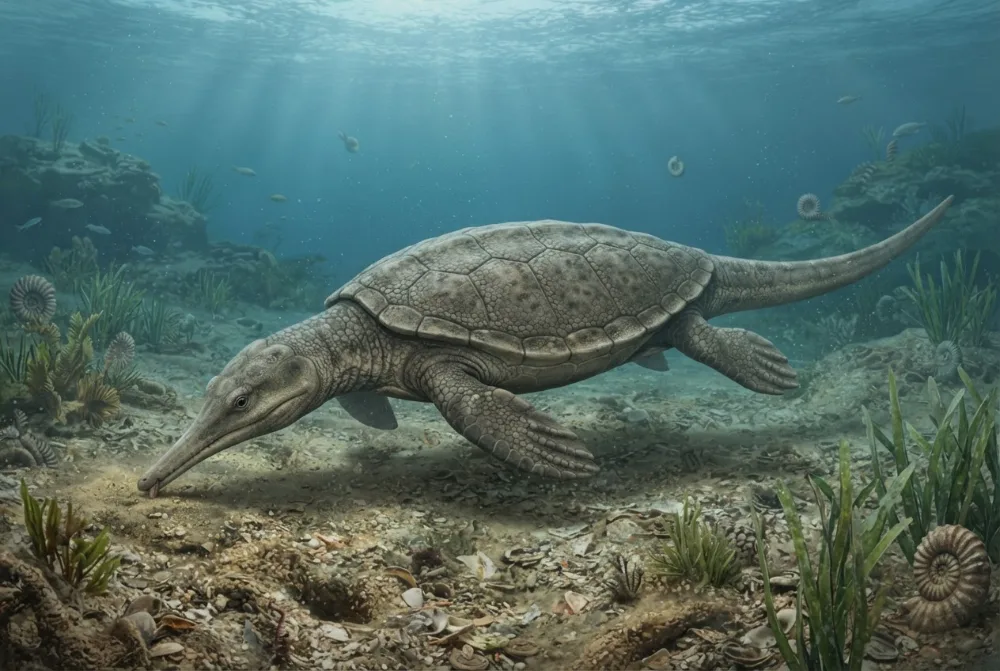
Psephoderma
Psephoderma was a marine reptile that lived in the Late Triassic, about 210 million years ago. It had a flat skull and a shell made of two parts, like a turtle, and used its long snout to dig up shellfish from the seafloor.1
Kañ la dundoon?
Naka la réyoon?
Naka la guddoon?
 gudd ni 4 muusu kër, bakkan ba geen🍌gudd ni 10 banaana yu ñu topp-toppale🏊mënoon na féey guddaayu pisin bu mag (50 m) ci 16 segond
Naka la Psephoderma réyoon, bu ñu ko méngalee ak YAW?
Ay kalkil rekk ci sa navigatëer. Dara du ñu denc, dara du ñu yónne fenn.
Naka la gaawoon?


Xibaar yu neex
Psephoderma had a long tail, up to about 80 cm (31 inches), covered in bony scutes.1
Its shell was split into two pieces: one over the ribs and another over the pelvis.1
The largest known Psephoderma fossil is 180 cm (5.9 feet) long.3
Its skull had a narrow, straight snout with grooves that led to the nostrils.1
Psephoderma had no teeth at the front of its mouth, only four large crushing teeth on each side of the palate.1
It lived in shallow, oxygen-rich waters near tidal channels, where it fed on shellfish like Modiolus and Isognomon.3
Laaj yi ñu gën a laaj ci Psephoderma
?Was Psephoderma a dinosaur?
No, Psephoderma was not a dinosaur. It was a marine reptile called a placodont, which is a type of sauropterygian.1
?How big was Psephoderma?
Psephoderma grew up to 180 centimetres (5.9 feet) long, which is about as long as a bathtub.1
?What did Psephoderma eat?
Psephoderma ate shellfish like Modiolus and Isognomon. It used its long snout to dig them up and crushed them with its large, flat teeth.3
?Could Psephoderma swim?
Yes, Psephoderma could swim. Its shell was streamlined for swimming, and it used its paddle-like limbs to move through the water.3
Ngir ñi xam dino lool
- Turu xam-xam
- Psephoderma
- Ku ko tudde
- von Meyer 18584
- Kurél
- Reptil yu géej
- Njaboot / klad
- Placochelyida4
- Klasifikasiyoŋ
- Placodontia > Sauropterygia4
- Màggaayu doj yi
- 243 ba 201 milyoŋ at ()4
- Formasiyoŋi doj
- Calcare di Zu, Kössener Schichten, Zorzino Limestone4
- Réew yi
- Itali, Otris, Israyel, Angalteer4
- Fosil yu ñu gis
- 10 ci The Paleobiology Database4
- Ñu ngi koy wooye itam
- Placochelyanus (tur yu njëkk yi, léegi ñu ngi leen jàppe ni benn rab rekk)4
- Gisees
- Psephoderma was named by German paleontologist Hermann von Meyer in 1858. Fossils have been found in the Alps and England.12
- Ñu ngi koy werante ba tey
- Scientists are not sure if Psephoderma used its shell mainly for defense or for swimming, but some think it was shaped to help it glide through water.3
Fa xibaar yi jóge
- Psephoderma (en.wikipedia.org)
- PBDB Taxon (paleobiodb.org)
- FUNCTIONAL MORPHOLOGY AND MODE OF LIFE OF THE LATE TRIASSIC PLACODONT PSEPHODERMA ALPINUM MEYER FROM THE CALCARE DI ZORZINO (LOMBARDY, N ITALY) | RIVISTA ITALIANA DI PALEONTOLOGIA E STRATIGRAFIA (riviste.unimi.it)
- Psephoderma in The Paleobiology Database (CC BY 4.0): at, béréb yi, formasiyoŋi doj, klasifikasiyoŋ.
Bépp xibaar ci xët wii am na lim bu wone fa mu jóge. Su nu juumee, baal nu, nun ñu bëgg dino lanu, du ab sërnaalu xam-xam. Wax nu ko ci [email protected] nu defar ko.
 Rex xiif na! Dino Wiki, mbiru ab baay la ngir doomam ju góor ju bëgg dinosoor, ci neen te amul kaamuñaate, amul tracker. Mag ñi mën nañu jox Rex tuuti ñam ngir dimbali ko mu des ci internet.Dundal Rex
 Nothosaurus
 Placodus
 Lariosaurus
 Cyamodus
 Cymatosaurus
 Proneusticosaurus
 Massospondylus
 Plateosaurus
 Coelophysis
 Podokesaurus
 Thecodontosaurus
 Eudimorphodon