 Ban dino nga? Kiis
 Xeexu dino
 Rawante dino
 Fo yu ndaw yu dino
 Albomu sitikeer
 Limu TOP yu dino
 Bett ma!
Sarmientosaurus
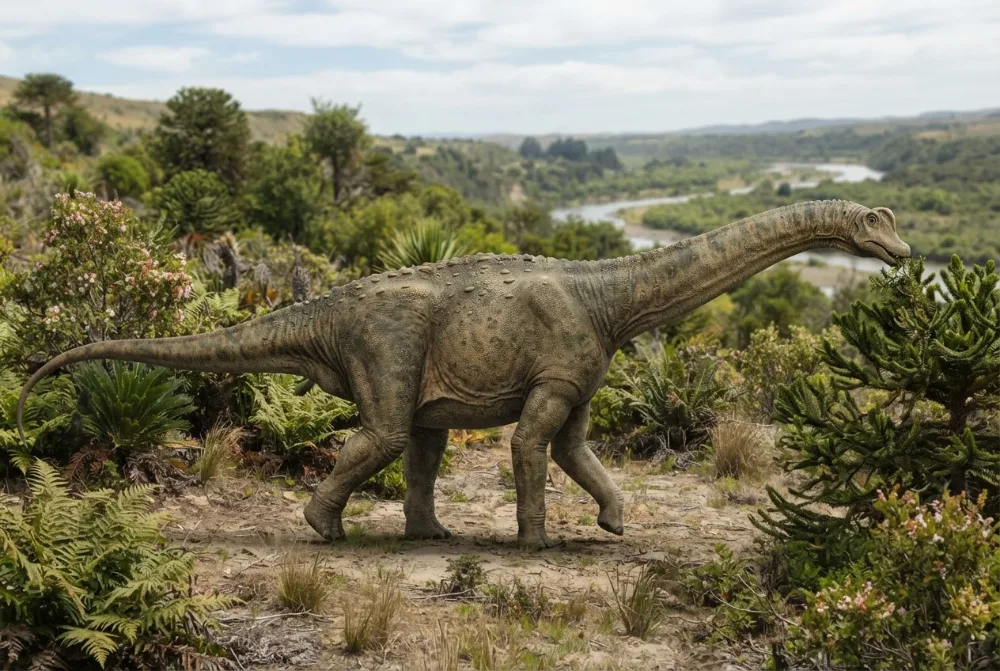
Sarmientosaurus was a long-necked plant-eater that lived in what is now Argentina. It had a complete skull with huge eye sockets, which might have given it excellent vision. Its skull and neck bones show it may have held its head low to eat ferns and other low-growing plants.1
Kañ la dundoon?
Naka la gaawoon?


Xibaar yu neex
Sarmientosaurus is one of the few sauropods known from a complete skull, which is in fantastic condition with all its teeth still in place.1
Its eye sockets were huge, about 40 percent of the length of its skull. This may have given it better vision than many other titanosaurs.12
The dinosaur had a strange, long ossified tendon along its neck, which may have helped support its head or control its posture.1
Sarmientosaurus is a basal lithostrotian titanosaur, meaning it was an early relative of the huge, armored titanosaurs like Ankylosaurus.1
Based on the inner ear and neck structure, scientists think Sarmientosaurus often kept its head and neck hanging downward, much like a sad donkey.2
It lived during the Cenomanian to Turonian ages of the Late Cretaceous, about 100 to 90 million years ago.4
Laaj yi ñu gën a laaj ci Sarmientosaurus
?How big was Sarmientosaurus?
Scientists do not know its exact size because only the skull and neck bones have been found. The skull is about 43 centimetres (17 inches) long.2
?What did Sarmientosaurus eat?
It was a plant-eater. It probably ate low-growing plants like ferns, because its skull and neck suggest it held its head and neck downward.23
?Why did Sarmientosaurus have huge eyes?
Its eye sockets were huge, about 40 percent of the skull's length. This may have given it better vision than many other titanosaurs.23
?When did Sarmientosaurus live?
It lived during the Late Cretaceous Period, about 95 million years ago, in what is now Argentina.2
Ngir ñi xam dino lool
- Turu xam-xam
- Sarmientosaurus
- Ku ko tudde
- Martínez et al. 20164
- Kurél
- Baat yu gudd
- Njaboot / klad
- Diamantinasauria4
- Klasifikasiyoŋ
- Sauropodomorpha > Sauropoda > Macronaria4
- Màggaayu doj yi
- 100 ba 90 milyoŋ at (Cenomanian / Turonian)4
- Formasiyoŋi doj
- Bajo Barreal4
- Réew yi
- Arsantin4
- Fosil yu ñu gis
- 1 ci The Paleobiology Database4
- Gisees
- The only known specimen of Sarmientosaurus was discovered in the Bajo Barreal Formation in Chubut Province, central Patagonia, Argentina. It was named in 2016 by Martínez and colleagues from a skull and part of the neck.41
- Ñu ngi koy werante ba tey
- Scientists are still unsure exactly how Sarmientosaurus held its neck. Some think it kept it low for eating low plants, but others debate its precise posture.1
Fa xibaar yi jóge
- A Basal Lithostrotian Titanosaur (Dinosauria: Sauropoda) with a Complete Skull: Implications for the Evolution and Paleobiology of Titanosauria - PMC (pmc.ncbi.nlm.nih.gov)
- Sarmientosaurus (en.wikipedia.org)
- A Basal Lithostrotian Titanosaur (Dinosauria: Sauropoda) with a Complete Skull: Implications for the Evolution and Paleobiology of Titanosauria (journals.plos.org)
- Sarmientosaurus in The Paleobiology Database (CC BY 4.0): at, béréb yi, formasiyoŋi doj, klasifikasiyoŋ.
Bépp xibaar ci xët wii am na lim bu wone fa mu jóge. Su nu juumee, baal nu, nun ñu bëgg dino lanu, du ab sërnaalu xam-xam. Wax nu ko ci [email protected] nu defar ko.
 Rex xiif na! Dino Wiki, mbiru ab baay la ngir doomam ju góor ju bëgg dinosoor, ci neen te amul kaamuñaate, amul tracker. Mag ñi mën nañu jox Rex tuuti ñam ngir dimbali ko mu des ci internet.Dundal Rex
 Brachiosaurus
 Diplodocus
 Brontosaurus
 Argentinosaurus
 Camarasaurus
 Morosaurus
 Tyrannosaurus
 Triceratops
 Velociraptor
 Spinosaurus
 Ankylosaurus
 Parasaurolophus