 Ban dino nga? Kiis
 Xeexu dino
 Rawante dino
 Fo yu ndaw yu dino
 Albomu sitikeer
 Limu TOP yu dino
 Bett ma!
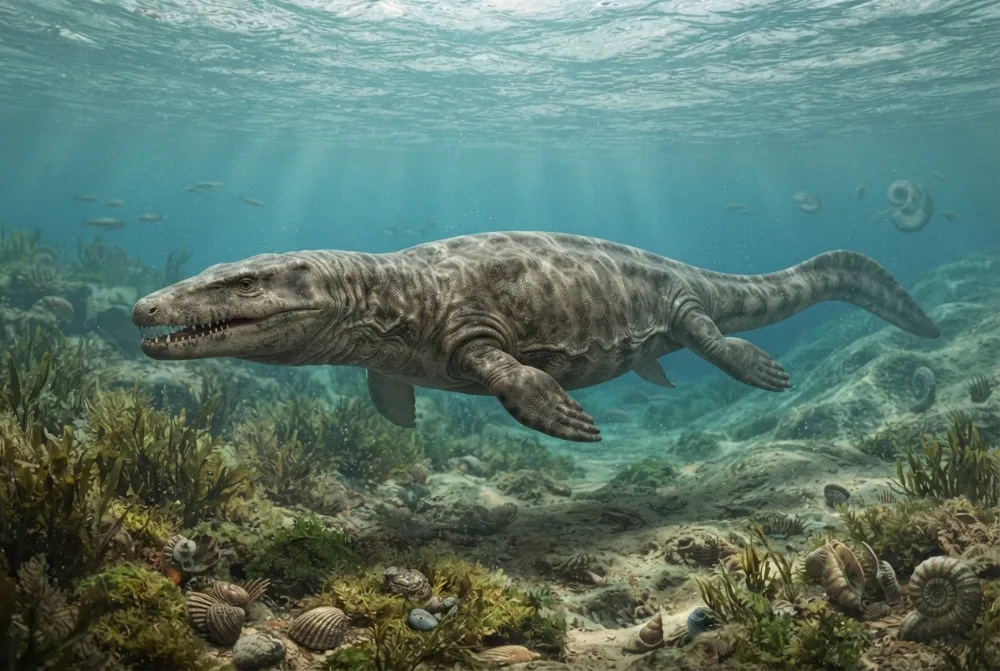
Simosaurus
Simosaurus was a marine reptile that swam in warm, shallow seas during the Middle Triassic, about 240 to 230 million years ago. It had a blunt, flattened head and blunt teeth for crushing hard-shelled prey like clams and ammonites.1
Kañ la dundoon?
Naka la réyoon?
Naka la guddoon?
Naka la diisoon?
 gudd ni 4 xaj, bakkan ba geen🍌gudd ni 22 banaana yu ñu topp-toppale🍉diis ni 26 xaal🧸diis ni 7 xale yu maternel🎒diis ni 4 xale yu lekkool🏊mënoon na féey guddaayu pisin bu mag (50 m) ci 7,8 segond
Naka la Simosaurus réyoon, bu ñu ko méngalee ak YAW?
Ay kalkil rekk ci sa navigatëer. Dara du ñu denc, dara du ñu yónne fenn.
Naka la gaawoon?


Xibaar yu neex
Simosaurus had large openings behind its eyes called upper temporal fossae, which were bigger than its eye sockets.1
Its jaw joint was set far back, projecting beyond the main part of the skull, giving it a unique bite.1
Simosaurus had a flattened trunk that prevented side-to-side swimming, unlike most other nothosaurs.1
It swam using powerful downstrokes of its forelimbs, but its upstroke was weak, making it a moderately strong swimmer.1
The first Simosaurus fossils were found in Lunéville, France, and described by German paleontologist Hermann von Meyer in 1842.1
Simosaurus is known from the Muschelkalk deposits in Germany, where it appears in layers marked by the ammonite Ceratites nodosus.1
Laaj yi ñu gën a laaj ci Simosaurus
?How big was Simosaurus?
Simosaurus grew from 3 to 4 metres (9.8 to 13.1 ft) in length.1
?What did Simosaurus eat?
It ate hard-shelled organisms like ammonites and holostean fish, using its blunt teeth to crush them.1
?How did Simosaurus swim?
It swam with powerful downstrokes of its forelimbs, but its upstroke was weak, making it a moderately strong swimmer.1
Ngir ñi xam dino lool
- Turu xam-xam
- Simosaurus
- Ku ko tudde
- Meyer 18423
- Kurél
- Reptil yu géej
- Njaboot / klad
- Simosauridae3
- Klasifikasiyoŋ
- Nothosauria > Sauropterygia3
- Màggaayu doj yi
- 247 ba 201 milyoŋ at ()3
- Formasiyoŋi doj
- Jilh, Erfurt, Gevanim3
- Réew yi
- Almaañ, Faraas, Arabi Sawudit, Israyel, Itali3
- Fosil yu ñu gis
- 15 ci The Paleobiology Database3
- Gisees
- German paleontologist Christian Erich Hermann von Meyer named Simosaurus in 1842 based on a skull from Lunéville, France. That original skull has since been lost.1
- Ñu ngi koy werante ba tey
- Scientists debate whether Simosaurus was a nothosaur, a pachypleurosaur, or a more primitive sauropterygian.1
Fa xibaar yi jóge
- Simosaurus (en.wikipedia.org)
- Bone histology, microanatomy, and growth of the nothosauroid Simosaurus gaillardoti (Sauropterygia) from the Upper Muschelkalk of southern Germany/Baden-Württemberg - Scientific Publications of the Muséum national d'Histoire naturelle, Paris (sciencepress.mnhn.fr)
- Simosaurus in The Paleobiology Database (CC BY 4.0): at, béréb yi, formasiyoŋi doj, klasifikasiyoŋ.
Bépp xibaar ci xët wii am na lim bu wone fa mu jóge. Su nu juumee, baal nu, nun ñu bëgg dino lanu, du ab sërnaalu xam-xam. Wax nu ko ci [email protected] nu defar ko.
 Rex xiif na! Dino Wiki, mbiru ab baay la ngir doomam ju góor ju bëgg dinosoor, ci neen te amul kaamuñaate, amul tracker. Mag ñi mën nañu jox Rex tuuti ñam ngir dimbali ko mu des ci internet.Dundal Rex
 Nothosaurus
 Placodus
 Lariosaurus
 Cyamodus
 Cymatosaurus
 Proneusticosaurus
 Massospondylus
 Plateosaurus
 Coelophysis
 Podokesaurus
 Thecodontosaurus
 Eudimorphodon