 Ban dino nga? Kiis
 Xeexu dino
 Rawante dino
 Fo yu ndaw yu dino
 Albomu sitikeer
 Limu TOP yu dino
 Bett ma!
Sinocephale
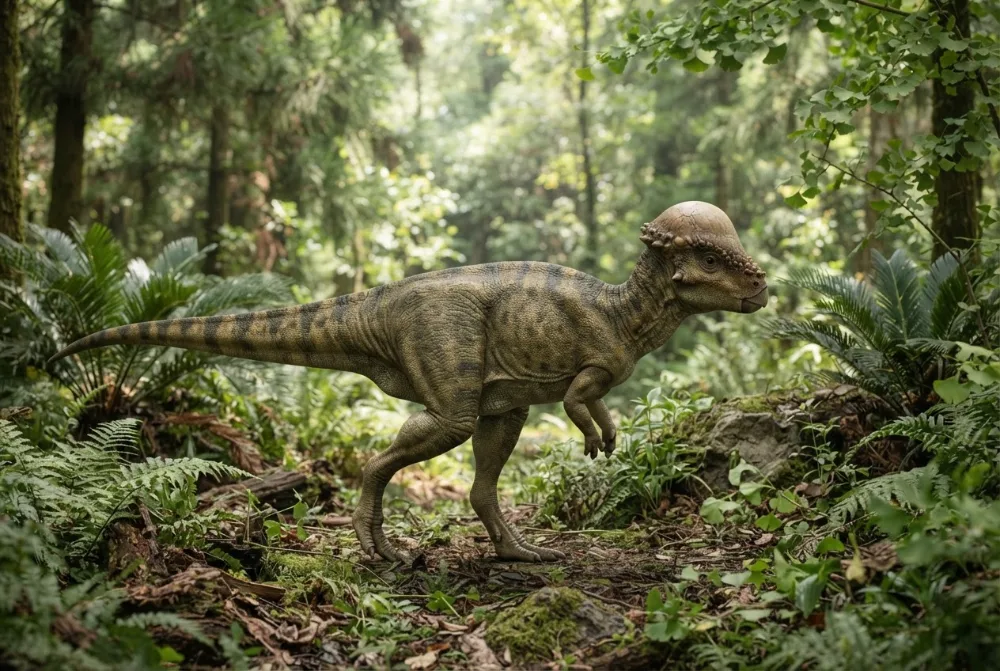
Sinocephale was a small, dome-headed dinosaur that lived in what is now China. It walked on two legs and used its thick, bony skull to head-butt rivals. Only a piece of its skull has been found, but scientists think it was a plant-eater.15
Kañ la dundoon?
Naka la réyoon?
Naka la guddoon?
Naka la diisoon?

 gudd ni 4 muusu kër, bakkan ba geen🍌gudd ni 12 banaana yu ñu topp-toppalediis ni 12 muusu kër🍉diis ni 9 xaal🧸diis ni 2,5 xale yu maternel🎒diis ni 1,5 xale yu lekkool🏃mënoon na daw 100 meetar ci 8,2 segond (nit ki gën a gaaw dafay soxla 9,6)
Naka la Sinocephale réyoon, bu ñu ko méngalee ak YAW?
Ay kalkil rekk ci sa navigatëer. Dara du ñu denc, dara du ñu yónne fenn.
Naka la gaawoon?


Xibaar yu neex
Sinocephale is the first pachycephalosaurid dinosaur ever found outside of North America.2
Its skull had a heart-shaped outline when viewed from above, because the back edge was deeply curved inward.1
The only known fossil is a piece of the skull roof, called a parietal bone. The original was lost, but plaster casts were found and used for study.12
Sinocephale was originally named as a species of Troodon in 1953, then moved to Stegoceras, and finally got its own genus in 2021.1
It lived during the Late Cretaceous, about 83 to 66 million years ago, in a floodplain environment with rivers.51
Sinocephale is related to famous dome-headed dinosaurs like Pachycephalosaurus and Prenocephale.1
Laaj yi ñu gën a laaj ci Sinocephale
?How big was Sinocephale?
Nobody knows for sure, because only a piece of the skull roof has been found. The dome was about 7.5 centimetres (3 inches) thick, but the full body size is unknown.14
?Did Sinocephale have a heart-shaped skull?
Yes. The back edge of its skull was deeply curved inward, giving the skull a heart-shaped outline when seen from above.1
?When did Sinocephale live?
Sinocephale lived during the Late Cretaceous, about 83 to 66 million years ago, in what is now Inner Mongolia, China.1
?What did Sinocephale eat?
Scientists think it was a plant-eater, based on its dome-headed dinosaur relatives, though no teeth or jaws have been found.1
Ku tas léeb yu dul dëgg
Léeb: Some people think Sinocephale was a theropod dinosaur like Troodon.
Dëgg: Sinocephale is actually a pachycephalosaur, a dome-headed plant-eater, not a meat-eating theropod.1
Ngir ñi xam dino lool
- Turu xam-xam
- Sinocephale
- Ku ko tudde
- Evans et al. 20215
- Kurél
- Bopp yu wërngel
- Njaboot / klad
- Pachycephalosauridae5
- Klasifikasiyoŋ
- Ornithischia > Pachycephalosauria5
- Màggaayu doj yi
- 84 ba 66 milyoŋ at (Campanian / Maastrichtian)5
- Formasiyoŋi doj
- Ulansuhai5
- Réew yi
- Siin5
- Fosil yu ñu gis
- 1 ci The Paleobiology Database5
- Gisees
- The fossil was found in 1930 or 1931 by Swedish paleontologists in Inner Mongolia. It was named Troodon bexelli by Birger Bohlin in 1953, but later renamed Sinocephale bexelli in 2021.1
- Ñu ngi koy werante ba tey
- Scientists are not sure exactly how old the Ulansuhai Formation is, so the age of Sinocephale is still debated.1
Fa xibaar yi jóge
- Sinocephale (en.wikipedia.org)
- Description and revised diagnosis of Asia’s first recorded pachycephalosaurid, Sinocephale bexelli gen. nov., from the Upper Cretaceous of Inner Mongolia, China (web.archive.org)
- Sinocephale bexelli | Dinosaur Database by DinoAnimals.com (dinoanimals.com)
- Description and revised diagnosis of Asia’s first recorded pachycephalosaurid, Sinocephale bexelli gen. nov., from the Upper Cretaceous of Inner Mongolia, China (cdnsciencepub.com)
- Sinocephale in The Paleobiology Database (CC BY 4.0): at, béréb yi, formasiyoŋi doj, klasifikasiyoŋ.
Bépp xibaar ci xët wii am na lim bu wone fa mu jóge. Su nu juumee, baal nu, nun ñu bëgg dino lanu, du ab sërnaalu xam-xam. Wax nu ko ci [email protected] nu defar ko.
 Rex xiif na! Dino Wiki, mbiru ab baay la ngir doomam ju góor ju bëgg dinosoor, ci neen te amul kaamuñaate, amul tracker. Mag ñi mën nañu jox Rex tuuti ñam ngir dimbali ko mu des ci internet.Dundal Rex
 Pachycephalosaurus
 Stegoceras
 Prenocephale
 Sphaerotholus
 Foraminacephale
 Brontotholus
 Tyrannosaurus
 Triceratops
 Velociraptor
 Spinosaurus
 Ankylosaurus
 Parasaurolophus