 Ban dino nga? Kiis
 Xeexu dino
 Rawante dino
 Fo yu ndaw yu dino
 Albomu sitikeer
 Limu TOP yu dino
 Bett ma!
Kañ la dundoon?

Naka la réyoon?
Naka la guddoon?
Naka la kawewoon?
Naka la diisoon?

 gudd ni 6 xaj, bakkan ba geen🍌gudd ni 31 banaana yu ñu topp-toppalediis ni 140 xaj🍉diis ni 540 xaal🎒diis ni 3 klaas yu mat yu xale yu lekkool🐻❄️diis ni 6 uurs yu weex🏃mënoon na daw 100 meetar ci 11 segond (nit ki gën a gaaw dafay soxla 9,6)
Naka la Styracosaurus réyoon, bu ñu ko méngalee ak YAW?
Ay kalkil rekk ci sa navigatëer. Dara du ñu denc, dara du ñu yónne fenn.
Naka la gaawoon?


Xibaar yu neex
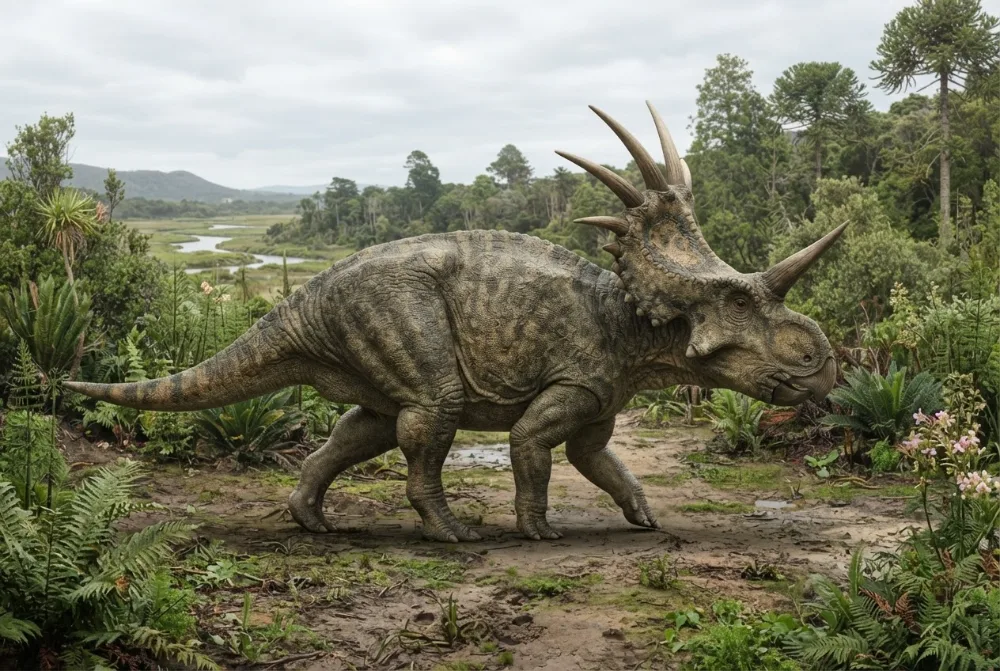
The nose horn of Styracosaurus could be up to 60 centimeters (2 feet) long and 15 centimeters (6 inches) wide.1
Its frill had four to six long spikes sticking out, which is why its name means 'spiked lizard'.1
Scientists have found a bone bed with many Styracosaurus skeletons together, which suggests they may have lived in herds.1
Styracosaurus lived alongside other famous dinosaurs like the horned Centrosaurus, the duck-billed Parasaurolophus, and the tyrannosaur Gorgosaurus.1
The first Styracosaurus fossil was a nearly complete skull found in 1913 by Charles H. Sternberg in what is now Dinosaur Provincial Park in Alberta, Canada.1
A nearly complete skeleton of the same individual was collected later, in 1935, and is now on display in Ottawa, Canada.1
Laaj yi ñu gën a laaj ci Styracosaurus
?How big was Styracosaurus?
About 5 to 5.5 metres long and weighed 1.8 to 2.7 metric tons. It stood about 1.8 metres tall.12
?What did Styracosaurus eat?
It was a plant-eater (herbivore) that ate low-growing plants. It had a parrot-like beak and rows of teeth for slicing tough vegetation.21
?How many horns did Styracosaurus have?
It had one big nose horn and four to six long spikes on its frill. The number of frill spikes varied between individuals.21
?Did Styracosaurus live in herds?
Yes, scientists think so. A bone bed with many Styracosaurus skeletons together suggests they may have lived and died in groups.21
?What predators did Styracosaurus have?
Large meat-eaters like Daspletosaurus, a relative of Tyrannosaurus, lived alongside it and probably hunted it.21
?How fast could Styracosaurus run?
It was very slow. It walked on four short legs and probably could not outrun predators.2
Ku tas léeb yu dul dëgg
Léeb: Some people think Styracosaurus used its frill spikes mainly for fighting predators.
Dëgg: Scientists debate the function of the horns and frill, but they may have been used for display to attract mates, for species recognition, or for defense, not just for fighting.1
Ngir ñi xam dino lool
- Turu xam-xam
- Styracosaurus
- Ku ko tudde
- Lambe 19134
- Kurél
- Dino yu am béjjén
- Njaboot / klad
- Ceratopsidae4
- Klasifikasiyoŋ
- Ornithischia > Ceratopsia > Ceratopsidae4
- Màggaayu doj yi
- 84 ba 72 milyoŋ at (Campanian)4
- Formasiyoŋi doj
- Dinosaur Park4
- Réew yi
- Kanadaa4
- Fosil yu ñu gis
- 10 ci The Paleobiology Database4
- Gisees
- Styracosaurus was named by Canadian paleontologist Lawrence Lambe in 1913, based on a skull found by Charles H. Sternberg in Alberta, Canada.13
- Ñu ngi koy werante ba tey
- Scientists still debate whether another species, Styracosaurus ovatus, should be its own genus (Rubeosaurus) or just a different specimen of Styracosaurus albertensis.1
Fa xibaar yi jóge
- Styracosaurus (en.wikipedia.org)
- Styracosaurus | Natural History Museum (nhm.ac.uk)
- PBDB Taxon (paleobiodb.org)
- Styracosaurus in The Paleobiology Database (CC BY 4.0): at, béréb yi, formasiyoŋi doj, klasifikasiyoŋ.
Bépp xibaar ci xët wii am na lim bu wone fa mu jóge. Su nu juumee, baal nu, nun ñu bëgg dino lanu, du ab sërnaalu xam-xam. Wax nu ko ci [email protected] nu defar ko.
 Rex xiif na! Dino Wiki, mbiru ab baay la ngir doomam ju góor ju bëgg dinosoor, ci neen te amul kaamuñaate, amul tracker. Mag ñi mën nañu jox Rex tuuti ñam ngir dimbali ko mu des ci internet.Dundal Rex
 Triceratops
 Protoceratops
 Ojoceratops
 Tatankaceratops
 Psittacosaurus
 Centrosaurus
 Tyrannosaurus
 Velociraptor
 Spinosaurus
 Ankylosaurus
 Parasaurolophus
 Pteranodon