 Ban dino nga? Kiis
 Xeexu dino
 Rawante dino
 Fo yu ndaw yu dino
 Albomu sitikeer
 Limu TOP yu dino
 Bett ma!
Kañ la dundoon?

Naka la réyoon?
Naka la guddoon?
Naka la kawewoon?
Naka la diisoon?
 gudd ni 4 xaj, bakkan ba geen🍌gudd ni 19 banaana yu ñu topp-toppale
 diis ni 10 muusu kër🍉diis ni 8 xaal🧸diis ni 2 xale yu maternel🎒diis ni 1 xale yu lekkool🏃mënoon na daw 100 meetar ci 7,8 segond (nit ki gën a gaaw dafay soxla 9,6)
Naka la Suskityrannus réyoon, bu ñu ko méngalee ak YAW?
Ay kalkil rekk ci sa navigatëer. Dara du ñu denc, dara du ñu yónne fenn.
Naka la gaawoon?


Xibaar yu neex
Suskityrannus had the earliest known arctometatarsalian foot among its group, meaning its foot bones were pinched together for running fast.21
The fossils were discovered in 1998 by a geologist named Robert Denton and a teenage museum volunteer named Sterling Nesbitt.1
Suskityrannus lived during a time when sea levels were high and much of North America was underwater.2
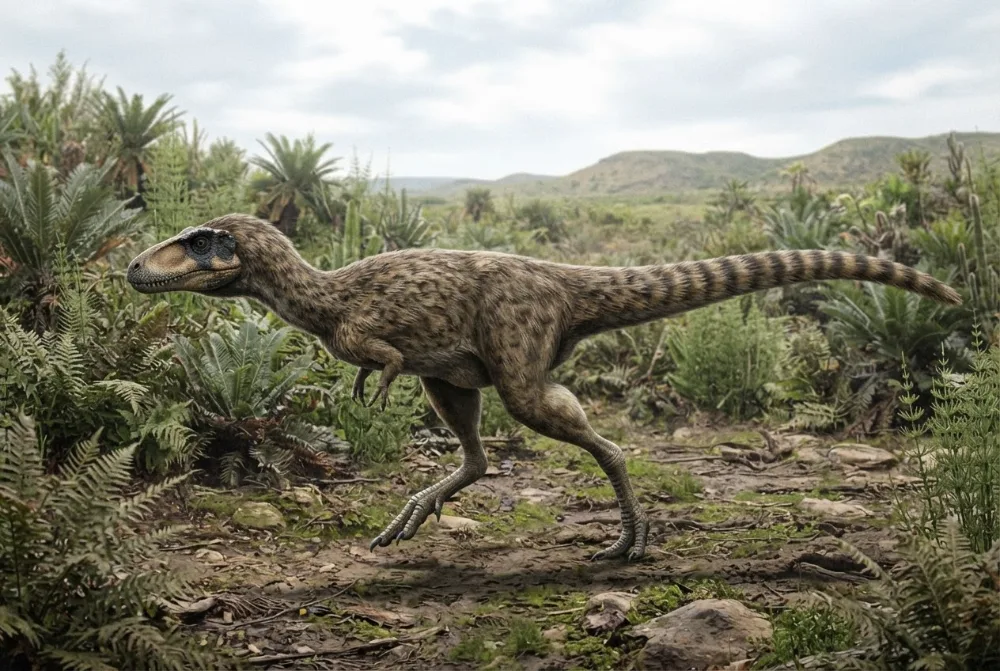
Its name means 'coyote tyrant' in the Zuni language, because it was a small, clever predator like a coyote.1
The two known skeletons belong to young individuals that were still growing, but adults were still much smaller than later tyrannosaurs like T. rex.1
Suskityrannus filled a big gap in the fossil record, showing how small early tyrannosaurs evolved into giant ones.2
Laaj yi ñu gën a laaj ci Suskityrannus
?How big was Suskityrannus?
Suskityrannus was a small dinosaur. Its skull was only 25 to 32 centimetres (9.8 to 12.6 inches) long, and the known specimens were still growing, so adults were much smaller than later tyrannosaurs like T. rex.1
?What did Suskityrannus eat?
Suskityrannus was a predator, so it likely ate small animals like lizards, early mammals, and maybe baby dinosaurs. Its sharp teeth and fast legs helped it hunt.12
?When did Suskityrannus live?
Suskityrannus lived about 92 million years ago during the Turonian stage of the Late Cretaceous period.12
?Where was Suskityrannus found?
Suskityrannus fossils were found in the Moreno Hill Formation of the Zuni Basin in western New Mexico, USA.1
?Was Suskityrannus a dinosaur?
Yes, Suskityrannus was a dinosaur. It was a small tyrannosauroid theropod, which is a group of meat-eating dinosaurs that includes T. rex.1
Ngir ñi xam dino lool
- Turu xam-xam
- Suskityrannus
- Ku ko tudde
- Nesbitt et al. 20193
- Kurél
- Tiranosoor yi
- Njaboot / klad
- Tyrannosauroidea3
- Klasifikasiyoŋ
- Theropoda > Tyrannosauroidea3
- Màggaayu doj yi
- 94 ba 90 milyoŋ at (Turonian)3
- Formasiyoŋi doj
- Moreno Hill3
- Réew yi
- Amerig3
- Fosil yu ñu gis
- 1 ci The Paleobiology Database3
- Gisees
- The first fossils were found in 1998 by geologist Robert Denton and teenager Sterling Nesbitt in New Mexico. The species was officially named Suskityrannus hazelae in 2019.1
- Ñu ngi koy werante ba tey
- Scientists are not sure exactly how big adult Suskityrannus grew, because only young skeletons have been found.1
Fa xibaar yi jóge
- Suskityrannus (en.wikipedia.org)
- A mid-Cretaceous tyrannosauroid and the origin of North American end-Cretaceous dinosaur assemblages | Nature Ecology & Evolution (nature.com)
- Suskityrannus in The Paleobiology Database (CC BY 4.0): at, béréb yi, formasiyoŋi doj, klasifikasiyoŋ.
Bépp xibaar ci xët wii am na lim bu wone fa mu jóge. Su nu juumee, baal nu, nun ñu bëgg dino lanu, du ab sërnaalu xam-xam. Wax nu ko ci [email protected] nu defar ko.
 Rex xiif na! Dino Wiki, mbiru ab baay la ngir doomam ju góor ju bëgg dinosoor, ci neen te amul kaamuñaate, amul tracker. Mag ñi mën nañu jox Rex tuuti ñam ngir dimbali ko mu des ci internet.Dundal Rex
 Tyrannosaurus
 Tarbosaurus
 Albertosaurus
 Daspletosaurus
 Gorgosaurus
 Alectrosaurus
 Triceratops
 Velociraptor
 Spinosaurus
 Ankylosaurus
 Parasaurolophus
 Pteranodon