 Ban dino nga? Kiis
 Xeexu dino
 Rawante dino
 Fo yu ndaw yu dino
 Albomu sitikeer
 Limu TOP yu dino
 Bett ma!
Wannanosaurus
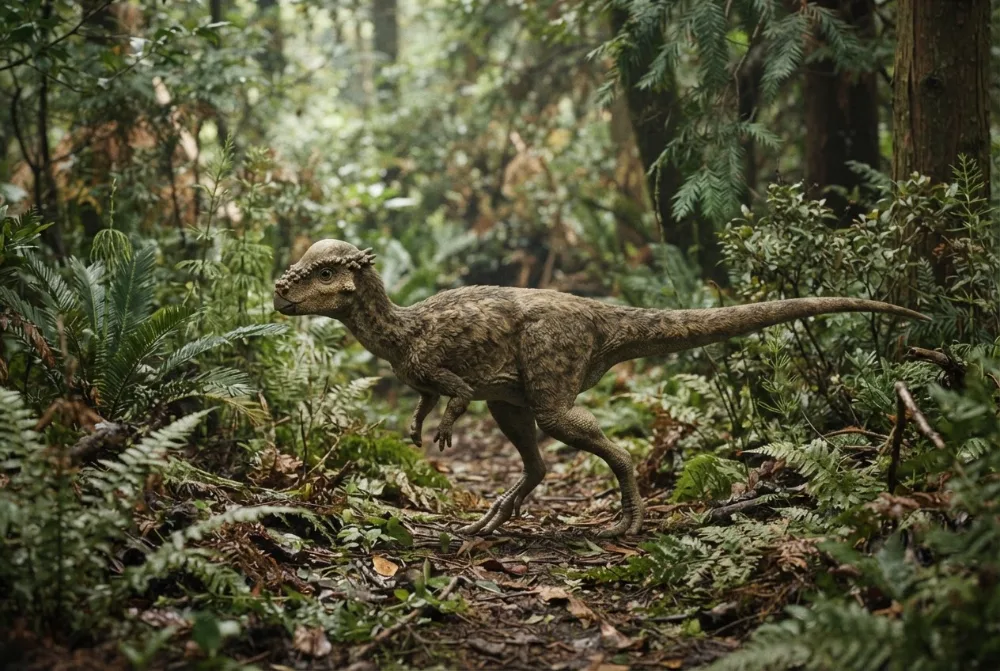
Wannanosaurus was a tiny dome-headed dinosaur that lived about 70 million years ago in what is now China. It had a flat skull instead of a big dome, and it was one of the smallest pachycephalosaurs ever found.12
Kañ la dundoon?
Naka la réyoon?
Naka la guddoon?
Naka la diisoon?
 lu tollu ci diisaayu muusu kër🍌diis ni 25 banaana🏃mënoon na daw 100 meetar ci 15 segond (nit ki gën a gaaw dafay soxla 9,6)
Naka la Wannanosaurus réyoon, bu ñu ko méngalee ak YAW?
Ay kalkil rekk ci sa navigatëer. Dara du ñu denc, dara du ñu yónne fenn.
Naka la gaawoon?


Xibaar yu neex
Wannanosaurus had a completely flat skull roof with large openings called supratemporal fenestrae, unlike later dome-headed relatives.2
Its femur was only about 8 centimeters (3.1 inches) long, making it one of the smallest pachycephalosaurs.1
The skull bones were fused together, showing that this tiny dinosaur was an adult when it died.1
It had a long lower jaw with small, denticulated (serrated) teeth, good for chewing plants.2
Wannanosaurus lived in the Late Cretaceous period, about 72 to 69 million years ago.1
Its forelimbs were short, with the humerus only half the length of the femur or less.2
Laaj yi ñu gën a laaj ci Wannanosaurus
?How big was Wannanosaurus?
It was very small, about 60 centimetres (2.0 feet) long. Its thigh bone was only about 8 centimetres (3.1 inches) long.1
?Did Wannanosaurus have a dome on its head?
No, it had a flat skull roof with large openings, unlike later dome-headed pachycephalosaurs. That is why scientists consider it a primitive member of the group.1
?What did Wannanosaurus eat?
It was probably herbivorous or omnivorous, eating low-growing plants and maybe insects. Its small, serrated teeth were good for chewing plants.1
?When did Wannanosaurus live?
It lived about 70 million years ago, during the Late Cretaceous period (Maastrichtian age).1
?Where was Wannanosaurus found?
Its fossils were discovered in Anhui, China, in the Xiaoyan Formation. The name means 'Wannan lizard' after the region.1
?Is Wannanosaurus a dinosaur?
Yes, it is a dinosaur. It belongs to the group Pachycephalosauria, which are dome-headed dinosaurs, even though its own skull was flat.1
Ngir ñi xam dino lool
- Turu xam-xam
- Wannanosaurus
- Ku ko tudde
- Hou 19774
- Kurél
- Bopp yu wërngel
- Njaboot / klad
- Pachycephalosauria4
- Klasifikasiyoŋ
- Ornithischia > Pachycephalosauria4
- Màggaayu doj yi
- 72 ba 66 milyoŋ at (Maastrichtian)4
- Formasiyoŋi doj
- Xiaoyan4
- Réew yi
- Siin4
- Fosil yu ñu gis
- 1 ci The Paleobiology Database4
- Gisees
- Wannanosaurus was named by Chinese paleontologist Hou Lian-Hai in 1977, based on a partial skeleton found in red sandstones of the Xiaoyan Formation in Anhui, China.21
- Ñu ngi koy werante ba tey
- Scientists are not sure if Wannanosaurus was a very primitive pachycephalosaur or if it was closely related to other flat-headed forms like Homalocephale.12
Fa xibaar yi jóge
- Wannanosaurus (en.wikipedia.org)
- A primitive pachycephalosaurid from the Cretaceous of Anhui, China, Wannanosaurus yansiensis gen. et sp. nov (naturalhistory.si.edu)
- Wannanosaurus yansiensis | Dinosaur Database by DinoAnimals.com (dinoanimals.com)
- Wannanosaurus in The Paleobiology Database (CC BY 4.0): at, béréb yi, formasiyoŋi doj, klasifikasiyoŋ.
Bépp xibaar ci xët wii am na lim bu wone fa mu jóge. Su nu juumee, baal nu, nun ñu bëgg dino lanu, du ab sërnaalu xam-xam. Wax nu ko ci [email protected] nu defar ko.
 Rex xiif na! Dino Wiki, mbiru ab baay la ngir doomam ju góor ju bëgg dinosoor, ci neen te amul kaamuñaate, amul tracker. Mag ñi mën nañu jox Rex tuuti ñam ngir dimbali ko mu des ci internet.Dundal Rex
 Pachycephalosaurus
 Stegoceras
 Prenocephale
 Sphaerotholus
 Foraminacephale
 Brontotholus
 Tyrannosaurus
 Triceratops
 Velociraptor
 Spinosaurus
 Ankylosaurus
 Parasaurolophus