 Uyiyiphi idayinaso? Ikwizi
 Idabi leedayinaso
 Ugqatso lweedayinaso
 Imidlalo emincinci yeedayinaso
 I-albhamu yezitikha
 Iilisti ze-TOP zeedayinaso
 Ndothuse!
Yaphila nini?

Yayinkulu kangakanani?
Yayinde kangakanani?
Yayinzima kangakanani?

 inde njengeekati zasekhaya ezingama-4, impumlo ukuya emsileni🍌inde njengeebhanana ezingama-10 zilandelelanainzima njengeekati zasekhaya ezingama-10🍉inzima njengamavatala angama-8🧸inzima njengabantwana basenkulisa abangama-2🎒inzima njengabantwana besikolo abangama-1🏃ibinokubaleka iimitha ezili-100 ngemizuzwana engama-8.2 (oyena mntu ukhawulezayo udinga i-9,6)
Acrotholus wayemkhulu kangakanani xa ethelekiswa NAWE?
Yimathematika nje kwibhrawuza yakho. Akukho nto igcinwayo okanye ithunyelwe naphi na.
Yayikhawuleza kangakanani?


Iinyani ezimnandi
Acrotholus is the oldest known pachycephalosaur from North America, and possibly the world.2
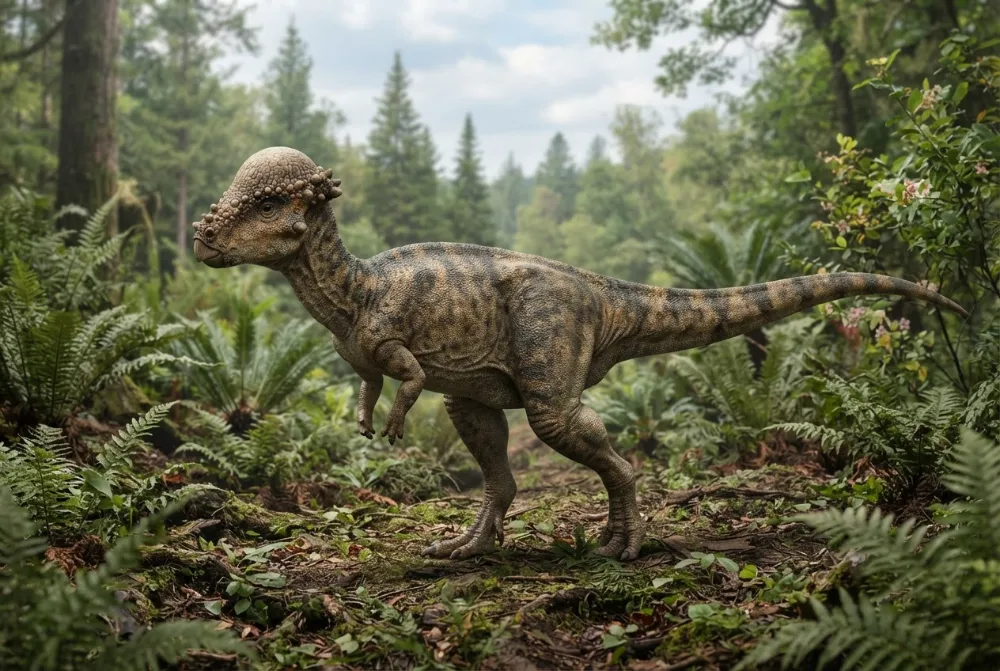
Its dome was very thick, up to 55 millimetres (about 2 inches) above the brain, which is almost half the total length of the dome.2
The dome was fully developed even though Acrotholus lived earlier than other pachycephalosaurs, showing that this feature evolved earlier than scientists thought.2
The name Acrotholus means 'highest dome' in Greek, referring to its thick skull roof.1
The species name audeti honors Roy Audet, a rancher who allowed scientists to dig on his land where the first skull was found.12
Acrotholus had a smooth dome without the bumps or grooves seen in some other pachycephalosaurs, which suggests the known fossils are from adults.2
Eyona mibuzo ibuzwa kakhulu: Acrotholus
?How big was Acrotholus?
Acrotholus was a small dinosaur, weighing 40 kg (88 lb) or less. Its skull dome was about 55 mm (2.2 in) thick.12
?What did Acrotholus eat?
Acrotholus was a plant-eating dinosaur, like other pachycephalosaurs.1
?Why did Acrotholus have a dome on its head?
The dome was probably used for head-butting contests between rivals, though scientists debate exactly how they used it.1
?When did Acrotholus live?
Acrotholus lived about 84 to 83.5 million years ago, during the Late Cretaceous period.1
Inyaniso ngeentsomi
Intsomi: Some people think Acrotholus used its dome to butt heads like bighorn sheep.
Inyaniso: Scientists are not sure. The dome might have been for display or for fighting, but there is no direct evidence of head-butting in Acrotholus.1
Kwiingcali zeedayinaso
- Igama lenzululwazi
- Acrotholus
- Inikwe igama ngu:
- Evans et al. 20134
- Iqela
- Iintloko-ngqukuva
- Usapho / iclade
- Pachycephalosauridae4
- Ukuhlelwa
- Ornithischia > Pachycephalosauria4
- Ubudala bamatye
- 86 ukuya ku-84 izigidi zeminyaka (Santonian)4
- Izakhiwo zamatye
- Milk River4
- Amazwe
- iKhanada4
- Iirekhodi zeefosili
- 1 kwi-Paleobiology Database4
- Ukufunyanwa
- The first fossil, a nearly complete skull dome, was found on Roy Audet's ranch in Alberta, Canada, and was named by David Evans and colleagues in 2013.12
- Kusaxoxwa ngayo
- Scientists still debate whether the dome was used for fighting between males or for showing off to mates, since no complete skeleton has been found.1
Apho iinyani zivela khona
- Acrotholus (en.wikipedia.org)
- The oldest North American pachycephalosaurid and the hidden diversity of small-bodied ornithischian dinosaurs | Nature Communications (nature.com)
- Study of new 'bone-head' hints at higher diversity of small dinosaurs | EurekAlert! (eurekalert.org)
- Acrotholus in The Paleobiology Database (CC BY 4.0): ubudala, iindawo, izakhiwo zamatye, ukuhlelwa.
Yonke inyani ekweli phepha inenombolo ebonisa umthombo wayo. Ukuba siphosisile, uxolo, sithanda iidayinaso, asiyojenali yenzululwazi. Sixelele apha: [email protected], siya kuyilungisa.
 URex ulambile! I-Dino Wiki yiprojekthi katata ukwenzela unyana wakhe othanda iidayinaso, isimahla, ayinazintengiso, ayinazilandeli. Abantu abadala banokuphakela uRex isidlwana ukuze incede ihlale kwi-intanethi.Phakela uRex
 Pachycephalosaurus
 Stegoceras
 Prenocephale
 Sphaerotholus
 Foraminacephale
 Brontotholus
 Tyrannosaurus
 Triceratops
 Velociraptor
 Spinosaurus
 Ankylosaurus
 Parasaurolophus