 Uyiyiphi idayinaso? Ikwizi
 Idabi leedayinaso
 Ugqatso lweedayinaso
 Imidlalo emincinci yeedayinaso
 I-albhamu yezitikha
 Iilisti ze-TOP zeedayinaso
 Ndothuse!
Alaskacephale
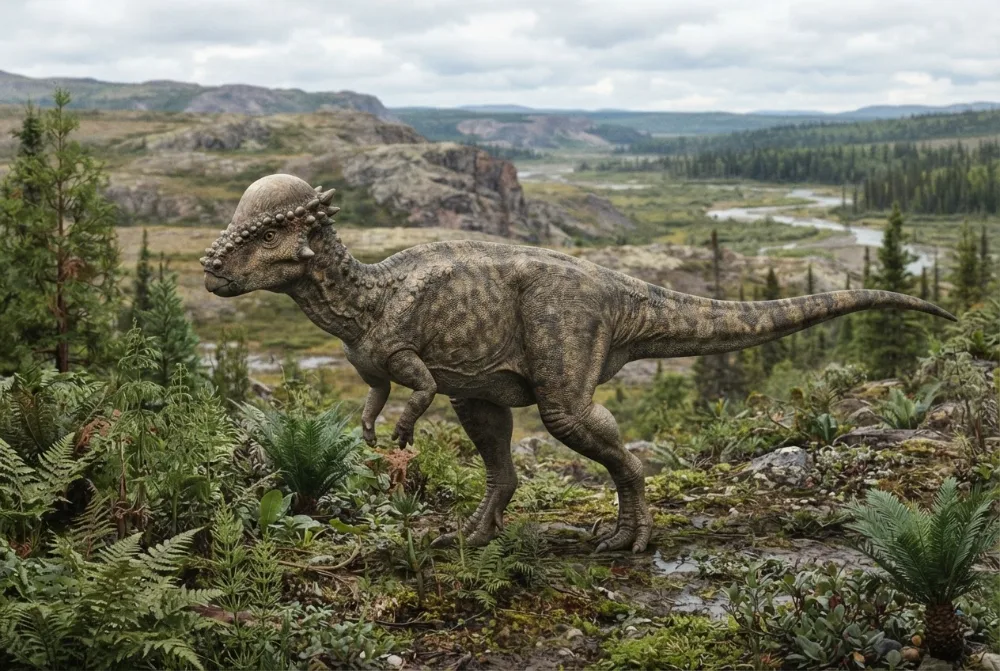
Alaskacephale was a small, dome-headed dinosaur that lived in the cold Arctic of ancient Alaska. It had a thick, bony skull with two rows of bumps along the back of its head. This plant-eater was one of the few dinosaurs that lived near the North Pole.1
Yaphila nini?
Yayinkulu kangakanani?
Yayinde kangakanani?
Yayinzima kangakanani?
 inde njengeekati zasekhaya ezingama-3, impumlo ukuya emsileni🍌inde njengeebhanana ezingama-8 zilandelelana🍌inzima njengeebhanana ezingama-83🏃ibinokubaleka iimitha ezili-100 ngemizuzwana engama-11 (oyena mntu ukhawulezayo udinga i-9,6)
Alaskacephale wayemkhulu kangakanani xa ethelekiswa NAWE?
Yimathematika nje kwibhrawuza yakho. Akukho nto igcinwayo okanye ithunyelwe naphi na.
Yayikhawuleza kangakanani?


Iinyani ezimnandi
Alaskacephale lived about 70 to 69 million years ago, during the Maastrichtian stage of the Late Cretaceous.1
Only one fossil of Alaskacephale has been found: a piece of skull bone called a squamosal.1
The skull had two rows of bony bumps that helped scientists tell it apart from other dome-headed dinosaurs.1
Alaskacephale lived in a cold Arctic environment with winter darkness for 120 days and temperatures as low as -2°C (28°F).1
It shared its home with other dinosaurs like the horned Pachyrhinosaurus, the duck-billed Edmontosaurus, and the tyrannosaur Nanuqsaurus.1
Alaskacephale was about half the size of its relative Pachycephalosaurus, making it one of the smaller pachycephalosaurs.1
Eyona mibuzo ibuzwa kakhulu: Alaskacephale
?How big was Alaskacephale?
About 1.5 metres long and 10 kilograms, based on a similarly sized relative. It was one of the smaller pachycephalosaurs.1
?What did Alaskacephale eat?
It was a plant-eater, like all dome-headed dinosaurs.1
?When did Alaskacephale live?
It lived about 72 to 71 million years ago, during the Late Cretaceous (Maastrichtian stage).1
?Is Alaskacephale a dinosaur?
Yes, it is a dome-headed dinosaur (a pachycephalosaur).1
?Why did Alaskacephale have a thick skull?
The thick, bony dome on its skull might have been used for head-butting or for display, but scientists are not sure.1
?Did Alaskacephale have feathers?
Nobody knows for sure. No fossil feathers have been found with Alaskacephale, and it is not known if pachycephalosaurs had feathers.1
Kwiingcali zeedayinaso
- Igama lenzululwazi
- Alaskacephale
- Inikwe igama ngu:
- Sullivan 20062
- Iqela
- Iintloko-ngqukuva
- Usapho / iclade
- Pachycephalosauridae2
- Ukuhlelwa
- Ornithischia > Pachycephalosauria2
- Ubudala bamatye
- 72 ukuya ku-66 izigidi zeminyaka (Maastrichtian)2
- Izakhiwo zamatye
- Prince Creek2
- Amazwe
- iUSA2
- Iirekhodi zeefosili
- 1 kwi-Paleobiology Database2
- Ukufunyanwa
- The only fossil was found in 1999 by a University of Alaska expedition on the Colville River. It was named Alaskacephale gangloffi in 2006 by paleontologist Robert Sullivan, honoring the earlier researcher Roland Gangloff.1
- Kusaxoxwa ngayo
- Scientists are not sure exactly how big Alaskacephale was, because only a skull fragment has been found.1
Apho iinyani zivela khona
- Alaskacephale (en.wikipedia.org)
- Alaskacephale in The Paleobiology Database (CC BY 4.0): ubudala, iindawo, izakhiwo zamatye, ukuhlelwa.
Yonke inyani ekweli phepha inenombolo ebonisa umthombo wayo. Ukuba siphosisile, uxolo, sithanda iidayinaso, asiyojenali yenzululwazi. Sixelele apha: [email protected], siya kuyilungisa.
 URex ulambile! I-Dino Wiki yiprojekthi katata ukwenzela unyana wakhe othanda iidayinaso, isimahla, ayinazintengiso, ayinazilandeli. Abantu abadala banokuphakela uRex isidlwana ukuze incede ihlale kwi-intanethi.Phakela uRex
 Pachycephalosaurus
 Stegoceras
 Prenocephale
 Sphaerotholus
 Foraminacephale
 Brontotholus
 Tyrannosaurus
 Triceratops
 Velociraptor
 Spinosaurus
 Ankylosaurus
 Parasaurolophus