 Uyiyiphi idayinaso? Ikwizi
 Idabi leedayinaso
 Ugqatso lweedayinaso
 Imidlalo emincinci yeedayinaso
 I-albhamu yezitikha
 Iilisti ze-TOP zeedayinaso
 Ndothuse!
Yaphila nini?

Yayinkulu kangakanani?
Yayinde kangakanani?
Yayiphakame kangakanani?
uqikelelo
Yayinzima kangakanani?
 inde njengezinja ezingama-6, impumlo ukuya emsileni🍌inde njengeebhanana ezingama-33 zilandelelana🍉inzima njengamavatala angama-140🧸inzima njengabantwana basenkulisa abangama-37🎒inzima njengabantwana besikolo abangama-22🏃ibinokubaleka iimitha ezili-100 ngemizuzwana engama-8.6 (oyena mntu ukhawulezayo udinga i-9,6)
Alioramus wayemkhulu kangakanani xa ethelekiswa NAWE?
Yimathematika nje kwibhrawuza yakho. Akukho nto igcinwayo okanye ithunyelwe naphi na.
Yayikhawuleza kangakanani?


Iinyani ezimnandi
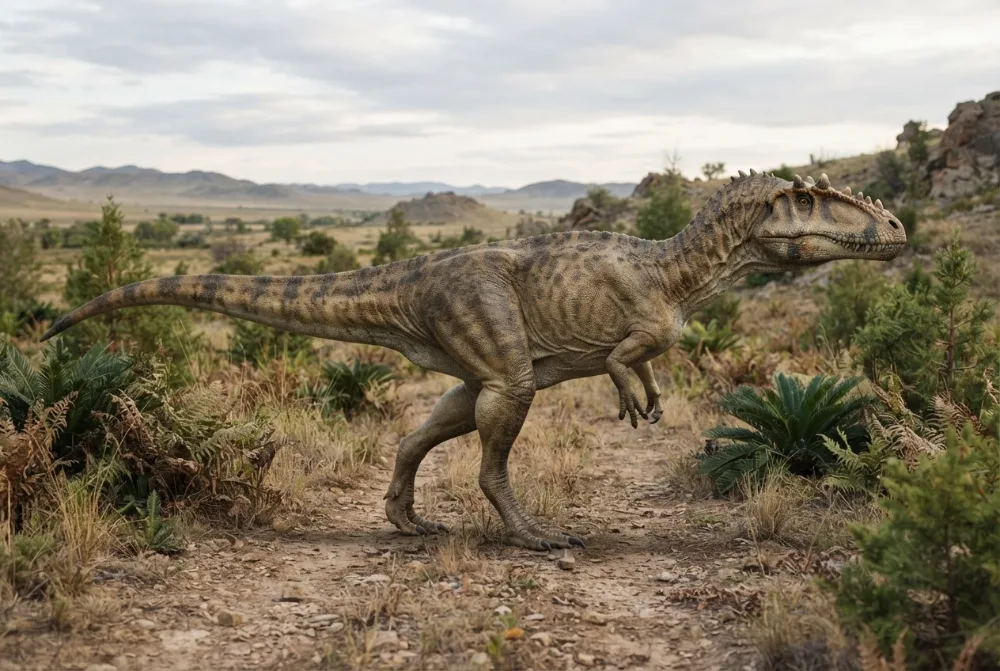
Alioramus had a long, low snout, unlike the deep, powerful skulls of most other tyrannosaurs.2
Its skull was decorated with eight separate horns, more than any other known tyrannosaur.2
One nearly complete skeleton belonged to a nine-year-old animal, but it was still smaller than other tyrannosaurs of the same age.2
Alioramus is closely related to the giant Tarbosaurus and Tyrannosaurus, even though it was much smaller and lighter.2
The name Alioramus means 'other branch', because scientists thought it was a different line of evolution.1
Eyona mibuzo ibuzwa kakhulu: Alioramus
?How big was Alioramus?
Alioramus was about 5 to 6 metres (16 to 20 feet) long and weighed around 385 to 700 kilograms (849 to 1,500 pounds), depending on the species and estimate. It was significantly smaller than a T. rex.341
?What did Alioramus eat?
Alioramus was a carnivore that ate meat. It had sharp teeth and probably hunted small prey, since its skull was not built for bone-crushing like larger tyrannosaurs.34
?How fast could Alioramus run?
The sources do not give a specific speed for Alioramus. It probably relied on speed and agility to hunt, but no exact running speed is known.4
?Why did Alioramus have horns on its head?
Alioramus had a row of five bony crests along the top of its snout, which may have been used for display or to attract mates. These crests were more than 1 cm (0.39 in) tall.3
?Is Alioramus a dinosaur?
Yes, Alioramus is a dinosaur. It is a genus of tyrannosaurid theropod dinosaurs from the Late Cretaceous period.31
Kwiingcali zeedayinaso
- Igama lenzululwazi
- Alioramus
- Inikwe igama ngu:
- Kurzanov 19765
- Iqela
- Iityrannosauri
- Usapho / iclade
- Tyrannosauridae5
- Ukuhlelwa
- Theropoda > Tyrannosauroidea > Tyrannosauridae5
- Ubudala bamatye
- 72 ukuya ku-66 izigidi zeminyaka (Maastrichtian)5
- Izakhiwo zamatye
- Beds of Nogon Tsav, Nemegt5
- Amazwe
- iMongolia, iTshayina5
- Iirekhodi zeefosili
- 3 kwi-Paleobiology Database5
- Ukufunyanwa
- Alioramus was named by Soviet paleontologist Sergei Kurzanov in 1976, based on fossils from the Nogon Tsav locality in Mongolia.5
- Kusaxoxwa ngayo
- Scientists still debate whether Alioramus is a juvenile of another tyrannosaur or a distinct, smaller adult species.2
Apho iinyani zivela khona
- Alioramus | Natural History Museum (nhm.ac.uk)
- pnas.org (pnas.org)
- Alioramus (en.wikipedia.org)
- Dinosaur - Alioramus altai - The Australian Museum (australian.museum)
- Alioramus in The Paleobiology Database (CC BY 4.0): ubudala, iindawo, izakhiwo zamatye, ukuhlelwa.
Yonke inyani ekweli phepha inenombolo ebonisa umthombo wayo. Ukuba siphosisile, uxolo, sithanda iidayinaso, asiyojenali yenzululwazi. Sixelele apha: [email protected], siya kuyilungisa.
 URex ulambile! I-Dino Wiki yiprojekthi katata ukwenzela unyana wakhe othanda iidayinaso, isimahla, ayinazintengiso, ayinazilandeli. Abantu abadala banokuphakela uRex isidlwana ukuze incede ihlale kwi-intanethi.Phakela uRex
 Tyrannosaurus
 Tarbosaurus
 Albertosaurus
 Daspletosaurus
 Gorgosaurus
 Alectrosaurus
 Triceratops
 Velociraptor
 Spinosaurus
 Ankylosaurus
 Parasaurolophus
 Pteranodon