 Uyiyiphi idayinaso? Ikwizi
 Idabi leedayinaso
 Ugqatso lweedayinaso
 Imidlalo emincinci yeedayinaso
 I-albhamu yezitikha
 Iilisti ze-TOP zeedayinaso
 Ndothuse!
Yaphila nini?

Yayinkulu kangakanani?
Yayinde kangakanani?
Yayiphakame kangakanani?
uqikelelo
Yayinzima kangakanani?

 inde njengezinja ezingama-8, impumlo ukuya emsileni🍌inde njengeebhanana ezingama-44 zilandelelanainzima njengezinja ezingama-150🍉inzima njengamavatala angama-600🎒inzima njengamagumbi okufundela apheleleyo abantwana angama-4🐻❄️inzima njengeebhere ezimhlophe ezingama-7🏃ibinokubaleka iimitha ezili-100 ngemizuzwana engama-15 (oyena mntu ukhawulezayo udinga i-9,6)
Amurosaurus wayemkhulu kangakanani xa ethelekiswa NAWE?
Yimathematika nje kwibhrawuza yakho. Akukho nto igcinwayo okanye ithunyelwe naphi na.
Yayikhawuleza kangakanani?


Iinyani ezimnandi
Amurosaurus is named after the Amur River, which forms the border between Russia and China.1
Most of the bones found in its bonebed belong to young Amurosaurus, not adults.1
Theropod teeth are common in the bonebed, and many bones have tooth marks, showing that predators or scavengers chewed on them.1
Amurosaurus had a unique S-shaped curve in its lower arm bone, the ulna.1
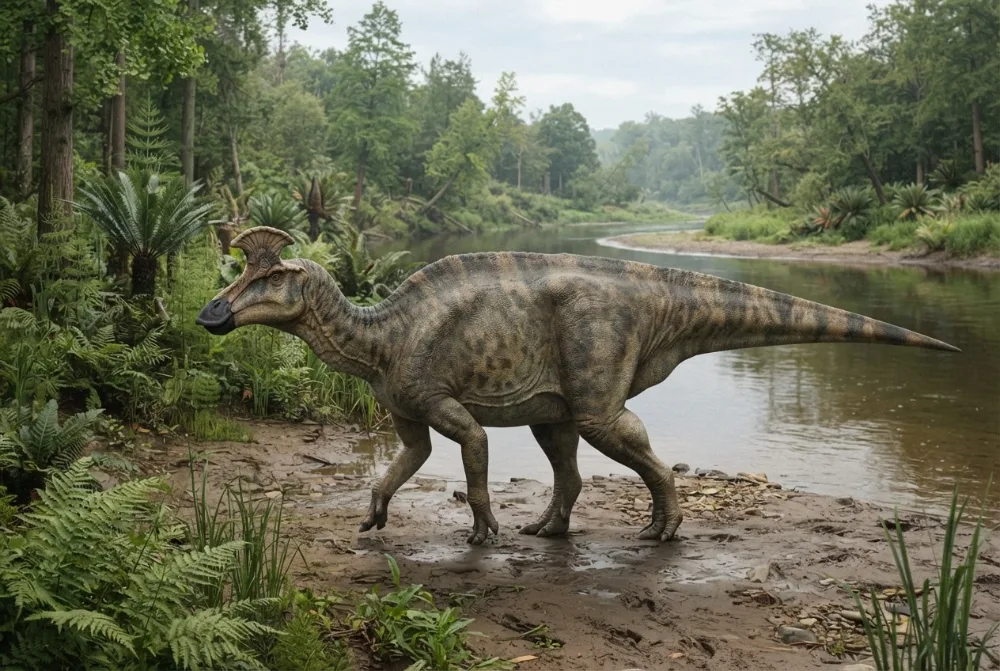
Although the crest bones are missing, the skull roof shows it likely had a hollow crest like other lambeosaurines.1
Amurosaurus had a relatively large brain compared to some other plant-eaters, which might mean it lived in groups.1
Eyona mibuzo ibuzwa kakhulu: Amurosaurus
?How big was Amurosaurus?
About 8 metres (26 feet) long and around 3 metric tons (3.3 short tons) in weight, though one source says it may have been up to 12 metres (39 feet) long.12
?What did Amurosaurus eat?
It was a plant-eater, or herbivore, like all hadrosaurid dinosaurs.1
?Did Amurosaurus have a crest?
Yes, it probably had a hollow crest on its head, even though the crest bones themselves have not been found yet.1
?When did Amurosaurus live?
It lived during the Late Cretaceous period, about 70 to 66 million years ago.1
?Where was Amurosaurus found?
All its fossils come from a single bonebed in Blagoveschensk, Russia, near the Amur River.1
?Was Amurosaurus a dinosaur?
Yes, it was a lambeosaurine hadrosaurid dinosaur.1
Inyaniso ngeentsomi
Intsomi: Amurosaurus was a meat-eater because it had sharp teeth.
Inyaniso: Amurosaurus was a plant-eater, as shown by its beak and teeth made for grinding plants.1
Kwiingcali zeedayinaso
- Igama lenzululwazi
- Amurosaurus
- Inikwe igama ngu:
- Bolotsky and Kurzanov 19913
- Iqela
- Imilomo-dada
- Usapho / iclade
- Hadrosauridae3
- Ukuhlelwa
- Ornithischia > Ornithopoda > Iguanodontia > Hadrosauridae3
- Ubudala bamatye
- 72 ukuya ku-66 izigidi zeminyaka (Maastrichtian)3
- Izakhiwo zamatye
- Udurchukan, Yuliangzi3
- Amazwe
- iRashiya, iTshayina3
- Iirekhodi zeefosili
- 2 kwi-Paleobiology Database3
- Ikwaziwa ngokuba
- Sahaliyania (amagama amadala ngoku abalwa njengesilwanyana esinye)3
- Ukufunyanwa
- Russian paleontologists Yuri Bolotsky and Sergei Kurzanov named Amurosaurus in 1991. The first fossils were found in 1984 in a bonebed inside the city of Blagoveschensk, Russia.1
- Kusaxoxwa ngayo
- Scientists are still debating whether Amurosaurus had a crest and what it looked like, because the crest bones have not been found.1
Apho iinyani zivela khona
- Amurosaurus (en.wikipedia.org)
- Amurosaurus State Darwin Museum (darwinmuseum.ru)
- Amurosaurus in The Paleobiology Database (CC BY 4.0): ubudala, iindawo, izakhiwo zamatye, ukuhlelwa.
Yonke inyani ekweli phepha inenombolo ebonisa umthombo wayo. Ukuba siphosisile, uxolo, sithanda iidayinaso, asiyojenali yenzululwazi. Sixelele apha: [email protected], siya kuyilungisa.
 URex ulambile! I-Dino Wiki yiprojekthi katata ukwenzela unyana wakhe othanda iidayinaso, isimahla, ayinazintengiso, ayinazilandeli. Abantu abadala banokuphakela uRex isidlwana ukuze incede ihlale kwi-intanethi.Phakela uRex
 Parasaurolophus
 Edmontosaurus
 Saurolophus
 Hypacrosaurus
 Corythosaurus
 Kritosaurus
 Tyrannosaurus
 Triceratops
 Velociraptor
 Spinosaurus
 Ankylosaurus
 Pteranodon