 Uyiyiphi idayinaso? Ikwizi
 Idabi leedayinaso
 Ugqatso lweedayinaso
 Imidlalo emincinci yeedayinaso
 I-albhamu yezitikha
 Iilisti ze-TOP zeedayinaso
 Ndothuse!
Augustynolophus
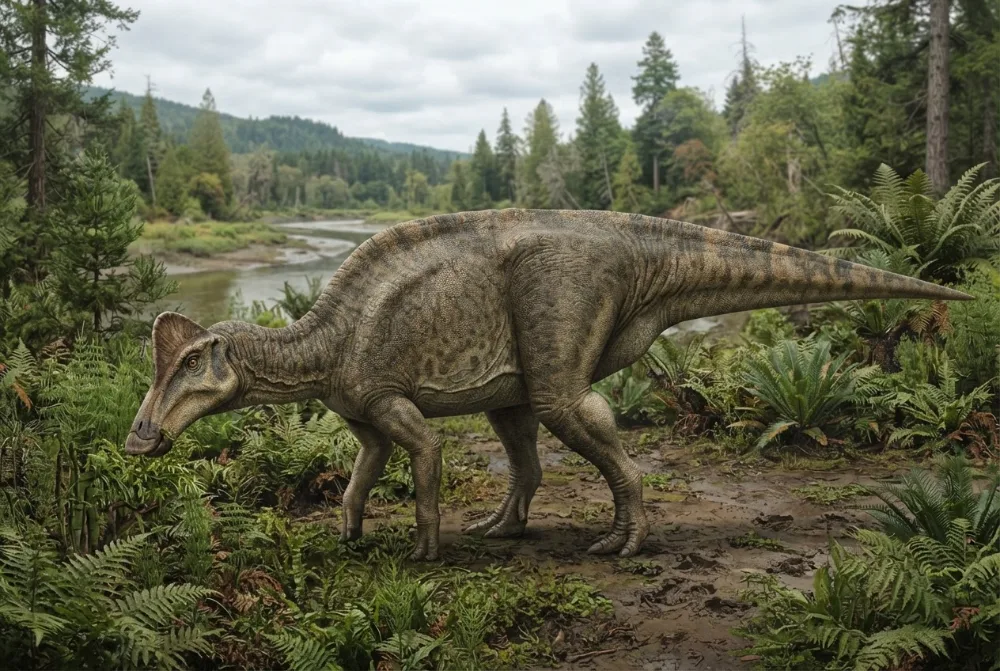
Augustynolophus was a duck-billed dinosaur that lived right at the end of the Age of Dinosaurs. It had a solid, bony crest on its head shaped like a triangle. This plant-eater is one of the last non-bird dinosaurs known before the big extinction.12
Yaphila nini?
Yayinkulu kangakanani?
Yayinde kangakanani?
Yayiphakame kangakanani?
uqikelelo
Yayinzima kangakanani?

 inde njengezinja ezingama-8, impumlo ukuya emsileni🍌inde njengeebhanana ezingama-44 zilandelelanainzima njengezinja ezingama-150🍉inzima njengamavatala angama-600🎒inzima njengamagumbi okufundela apheleleyo abantwana angama-4🐻❄️inzima njengeebhere ezimhlophe ezingama-7🏃ibinokubaleka iimitha ezili-100 ngemizuzwana engama-15 (oyena mntu ukhawulezayo udinga i-9,6)
Augustynolophus wayemkhulu kangakanani xa ethelekiswa NAWE?
Yimathematika nje kwibhrawuza yakho. Akukho nto igcinwayo okanye ithunyelwe naphi na.
Yayikhawuleza kangakanani?


Iinyani ezimnandi
Augustynolophus is the official state dinosaur of California, chosen in 2017.1
Only two specimens of Augustynolophus have been found, both in California. One might be a juvenile because it is smaller.1
Its solid nasal crest was a long triangular plate that stuck up above its skull. The crest had a knob at the tip that curved forward.2
Augustynolophus lived about 70 to 66 million years ago, during the very end of the Cretaceous Period.1
It shared its home with many marine animals like mosasaurs, plesiosaurs, and sea turtles, because California was mostly underwater at that time.1
Eyona mibuzo ibuzwa kakhulu: Augustynolophus
?How big was Augustynolophus?
Augustynolophus was about 8 metres (26 feet) long and weighed around 3 metric tons (3.3 short tons).3
?What did Augustynolophus eat?
Augustynolophus was a plant-eater. It had a duck-shaped bill and could chew its food, which was special for a dinosaur.3
?When did Augustynolophus live?
Augustynolophus lived about 70 to 66 million years ago, right at the very end of the Age of Dinosaurs.3
?Where was Augustynolophus found?
Both known fossils of Augustynolophus were found in California, one in Fresno County and one in San Benito County.4
?Why did Augustynolophus have a crest?
Augustynolophus had a solid triangular crest on its head made of bone. Scientists think it was used for display, but they are not completely sure.2
?Is Augustynolophus a dinosaur?
Yes, Augustynolophus is a dinosaur. It is a duck-billed hadrosaur from the group Ornithischia.3
Kwiingcali zeedayinaso
- Igama lenzululwazi
- Augustynolophus
- Inikwe igama ngu:
- Prieto-Márquez et al. 20155
- Iqela
- Imilomo-dada
- Usapho / iclade
- Hadrosauridae5
- Ukuhlelwa
- Ornithischia > Ornithopoda > Iguanodontia > Hadrosauridae5
- Ubudala bamatye
- 72 ukuya ku-66 izigidi zeminyaka (Maastrichtian)5
- Izakhiwo zamatye
- Moreno5
- Amazwe
- iUSA5
- Iirekhodi zeefosili
- 2 kwi-Paleobiology Database5
- Ukufunyanwa
- The first specimen was dug up in 1943 in California. It was named Saurolophus morrisi in 2013, and then renamed Augustynolophus morrisi in 2014 by a team including Albert Prieto-Márquez.15
- Kusaxoxwa ngayo
- Scientists are not sure exactly how the solid crest on its head was used, whether for display, recognition, or something else.2
Apho iinyani zivela khona
- Augustynolophus (en.wikipedia.org)
- The late-surviving ‘duck-billed’ dinosaur Augustynolophus from the upper Maastrichtian of western North America and crest evolution in Saurolophini | Geological Magazine | Cambridge Core (cambridge.org)
- Augustynolophus (en.m.wikipedia.org)
- Dinosaur - Augustynolophus Morrisi - California State Capitol ... (capitolmuseum.ca.gov)
- Augustynolophus in The Paleobiology Database (CC BY 4.0): ubudala, iindawo, izakhiwo zamatye, ukuhlelwa.
Yonke inyani ekweli phepha inenombolo ebonisa umthombo wayo. Ukuba siphosisile, uxolo, sithanda iidayinaso, asiyojenali yenzululwazi. Sixelele apha: [email protected], siya kuyilungisa.
 URex ulambile! I-Dino Wiki yiprojekthi katata ukwenzela unyana wakhe othanda iidayinaso, isimahla, ayinazintengiso, ayinazilandeli. Abantu abadala banokuphakela uRex isidlwana ukuze incede ihlale kwi-intanethi.Phakela uRex
 Parasaurolophus
 Edmontosaurus
 Saurolophus
 Hypacrosaurus
 Corythosaurus
 Kritosaurus
 Tyrannosaurus
 Triceratops
 Velociraptor
 Spinosaurus
 Ankylosaurus
 Pteranodon