 Uyiyiphi idayinaso? Ikwizi
 Idabi leedayinaso
 Ugqatso lweedayinaso
 Imidlalo emincinci yeedayinaso
 I-albhamu yezitikha
 Iilisti ze-TOP zeedayinaso
 Ndothuse!
Yaphila nini?

Yayinkulu kangakanani?
Yayinde kangakanani?
Yayiphakame kangakanani?
uqikelelo
Yayinzima kangakanani?

 inde njengeekati zasekhaya ezingama-3, impumlo ukuya emsileni🍌inde njengeebhanana ezingama-8 zilandelelanainzima njengeekati zasekhaya ezingama-11🍉inzima njengamavatala angama-9🧸inzima njengabantwana basenkulisa abangama-2.5🎒inzima njengabantwana besikolo abangama-1.5🏃ibinokubaleka iimitha ezili-100 ngemizuzwana engama-10 (oyena mntu ukhawulezayo udinga i-9,6)
Bagaceratops wayemkhulu kangakanani xa ethelekiswa NAWE?
Yimathematika nje kwibhrawuza yakho. Akukho nto igcinwayo okanye ithunyelwe naphi na.
Yayikhawuleza kangakanani?


Iinyani ezimnandi
Bagaceratops had no teeth at the front of its upper jaw, unlike its relative Protoceratops.1
It lived about 72 to 71 million years ago, near the end of the age of dinosaurs.1
Scientists once thought that fossils of Bagaceratops were several different dinosaurs, like Gobiceratops and Magnirostris, but now they think those are just Bagaceratops.1
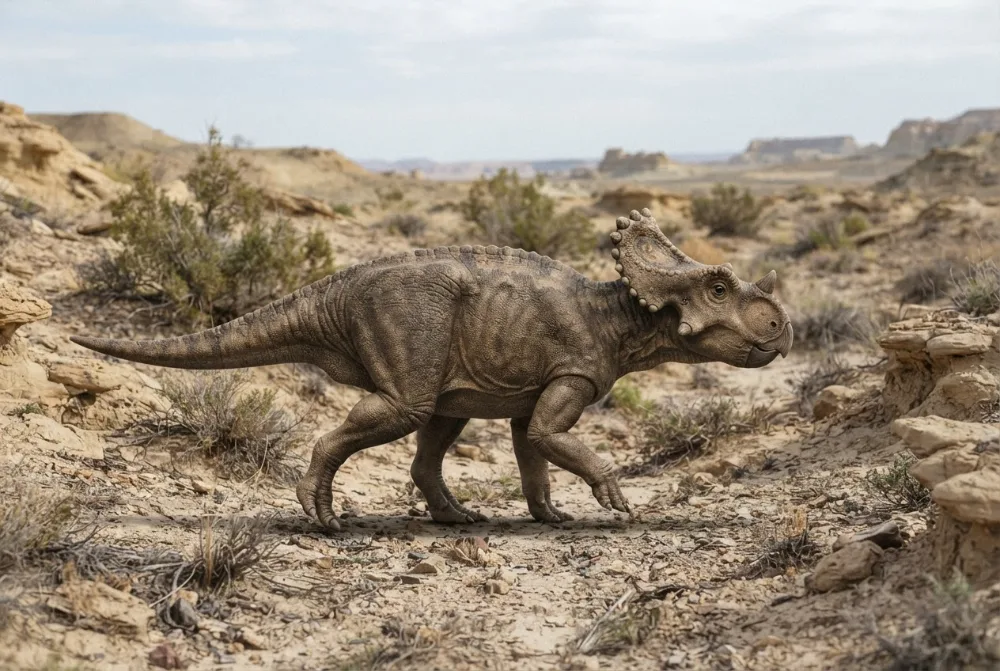
Bagaceratops had a small frill on its head, much smaller than the frills of later horned dinosaurs.1
Its skull was more triangular than that of its close cousin Protoceratops.1
Eyona mibuzo ibuzwa kakhulu: Bagaceratops
?How big was Bagaceratops?
Bagaceratops was about 1 to 1.5 metres (3.3 to 4.9 feet) long and weighed around 22 to 45 kilograms (49 to 99 pounds). It was one of the smallest horned dinosaurs.12
?What did Bagaceratops eat?
Bagaceratops was an herbivore, meaning it ate plants. It used its parrot-like beak to chomp on plants and had about ten grinding teeth per jaw to chew them.12
?Where did Bagaceratops live?
Bagaceratops lived in Asia, in what is now the Gobi Desert in Mongolia. Its fossils have been found in the Barun Goyot Formation and Bayan Mandahu Formation.12
?When did Bagaceratops live?
Bagaceratops lived during the Late Cretaceous Period, about 72 to 71 million years ago. That was near the very end of the age of dinosaurs.12
?Did Bagaceratops have horns?
Bagaceratops did not have large horns like Triceratops. Its name means 'small-horned face,' and it had a small frill on its head but no big horns.1
Kwiingcali zeedayinaso
- Igama lenzululwazi
- Bagaceratops
- Inikwe igama ngu:
- Maryanska and Osmólska 19753
- Iqela
- Iidayinaso ezineempondo
- Usapho / iclade
- Protoceratopsidae3
- Ukuhlelwa
- Ornithischia > Ceratopsia3
- Ubudala bamatye
- 84 ukuya ku-66 izigidi zeminyaka (Campanian / Maastrichtian)3
- Izakhiwo zamatye
- Baruungoyot, Djadokhta, Bayan Mandahu3
- Amazwe
- iMongolia, iTshayina3
- Iirekhodi zeefosili
- 18 kwi-Paleobiology Database3
- Ikwaziwa ngokuba
- Gobiceratops, Lamaceratops, Magnirostris, Platyceratops (amagama amadala ngoku abalwa njengesilwanyana esinye)3
- Ukufunyanwa
- Bagaceratops was named in 1975 by Polish paleontologists Teresa Maryańska and Halszka Osmólska, based on fossils found in the Gobi Desert during the Polish-Mongolian expeditions.12
- Kusaxoxwa ngayo
- Scientists are still debating whether some other ceratopsians, like Breviceratops, are really a separate genus or just Bagaceratops.1
Apho iinyani zivela khona
- Bagaceratops (en.wikipedia.org)
- Bagaceratops | Natural History Museum (nhm.ac.uk)
- Bagaceratops in The Paleobiology Database (CC BY 4.0): ubudala, iindawo, izakhiwo zamatye, ukuhlelwa.
Yonke inyani ekweli phepha inenombolo ebonisa umthombo wayo. Ukuba siphosisile, uxolo, sithanda iidayinaso, asiyojenali yenzululwazi. Sixelele apha: [email protected], siya kuyilungisa.
 URex ulambile! I-Dino Wiki yiprojekthi katata ukwenzela unyana wakhe othanda iidayinaso, isimahla, ayinazintengiso, ayinazilandeli. Abantu abadala banokuphakela uRex isidlwana ukuze incede ihlale kwi-intanethi.Phakela uRex
 Triceratops
 Protoceratops
 Ojoceratops
 Tatankaceratops
 Psittacosaurus
 Centrosaurus
 Tyrannosaurus
 Velociraptor
 Spinosaurus
 Ankylosaurus
 Parasaurolophus
 Pteranodon