 Uyiyiphi idayinaso? Ikwizi
 Idabi leedayinaso
 Ugqatso lweedayinaso
 Imidlalo emincinci yeedayinaso
 I-albhamu yezitikha
 Iilisti ze-TOP zeedayinaso
 Ndothuse!
Yaphila nini?

Yayinkulu kangakanani?
Yayinde kangakanani?
Yayiphakame kangakanani?
 inde njengezinja ezingama-4, impumlo ukuya emsileni🍌inde njengeebhanana ezingama-19 zilandelelana🏃ibinokubaleka iimitha ezili-100 ngemizuzwana engama-7.2 (oyena mntu ukhawulezayo udinga i-9,6)
Bagaraatan wayemkhulu kangakanani xa ethelekiswa NAWE?
Yimathematika nje kwibhrawuza yakho. Akukho nto igcinwayo okanye ithunyelwe naphi na.
Yayikhawuleza kangakanani?


Iinyani ezimnandi
Bagaraatan had a tail that was not very flexible near the body, because many bones in the tail were locked together.2
The first fossil of Bagaraatan was found in 1970 by Zofia Kielan-Jaworowska during a Polish-Mongolian expedition.2
At first, scientists thought Bagaraatan was a mix of different dinosaur parts, but later studies showed it is likely a small relative of Tyrannosaurus.1
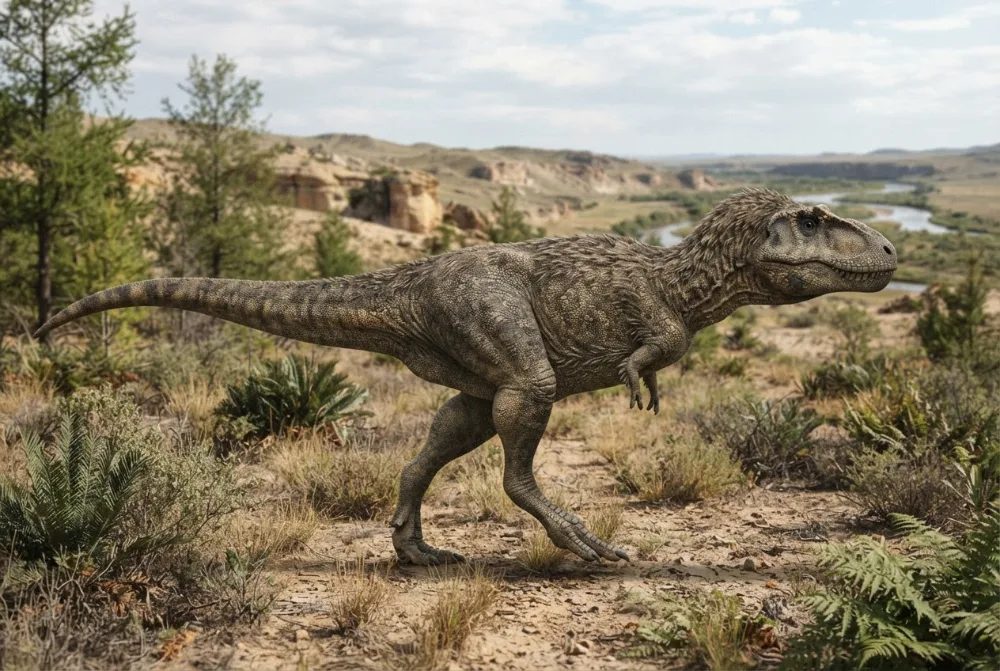
Bagaraatan was about 3 to 3.5 meters long, which is similar to a large Deinonychus.2
The shin and ankle bones of Bagaraatan were fused together, giving it a strong lower leg.2
Bagaraatan had two holes in the back part of its lower jaw, which is unusual among theropod dinosaurs.2
Eyona mibuzo ibuzwa kakhulu: Bagaraatan
?How big was Bagaraatan?
About 3 to 3.5 metres (10 to 11.5 feet) long, which is about as long as a small car. It stood less than 1 metre (3.3 feet) tall at the hips.12
?What did Bagaraatan eat?
It was a meat-eater. It had strong jaws with sharp teeth and long legs for chasing prey, so it was probably an active predator or scavenger.2
?Was Bagaraatan a dinosaur?
Yes, it was a theropod dinosaur from the Late Cretaceous period. It lived in what is now Mongolia.1
Inyaniso ngeentsomi
Intsomi: Bagaraatan was a bird-like dinosaur with feathers.
Inyaniso: Scientists have not found any evidence of feathers for Bagaraatan, and it is now thought to be a small tyrannosaurid, which probably had scaly skin like other tyrannosaurs.1
Kwiingcali zeedayinaso
- Igama lenzululwazi
- Bagaraatan
- Inikwe igama ngu:
- Osmólska 19964
- Iqela
- Iityrannosauri
- Usapho / iclade
- Tyrannosauridae4
- Ukuhlelwa
- Theropoda > Tyrannosauroidea > Tyrannosauridae4
- Ubudala bamatye
- 72 ukuya ku-66 izigidi zeminyaka (Maastrichtian)4
- Izakhiwo zamatye
- Nemegt4
- Amazwe
- iMongolia4
- Iirekhodi zeefosili
- 1 kwi-Paleobiology Database4
- Ukufunyanwa
- Bagaraatan was named in 1996 by Halszka Osmólska based on a partial skeleton found in Mongolia. The skeleton was discovered by Zofia Kielan-Jaworowska in 1970.42
- Kusaxoxwa ngayo
- Scientists are still debating whether Bagaraatan is a true tyrannosaurid or a close relative, and whether the fossils include bones from more than one animal.1
Apho iinyani zivela khona
- Bagaraatan (en.wikipedia.org)
- An unusual theropod dinosaur from the Late Cretaceous Nemegt Formation of Mongolia (app.pan.pl)
- Reassessment of the enigmatic Late Cretaceous theropod dinosaur, Bagaraatan ostromi | Zoological Journal of the Linnean Society | Oxford Academic (academic.oup.com)
- Bagaraatan in The Paleobiology Database (CC BY 4.0): ubudala, iindawo, izakhiwo zamatye, ukuhlelwa.
Yonke inyani ekweli phepha inenombolo ebonisa umthombo wayo. Ukuba siphosisile, uxolo, sithanda iidayinaso, asiyojenali yenzululwazi. Sixelele apha: [email protected], siya kuyilungisa.
 URex ulambile! I-Dino Wiki yiprojekthi katata ukwenzela unyana wakhe othanda iidayinaso, isimahla, ayinazintengiso, ayinazilandeli. Abantu abadala banokuphakela uRex isidlwana ukuze incede ihlale kwi-intanethi.Phakela uRex
 Tyrannosaurus
 Tarbosaurus
 Albertosaurus
 Daspletosaurus
 Gorgosaurus
 Alectrosaurus
 Triceratops
 Velociraptor
 Spinosaurus
 Ankylosaurus
 Parasaurolophus
 Pteranodon