 Uyiyiphi idayinaso? Ikwizi
 Idabi leedayinaso
 Ugqatso lweedayinaso
 Imidlalo emincinci yeedayinaso
 I-albhamu yezitikha
 Iilisti ze-TOP zeedayinaso
 Ndothuse!
Yaphila nini?

Yayinkulu kangakanani?
Yayinde kangakanani?
Yayiphakame kangakanani?
uqikelelo
Yayinzima kangakanani?

 inde njengezinja ezingama-5, impumlo ukuya emsileni🍌inde njengeebhanana ezingama-28 zilandelelanainzima njengezinja ezingama-100🍉inzima njengamavatala angama-400🎒inzima njengamagumbi okufundela apheleleyo abantwana angama-2.5🐻❄️inzima njengeebhere ezimhlophe ezingama-4🏃ibinokubaleka iimitha ezili-100 ngemizuzwana engama-11 (oyena mntu ukhawulezayo udinga i-9,6)
Coronosaurus wayemkhulu kangakanani xa ethelekiswa NAWE?
Yimathematika nje kwibhrawuza yakho. Akukho nto igcinwayo okanye ithunyelwe naphi na.
Yayikhawuleza kangakanani?


Iinyani ezimnandi
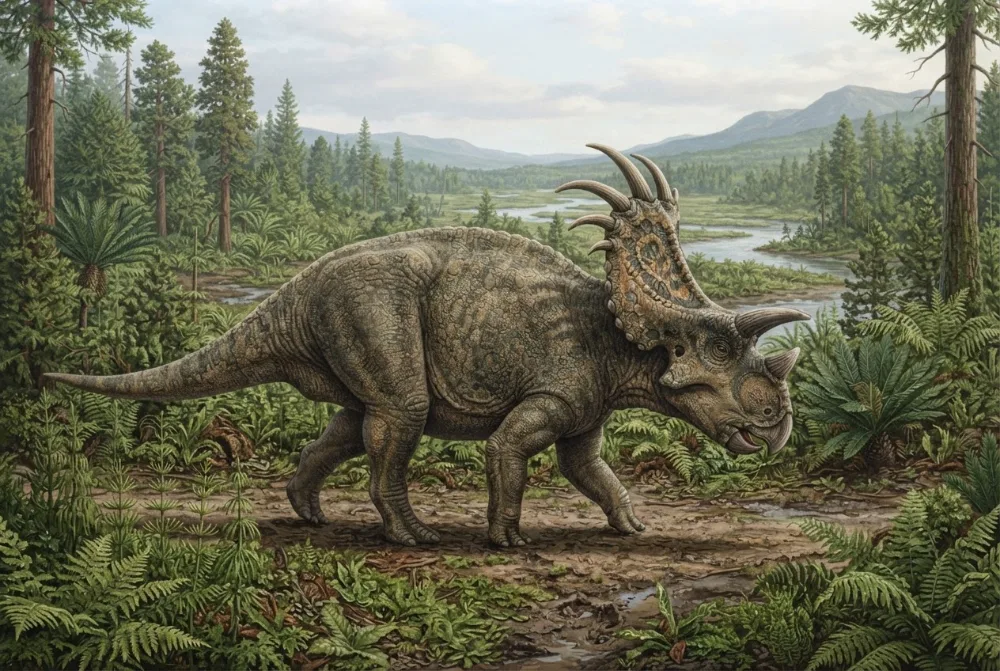
Coronosaurus had a unique crown of spiky bones on its frill, which no other ceratopsian dinosaur had.1
It was originally thought to be a species of Centrosaurus, but scientists later gave it its own name in 2012.1
Its fossils were found in two bone beds in Alberta, Canada, which were discovered by paleontologist Philip Currie.1
Coronosaurus lived about 83 to 72 million years ago, during the Campanian stage of the Late Cretaceous.2
It was a medium-sized ceratopsid, about 5 metres (16 feet) long and weighing around 2 tonnes (2.2 short tons).1
The dinosaur's name comes from the Latin word 'corona', meaning crown, because of the crown-like horns on its frill.1
Coronosaurus shared its home with other dinosaurs like Daspletosaurus, Troodon, and Parasaurolophus.1
Eyona mibuzo ibuzwa kakhulu: Coronosaurus
?How big was Coronosaurus?
About 5 metres (16 feet) long and 2 tonnes (2.2 short tons) in weight. It was a medium sized dinosaur for its kind.1
?What did Coronosaurus eat?
It ate plants. It was a herbivore that walked on four legs and had a beak for cropping vegetation.12
?Why did Coronosaurus have a crown of spikes?
Scientists think the crown of spiky bones on its frill was used for display, maybe to attract mates or scare off rivals. It is unique among ceratopsians.1
?Where was Coronosaurus found?
Its fossils were found in two bone beds in Alberta, Canada, in the Oldman Formation. They were discovered by paleontologist Philip Currie.1
Kwiingcali zeedayinaso
- Igama lenzululwazi
- Coronosaurus
- Inikwe igama ngu:
- Ryan et al. 20122
- Iqela
- Iidayinaso ezineempondo
- Usapho / iclade
- Ceratopsidae2
- Ukuhlelwa
- Ornithischia > Ceratopsia > Ceratopsidae2
- Ubudala bamatye
- 84 ukuya ku-72 izigidi zeminyaka (Campanian)2
- Izakhiwo zamatye
- Oldman2
- Amazwe
- iKhanada2
- Iirekhodi zeefosili
- 2 kwi-Paleobiology Database2
- Ukufunyanwa
- Coronosaurus was first described in 2005 as a species of Centrosaurus, but in 2012 scientists Michael Ryan, David Evans, and Kieran Shepherd gave it its own genus name because of its unique frill horns.1
- Kusaxoxwa ngayo
- Scientists are still debating exactly how Coronosaurus is related to other horned dinosaurs like Styracosaurus and Centrosaurus.1
Apho iinyani zivela khona
- Coronosaurus (en.wikipedia.org)
- Coronosaurus in The Paleobiology Database (CC BY 4.0): ubudala, iindawo, izakhiwo zamatye, ukuhlelwa.
Yonke inyani ekweli phepha inenombolo ebonisa umthombo wayo. Ukuba siphosisile, uxolo, sithanda iidayinaso, asiyojenali yenzululwazi. Sixelele apha: [email protected], siya kuyilungisa.
 URex ulambile! I-Dino Wiki yiprojekthi katata ukwenzela unyana wakhe othanda iidayinaso, isimahla, ayinazintengiso, ayinazilandeli. Abantu abadala banokuphakela uRex isidlwana ukuze incede ihlale kwi-intanethi.Phakela uRex
 Triceratops
 Protoceratops
 Ojoceratops
 Tatankaceratops
 Psittacosaurus
 Centrosaurus
 Tyrannosaurus
 Velociraptor
 Spinosaurus
 Ankylosaurus
 Parasaurolophus
 Pteranodon