 Uyiyiphi idayinaso? Ikwizi
 Idabi leedayinaso
 Ugqatso lweedayinaso
 Imidlalo emincinci yeedayinaso
 I-albhamu yezitikha
 Iilisti ze-TOP zeedayinaso
 Ndothuse!
Euoplocephalus
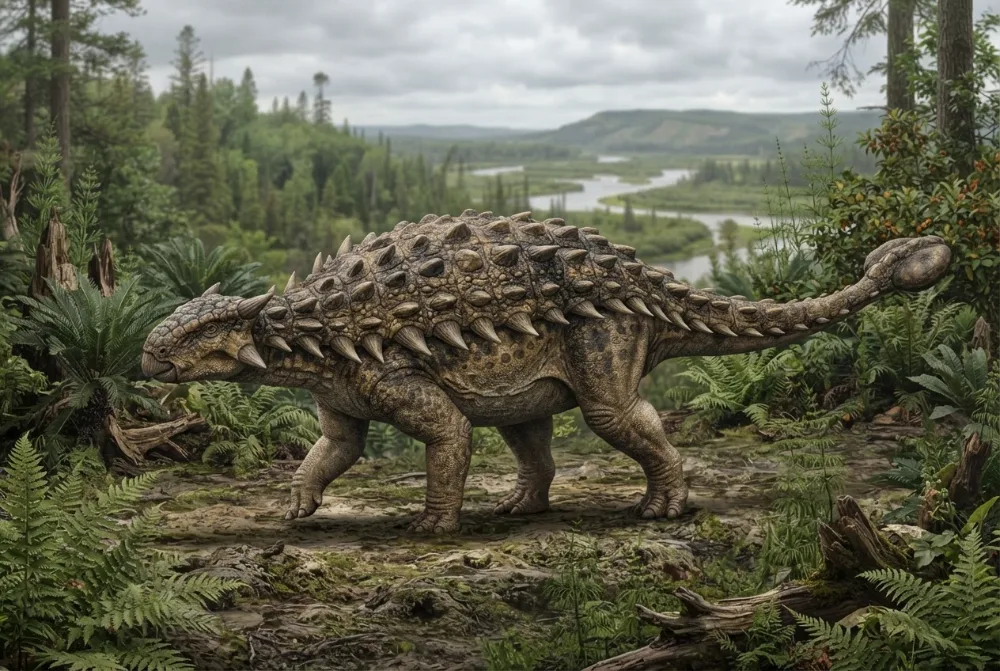
Euoplocephalus was a tank-like dinosaur covered in bony armour and a heavy club on its tail. It lived in what is now Canada and the USA during the Late Cretaceous period. This slow-moving plant-eater could defend itself from big predators like Albertosaurus.1
Yaphila nini?
Yayinkulu kangakanani?
Yayinde kangakanani?
Yayiphakame kangakanani?
Yayinzima kangakanani?

 inde njengezinja ezingama-5, impumlo ukuya emsileni🍌inde njengeebhanana ezingama-29 zilandelelanainzima njengezinja ezingama-100🍉inzima njengamavatala angama-400🎒inzima njengamagumbi okufundela apheleleyo abantwana angama-2.5🐻❄️inzima njengeebhere ezimhlophe ezingama-4🏃ibinokubaleka iimitha ezili-100 ngemizuzwana engama-24 (oyena mntu ukhawulezayo udinga i-9,6)
Euoplocephalus wayemkhulu kangakanani xa ethelekiswa NAWE?
Yimathematika nje kwibhrawuza yakho. Akukho nto igcinwayo okanye ithunyelwe naphi na.
Yayikhawuleza kangakanani?


Iinyani ezimnandi
Euoplocephalus had a heavy club at the end of its tail made of bone. It could swing this club to fight off predators.1
Its body was covered in rows of bony plates called scutes. It also had two bone rings around its neck for extra protection.1
Euoplocephalus was about 5.3 metres (17 feet) long and weighed around 2 metric tons (2.2 short tons). That is as heavy as a small car.1
The first fossil was found in 1897 in Alberta, Canada. It was originally named Stereocephalus, but that name was already used for an insect, so it was changed to Euoplocephalus in 1910.1
Euoplocephalus lived between about 76 and 75 million years ago, during the late Campanian stage of the Late Cretaceous.1
Scientists once thought many different ankylosaur fossils all belonged to Euoplocephalus, but now they know most are separate species like Scolosaurus and Platypelta.1
Euoplocephalus had a short, drooping snout and a horny beak to bite off plants. Its teeth show it could chew tough plant material.1
Eyona mibuzo ibuzwa kakhulu: Euoplocephalus
?How big was Euoplocephalus?
About 5.3 metres (17 feet) long and 2 tonnes (2.2 short tons) in weight, as heavy as a small car.13
?What did Euoplocephalus eat?
It was a plant-eater. It used a horny beak to bite off plants and had small teeth to chew tough plant material.13
?Did Euoplocephalus have a tail club?
Yes, it had a heavy bony club at the end of its tail. It could swing this club to defend itself from predators like Albertosaurus.13
?Was Euoplocephalus bigger than Ankylosaurus?
No, Ankylosaurus was bigger. Among ankylosaurids, Euoplocephalus was exceeded in size only by Ankylosaurus and perhaps Tarchia and Cedarpelta.1
?When did Euoplocephalus live?
It lived during the Late Cretaceous period, about 76 to 70 million years ago.3
?Where was Euoplocephalus found?
Fossils have been found in Canada (Alberta) and the United States (Montana).13
?How fast could Euoplocephalus run?
Nobody knows for sure, but it was a slow-moving dinosaur with short, sturdy legs built for walking, not running.1
?What does the name Euoplocephalus mean?
It means 'well-armed head', from Greek words for 'well', 'armed', and 'head'.1
Inyaniso ngeentsomi
Intsomi: Euoplocephalus could roll into a ball like an armadillo to protect itself.
Inyaniso: Euoplocephalus could not roll into a ball. It relied on its armour and tail club for defence.1
Kwiingcali zeedayinaso
- Igama lenzululwazi
- Euoplocephalus
- Inikwe igama ngu:
- Lambe 19104
- Iqela
- Iidayinaso ezinesikrweqe
- Usapho / iclade
- Ankylosauridae4
- Ukuhlelwa
- Ornithischia > Ankylosauria > Ankylosauridae > Thyreophora4
- Ubudala bamatye
- 84 ukuya ku-66 izigidi zeminyaka (Campanian / Maastrichtian)4
- Izakhiwo zamatye
- Dinosaur Park, Judith River, Two Medicine4
- Amazwe
- iKhanada, iUSA, iTshayina4
- Iirekhodi zeefosili
- 18 kwi-Paleobiology Database4
- Ikwaziwa ngokuba
- Stereocephalus (amagama amadala ngoku abalwa njengesilwanyana esinye)4
- Ukufunyanwa
- Canadian paleontologist Lawrence Morris Lambe discovered the first Euoplocephalus fossil on 18 August 1897 in what is now Dinosaur Provincial Park, Alberta. He named it Stereocephalus in 1902, but changed the name to Euoplocephalus in 1910 because the old name was already taken.1
- Kusaxoxwa ngayo
- Scientists still debate exactly which fossils belong to Euoplocephalus and which belong to other closely related ankylosaurs like Anodontosaurus and Scolosaurus.1
Apho iinyani zivela khona
- Euoplocephalus (en.wikipedia.org)
- PBDB Taxon (paleobiodb.org)
- Euoplocephalus | Natural History Museum (nhm.ac.uk)
- Euoplocephalus in The Paleobiology Database (CC BY 4.0): ubudala, iindawo, izakhiwo zamatye, ukuhlelwa.
Yonke inyani ekweli phepha inenombolo ebonisa umthombo wayo. Ukuba siphosisile, uxolo, sithanda iidayinaso, asiyojenali yenzululwazi. Sixelele apha: [email protected], siya kuyilungisa.
 URex ulambile! I-Dino Wiki yiprojekthi katata ukwenzela unyana wakhe othanda iidayinaso, isimahla, ayinazintengiso, ayinazilandeli. Abantu abadala banokuphakela uRex isidlwana ukuze incede ihlale kwi-intanethi.Phakela uRex
 Ankylosaurus
 Sauropelta
 Pinacosaurus
 Scutellosaurus
 Struthiosaurus
 Edmontonia
 Tyrannosaurus
 Triceratops
 Velociraptor
 Spinosaurus
 Parasaurolophus
 Pteranodon