 Uyiyiphi idayinaso? Ikwizi
 Idabi leedayinaso
 Ugqatso lweedayinaso
 Imidlalo emincinci yeedayinaso
 I-albhamu yezitikha
 Iilisti ze-TOP zeedayinaso
 Ndothuse!
Globidens
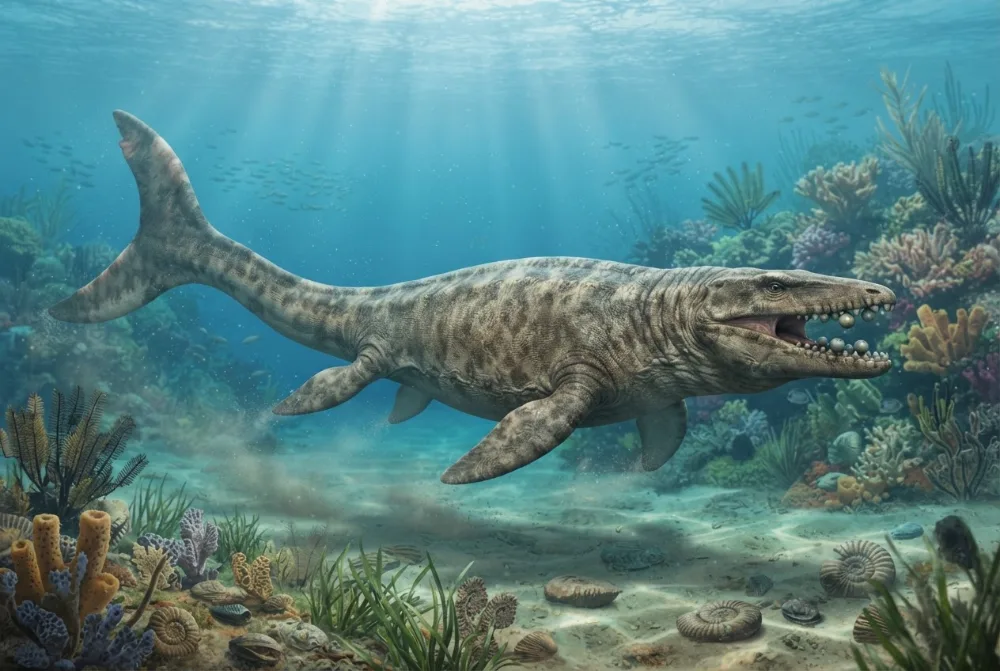
Globidens was a marine lizard that lived in the warm, shallow seas of the Late Cretaceous. It had strange, round teeth like little balls, perfect for crushing the hard shells of its prey. Unlike many other sea reptiles, Globidens was a shell-crushing specialist!1
Yaphila nini?
Yayinkulu kangakanani?
Yayinde kangakanani?
 inde njengezinja ezingama-6, impumlo ukuya emsileni🍌inde njengeebhanana ezingama-33 zilandelelana🏊ibinokuqubha ubude bechibi elikhulu lokuqubha (50 m) ngemizuzwana engama-4.7
Globidens wayemkhulu kangakanani xa ethelekiswa NAWE?
Yimathematika nje kwibhrawuza yakho. Akukho nto igcinwayo okanye ithunyelwe naphi na.
Yayikhawuleza kangakanani?


Iinyani ezimnandi
Globidens had round, globe-shaped teeth that were different from the sharp teeth of most other mosasaurs.1
Scientists found stomach contents inside a Globidens fossil from South Dakota, showing it ate clams called inoceramids.1
Globidens lived about 84 to 66 million years ago, during the Late Cretaceous period.3
The first Globidens fossil was a partial skull and a neck bone found in Alabama, USA, and named in 1912 by Charles W. Gilmore.1
Globidens had a strong, robust skull and a powerful bite to crush the shells of its prey.1
Eyona mibuzo ibuzwa kakhulu: Globidens
?How big was Globidens?
Globidens was a medium-sized mosasaur, measuring about 5 to 6 metres (16 to 20 feet) long.1
?What did Globidens eat?
Globidens ate hard-shelled prey like turtles, ammonites, nautili, and bivalves. Stomach contents from a fossil found in South Dakota showed it ate clams called inoceramids.12
?Why did Globidens have round teeth?
Globidens had round, globe-shaped teeth that were perfect for crushing tough shells. Unlike most mosasaurs with sharp teeth for grabbing slippery prey, Globidens was a shell-crushing specialist.1
?Was Globidens a dinosaur?
No, Globidens was not a dinosaur. It was a marine lizard, a type of mosasaur that lived in the sea during the Late Cretaceous.1
?When did Globidens live?
Globidens lived during the Late Cretaceous period, about 84 to 66 million years ago.1
?Where have Globidens fossils been found?
Globidens fossils have been found in Angola, Brazil, Colombia, Morocco, Syria, and the United States.1
Kwiingcali zeedayinaso
- Igama lenzululwazi
- Globidens
- Inikwe igama ngu:
- Gilmore 19123
- Iqela
- Iimosasauri
- Usapho / iclade
- Mosasauridae3
- Ukuhlelwa
- Mosasauroidea3
- Ubudala bamatye
- 90 ukuya ku-66 izigidi zeminyaka (Coniacian / Maastrichtian)3
- Izakhiwo zamatye
- Pierre Shale, Wolfe City/Sprinkle, Phosphates3
- Amazwe
- iUSA, iMorocco, iSyria, iJordan, iYiputa, i-Angola3
- Iirekhodi zeefosili
- 32 kwi-Paleobiology Database3
- Ukufunyanwa
- Globidens was first described in 1912 by Charles W. Gilmore, based on an incomplete skull and a neck bone from Alabama, USA. The name means 'globe tooth' because of its round teeth.1
- Kusaxoxwa ngayo
- Scientists are still debating exactly how many species of Globidens existed, as some fossils have been moved to other groups like Prognathodon.1
Apho iinyani zivela khona
- Globidens (en.wikipedia.org)
- Stomach contents of Globidens, a shell-crushing mosasaur (Squamata), from the Late Cretaceous Pierre Shale Group, Big Bend area of the Missouri River, central South Dakota (exa.ai)
- Globidens in The Paleobiology Database (CC BY 4.0): ubudala, iindawo, izakhiwo zamatye, ukuhlelwa.
Yonke inyani ekweli phepha inenombolo ebonisa umthombo wayo. Ukuba siphosisile, uxolo, sithanda iidayinaso, asiyojenali yenzululwazi. Sixelele apha: [email protected], siya kuyilungisa.
 URex ulambile! I-Dino Wiki yiprojekthi katata ukwenzela unyana wakhe othanda iidayinaso, isimahla, ayinazintengiso, ayinazilandeli. Abantu abadala banokuphakela uRex isidlwana ukuze incede ihlale kwi-intanethi.Phakela uRex
 Mosasaurus
 Prognathodon
 Tylosaurus
 Platecarpus
 Clidastes
 Halisaurus
 Tyrannosaurus
 Triceratops
 Velociraptor
 Spinosaurus
 Ankylosaurus
 Parasaurolophus