 Uyiyiphi idayinaso? Ikwizi
 Idabi leedayinaso
 Ugqatso lweedayinaso
 Imidlalo emincinci yeedayinaso
 I-albhamu yezitikha
 Iilisti ze-TOP zeedayinaso
 Ndothuse!
Yaphila nini?

Yayinkulu kangakanani?
Yayinde kangakanani?
Yayinzima kangakanani?
 inde njengeekati zasekhaya ezingama-4, impumlo ukuya emsileni🍌inde njengeebhanana ezingama-11 zilandelelana🍌inzima njengeebhanana ezingama-76🏃ibinokubaleka iimitha ezili-100 ngemizuzwana engama-16 (oyena mntu ukhawulezayo udinga i-9,6)
Graciliceratops wayemkhulu kangakanani xa ethelekiswa NAWE?
Yimathematika nje kwibhrawuza yakho. Akukho nto igcinwayo okanye ithunyelwe naphi na.
Yayikhawuleza kangakanani?


Iinyani ezimnandi
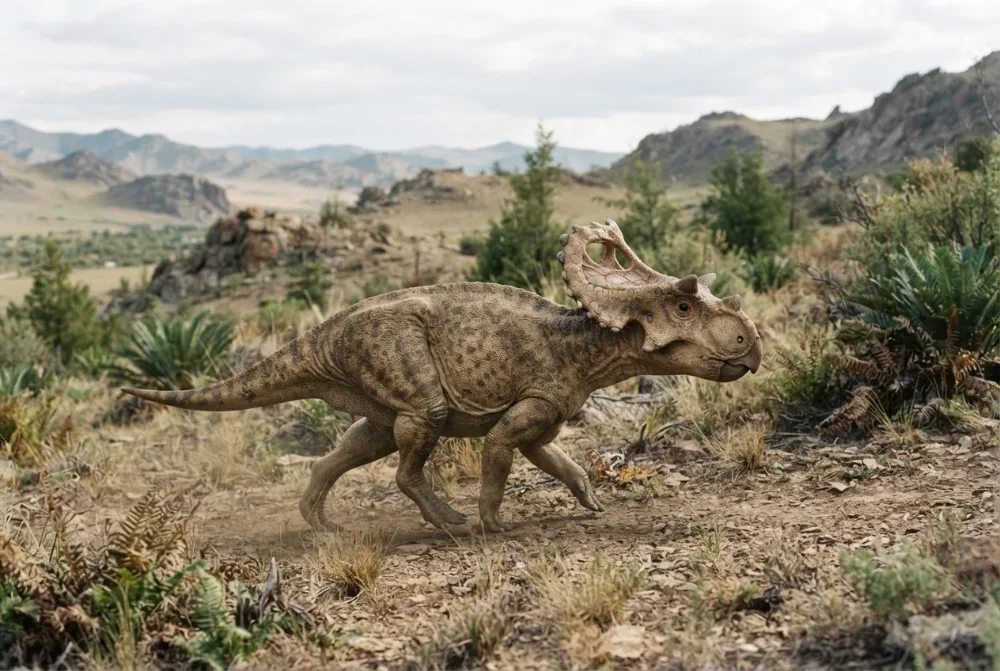
Graciliceratops had a very slender, fragile frill with large holes in it, held up by thin struts of bone.2
The only fossil found is a young animal, because its sacral vertebrae were not yet fused together.2
Its shin bone (tibia) was longer than its thigh bone (femur), which helped it run fast.2
Graciliceratops lived alongside the large dromaeosaurid Achillobator and the tyrannosauroid Khankhuuluu.2
It was a basal neoceratopsian, an early relative of later horned dinosaurs like Protoceratops.2
Eyona mibuzo ibuzwa kakhulu: Graciliceratops
?How big was Graciliceratops?
The only known fossil is a young animal about 60 cm long and weighing 2.27 to 9.1 kg. Scientists think a full-grown adult would have been around 2 m long, about the size of a small pony.21
?What did Graciliceratops eat?
It was an herbivore, eating plants. Fossil fruits found in the same area show that flowering plants grew there, so it probably ate those.21
Kwiingcali zeedayinaso
- Igama lenzululwazi
- Graciliceratops
- Inikwe igama ngu:
- Sereno 20003
- Iqela
- Iidayinaso ezineempondo
- Usapho / iclade
- Neoceratopsia3
- Ukuhlelwa
- Ornithischia > Ceratopsia3
- Ubudala bamatye
- 100 ukuya ku-84 izigidi zeminyaka (Cenomanian / Santonian)3
- Izakhiwo zamatye
- Baynshire3
- Amazwe
- iMongolia3
- Iirekhodi zeefosili
- 1 kwi-Paleobiology Database3
- Ukufunyanwa
- The first fossil was found in 1971 by a Polish-Mongolian expedition. It was originally called Microceratops, but Paul Sereno gave it the new name Graciliceratops in 2000.21
- Kusaxoxwa ngayo
- Scientists are not sure exactly how big a fully grown Graciliceratops was, because the only known skeleton is from a juvenile.2
Apho iinyani zivela khona
- Graciliceratops | Natural History Museum (nhm.ac.uk)
- Graciliceratops (en.wikipedia.org)
- Graciliceratops in The Paleobiology Database (CC BY 4.0): ubudala, iindawo, izakhiwo zamatye, ukuhlelwa.
Yonke inyani ekweli phepha inenombolo ebonisa umthombo wayo. Ukuba siphosisile, uxolo, sithanda iidayinaso, asiyojenali yenzululwazi. Sixelele apha: [email protected], siya kuyilungisa.
 URex ulambile! I-Dino Wiki yiprojekthi katata ukwenzela unyana wakhe othanda iidayinaso, isimahla, ayinazintengiso, ayinazilandeli. Abantu abadala banokuphakela uRex isidlwana ukuze incede ihlale kwi-intanethi.Phakela uRex
 Triceratops
 Protoceratops
 Ojoceratops
 Tatankaceratops
 Psittacosaurus
 Centrosaurus
 Tyrannosaurus
 Velociraptor
 Spinosaurus
 Ankylosaurus
 Parasaurolophus
 Pteranodon