 Uyiyiphi idayinaso? Ikwizi
 Idabi leedayinaso
 Ugqatso lweedayinaso
 Imidlalo emincinci yeedayinaso
 I-albhamu yezitikha
 Iilisti ze-TOP zeedayinaso
 Ndothuse!
Kamuysaurus
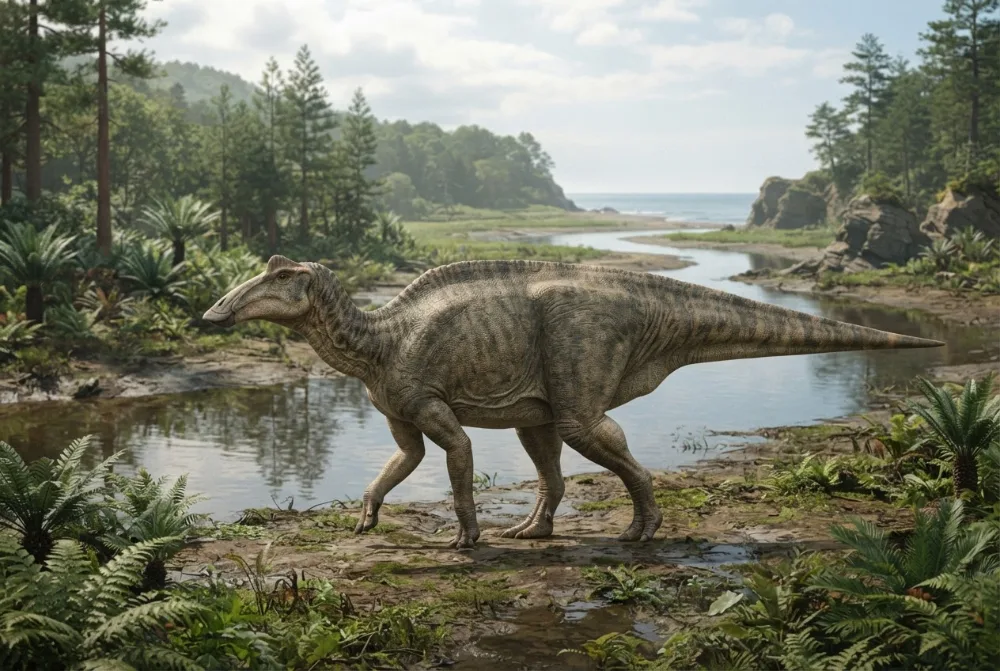
Kamuysaurus was a duck-billed dinosaur that lived in what is now Japan. It had a flat, toothless beak and hundreds of cheek teeth for chewing plants. This dinosaur is one of the most complete skeletons ever found in Japan.12
Yaphila nini?
Yayinkulu kangakanani?
Yayinde kangakanani?
Yayiphakame kangakanani?
uqikelelo
Yayinzima kangakanani?
 inde njengeemoto ezingama-2 zipakwe zilandelelana🍌inde njengeebhanana ezingama-50 zilandelelana
 malunga nobunzima bendlovu🍉inzima njengamavatala angama-1000🎒inzima njengamagumbi okufundela apheleleyo abantwana angama-6🐻❄️inzima njengeebhere ezimhlophe ezingama-11🏃ibinokubaleka iimitha ezili-100 ngemizuzwana engama-16 (oyena mntu ukhawulezayo udinga i-9,6)
Kamuysaurus wayemkhulu kangakanani xa ethelekiswa NAWE?
Yimathematika nje kwibhrawuza yakho. Akukho nto igcinwayo okanye ithunyelwe naphi na.
Yayikhawuleza kangakanani?


Iinyani ezimnandi
The skeleton is over 60% complete and includes the skull, making it one of the most complete dinosaur skeletons from Japan.1
It lived about 72 to 70 million years ago during the early Maastrichtian age.1
Kamuysaurus belongs to a group of duck-billed dinosaurs called Edmontosaurini, which also includes Edmontosaurus.2
The dinosaur was named after the Ainu word 'kamuy', meaning deity or god.1
It was an adult at least nine years old when it died.1
Eyona mibuzo ibuzwa kakhulu: Kamuysaurus
?How big was Kamuysaurus?
It was about 8 metres long and weighed 4 to 5.3 tonnes.1
?What did Kamuysaurus eat?
It was a plant-eater. It had a toothless beak and rows of cheek teeth for chewing tough plants.1
?When did Kamuysaurus live?
It lived about 72 to 70 million years ago, during the early Maastrichtian age of the Late Cretaceous.1
?Was Kamuysaurus a dinosaur?
Yes, it was a duck-billed dinosaur called a hadrosaur, but it was not a meat-eater.1
?Did Kamuysaurus have a crest?
It may have had a small, flat crest on its head, similar to the crest of Brachylophosaurus.24
?Where was Kamuysaurus found?
It was found in marine rocks in Hokkaido, Japan. Its body likely washed out to sea after it died.1
Kwiingcali zeedayinaso
- Igama lenzululwazi
- Kamuysaurus
- Inikwe igama ngu:
- Kobayashi et al. 20195
- Iqela
- Imilomo-dada
- Usapho / iclade
- Hadrosauridae5
- Ukuhlelwa
- Ornithischia > Ornithopoda > Iguanodontia > Hadrosauridae5
- Ubudala bamatye
- 72 ukuya ku-66 izigidi zeminyaka (Maastrichtian)5
- Izakhiwo zamatye
- Hakobuchi5
- Amazwe
- iJapan5
- Iirekhodi zeefosili
- 1 kwi-Paleobiology Database5
- Ukufunyanwa
- Amateur paleontologist Yoshiyuki Horita found the tail in 2003. Teams from the Hobetsu Museum and Hokkaido University Museum dug up the rest of the skeleton in 2013 and 2014. It was named Kamuysaurus japonicus in 2019 by Yoshitsugu Kobayashi and colleagues.12
- Kusaxoxwa ngayo
- Scientists are not sure if Kamuysaurus had a small crest on its head, because the bones at the front of the skull are missing.2
Apho iinyani zivela khona
- Kamuysaurus (en.wikipedia.org)
- A New Hadrosaurine (Dinosauria: Hadrosauridae) from the Marine Deposits of the Late Cretaceous Hakobuchi Formation, Yezo Group, Japan | Scientific Reports (nature.com)
- PBDB Taxon (paleobiodb.org)
- A new duck-billed dinosaur, Kamuysaurus japonicus, identified | Hokkaido University (global.hokudai.ac.jp)
- Kamuysaurus in The Paleobiology Database (CC BY 4.0): ubudala, iindawo, izakhiwo zamatye, ukuhlelwa.
Yonke inyani ekweli phepha inenombolo ebonisa umthombo wayo. Ukuba siphosisile, uxolo, sithanda iidayinaso, asiyojenali yenzululwazi. Sixelele apha: [email protected], siya kuyilungisa.
 URex ulambile! I-Dino Wiki yiprojekthi katata ukwenzela unyana wakhe othanda iidayinaso, isimahla, ayinazintengiso, ayinazilandeli. Abantu abadala banokuphakela uRex isidlwana ukuze incede ihlale kwi-intanethi.Phakela uRex
 Parasaurolophus
 Edmontosaurus
 Saurolophus
 Hypacrosaurus
 Corythosaurus
 Kritosaurus
 Tyrannosaurus
 Triceratops
 Velociraptor
 Spinosaurus
 Ankylosaurus
 Pteranodon