 Uyiyiphi idayinaso? Ikwizi
 Idabi leedayinaso
 Ugqatso lweedayinaso
 Imidlalo emincinci yeedayinaso
 I-albhamu yezitikha
 Iilisti ze-TOP zeedayinaso
 Ndothuse!
Kerberosaurus
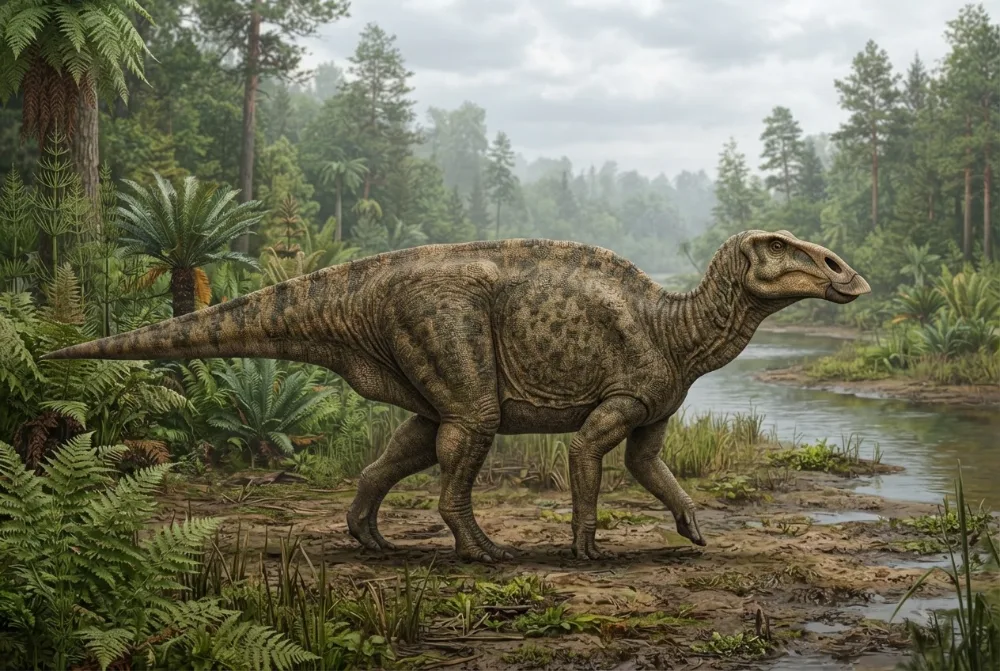
Kerberosaurus was a duck-billed dinosaur that lived in what is now Russia. It had a flat head and a wide, flattened crest around its nostrils. This plant-eater could walk on two legs or all fours.1
Yaphila nini?
Yayinkulu kangakanani?
Yayinde kangakanani?
Yayiphakame kangakanani?
uqikelelo
 inde njengezinja ezingama-8, impumlo ukuya emsileni🍌inde njengeebhanana ezingama-44 zilandelelana🏃ibinokubaleka iimitha ezili-100 ngemizuzwana engama-14 (oyena mntu ukhawulezayo udinga i-9,6)
Kerberosaurus wayemkhulu kangakanani xa ethelekiswa NAWE?
Yimathematika nje kwibhrawuza yakho. Akukho nto igcinwayo okanye ithunyelwe naphi na.
Yayikhawuleza kangakanani?


Iinyani ezimnandi
Kerberosaurus is named after Kerberos, the three-headed dog that guarded the underworld in Greek myths.1
Its fossils were found in a bonebed with many other dinosaurs, including Amurosaurus, turtles, crocodiles, and even meat-eaters.1
Scientists think Kerberosaurus was closely related to Saurolophus and Prosaurolophus, which lived in North America.1
Kerberosaurus lived about 66 million years ago, right at the end of the Age of Dinosaurs.1
The first fossils of Kerberosaurus were discovered in 1984, but the dinosaur was not named until 2004.1
Kerberosaurus had a narrow frontal bone on its skull and a unique shape to its braincase.1
Eyona mibuzo ibuzwa kakhulu: Kerberosaurus
?How big was Kerberosaurus?
Kerberosaurus was about 8 metres (26 feet) long.1
?What did Kerberosaurus eat?
Kerberosaurus was a plant-eater. It ate plant matter using its complex teeth.1
?When did Kerberosaurus live?
Kerberosaurus lived about 66 million years ago, at the very end of the Age of Dinosaurs.1
?Where was Kerberosaurus found?
Kerberosaurus was found in Russia, in the Amur Region near Blagoveshchensk.1
Inyaniso ngeentsomi
Intsomi: Kerberosaurus might be the same dinosaur as Kundurosaurus.
Inyaniso: Some scientists think Kundurosaurus is a younger name for the same animal, but others are not sure.2
Kwiingcali zeedayinaso
- Igama lenzululwazi
- Kerberosaurus
- Inikwe igama ngu:
- Bolotsky and Godefroit 20042
- Iqela
- Imilomo-dada
- Usapho / iclade
- Hadrosauridae2
- Ukuhlelwa
- Ornithischia > Ornithopoda > Iguanodontia > Hadrosauridae2
- Ubudala bamatye
- 72 ukuya ku-66 izigidi zeminyaka (Maastrichtian)2
- Izakhiwo zamatye
- Udurchukan2
- Amazwe
- iRashiya2
- Iirekhodi zeefosili
- 2 kwi-Paleobiology Database2
- Ikwaziwa ngokuba
- Kundurosaurus (amagama amadala ngoku abalwa njengesilwanyana esinye)2
- Ukufunyanwa
- Yuri Bolotsky and the Amur Complex Integrated Research Institute found the first fossils in 1984 at a bonebed near Blagoveschensk, Russia. The dinosaur was named Kerberosaurus manakini by Bolotsky and Pascal Godefroit in 2004.1
- Kusaxoxwa ngayo
- Scientists debate whether Kerberosaurus is the same as Kundurosaurus, another duck-billed dinosaur from the same area.2
Apho iinyani zivela khona
- Kerberosaurus (en.wikipedia.org)
- Kerberosaurus in The Paleobiology Database (CC BY 4.0): ubudala, iindawo, izakhiwo zamatye, ukuhlelwa.
Yonke inyani ekweli phepha inenombolo ebonisa umthombo wayo. Ukuba siphosisile, uxolo, sithanda iidayinaso, asiyojenali yenzululwazi. Sixelele apha: [email protected], siya kuyilungisa.
 URex ulambile! I-Dino Wiki yiprojekthi katata ukwenzela unyana wakhe othanda iidayinaso, isimahla, ayinazintengiso, ayinazilandeli. Abantu abadala banokuphakela uRex isidlwana ukuze incede ihlale kwi-intanethi.Phakela uRex
 Parasaurolophus
 Edmontosaurus
 Saurolophus
 Hypacrosaurus
 Corythosaurus
 Kritosaurus
 Tyrannosaurus
 Triceratops
 Velociraptor
 Spinosaurus
 Ankylosaurus
 Pteranodon