 Uyiyiphi idayinaso? Ikwizi
 Idabi leedayinaso
 Ugqatso lweedayinaso
 Imidlalo emincinci yeedayinaso
 I-albhamu yezitikha
 Iilisti ze-TOP zeedayinaso
 Ndothuse!
Leptoceratops
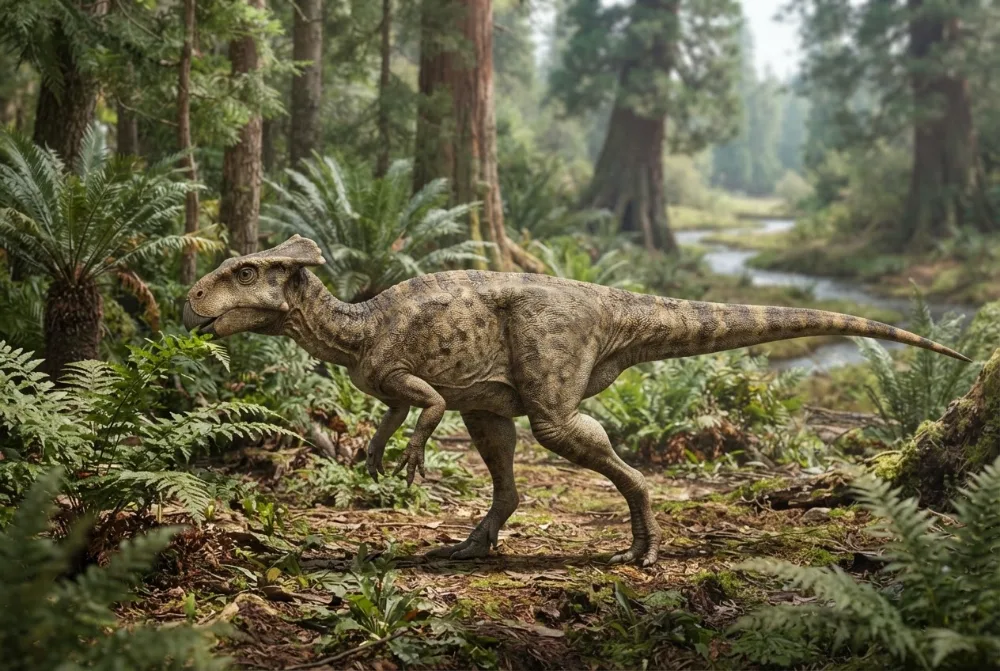
Leptoceratops was a tiny horned dinosaur that lived at the very end of the Age of Dinosaurs. It had a small frill on its head and no horns, and it walked on two legs. Even though it was small, it was a tough plant-eater that lived alongside giants like Triceratops and Tyrannosaurus.1
Yaphila nini?
Yayinkulu kangakanani?
Yayinde kangakanani?
Yayiphakame kangakanani?
Yayinzima kangakanani?
 inde njengezinja ezingama-3, impumlo ukuya emsileni🍌inde njengeebhanana ezingama-17 zilandelelana🍉inzima njengamavatala angama-40🧸inzima njengabantwana basenkulisa abangama-11🎒inzima njengabantwana besikolo abangama-6🏃ibinokubaleka iimitha ezili-100 ngemizuzwana engama-9.7 (oyena mntu ukhawulezayo udinga i-9,6)
Leptoceratops wayemkhulu kangakanani xa ethelekiswa NAWE?
Yimathematika nje kwibhrawuza yakho. Akukho nto igcinwayo okanye ithunyelwe naphi na.
Yayikhawuleza kangakanani?


Iinyani ezimnandi
Leptoceratops is one of the smallest horned dinosaurs ever found, only about the size of a large dog.1
Unlike its big cousin Triceratops, Leptoceratops had no horns and only a tiny frill at the back of its skull.1
The first Leptoceratops fossils were discovered in 1910 by Barnum Brown along the Red Deer River in Alberta, Canada.13
Scientists have found at least eight Leptoceratops specimens, including several nearly complete skeletons.2
Leptoceratops lived right at the end of the Cretaceous Period, about 66 to 72 million years ago.6
Some bonebeds in Montana suggest that Leptoceratops may have dug burrows and lived in groups.3
Leptoceratops had a deep, pointed beak and teeth with simple roots, perfect for chewing tough plants.2
Eyona mibuzo ibuzwa kakhulu: Leptoceratops
?How big was Leptoceratops?
About 2 metres (6.6 feet) long and 0.6 to 0.9 metres (2 to 3 feet) tall at the hips, roughly the size of a large dog.14
?Did Leptoceratops have horns?
No, Leptoceratops had no horns, only a small frill on its head, unlike its big cousin Triceratops.14
?What did Leptoceratops eat?
It was a plant-eater that ate tough plants like angiosperms, conifers, and cycads, using its beak and special teeth to chew.1
?Could Leptoceratops walk on two legs?
Yes, it likely walked on two legs when moving fast and on all fours when moving slowly.14
Inyaniso ngeentsomi
Intsomi: Leptoceratops is often thought to be a baby Triceratops because of its small size and simple frill.
Inyaniso: Leptoceratops is a separate, smaller species of horned dinosaur that lived at the same time as Triceratops. It had its own unique features like a tiny frill and no horns.1
Kwiingcali zeedayinaso
- Igama lenzululwazi
- Leptoceratops
- Inikwe igama ngu:
- Brown 19146
- Iqela
- Iidayinaso ezineempondo
- Usapho / iclade
- Leptoceratopsidae6
- Ukuhlelwa
- Ornithischia > Ceratopsia6
- Ubudala bamatye
- 72 ukuya ku-66 izigidi zeminyaka (Maastrichtian)6
- Izakhiwo zamatye
- Scollard, Hell Creek, "Lance"6
- Amazwe
- iUSA, iKhanada6
- Iirekhodi zeefosili
- 8 kwi-Paleobiology Database6
- Ukufunyanwa
- Leptoceratops was named by American paleontologist Barnum Brown in 1914, based on a partial skull and skeleton found in 1910 in Alberta, Canada.13
- Kusaxoxwa ngayo
- Scientists still debate whether some fossils from Montana belong to Leptoceratops or to its close relatives Montanoceratops and Cerasinops.1
Apho iinyani zivela khona
- Leptoceratops - Wikipedia (en.wikipedia.org)
- A NEW PARTIAL SKELETON OF LEPTOCERATOPS GRACILIS FROM (experiment-uploads.s3.amazonaws.com)
- LEPTOCERATOPS - DinoChecker dinosaur archive (dinochecker.com)
- Leptoceratops Gracilis, Dinosaur Pictures, Dinosaur Facts - National Geographic | National Geographic (nationalgeographic.com)
- Leptoceratops | Natural History Museum (nhm.ac.uk)
- Leptoceratops in The Paleobiology Database (CC BY 4.0): ubudala, iindawo, izakhiwo zamatye, ukuhlelwa.
Yonke inyani ekweli phepha inenombolo ebonisa umthombo wayo. Ukuba siphosisile, uxolo, sithanda iidayinaso, asiyojenali yenzululwazi. Sixelele apha: [email protected], siya kuyilungisa.
 URex ulambile! I-Dino Wiki yiprojekthi katata ukwenzela unyana wakhe othanda iidayinaso, isimahla, ayinazintengiso, ayinazilandeli. Abantu abadala banokuphakela uRex isidlwana ukuze incede ihlale kwi-intanethi.Phakela uRex
 Triceratops
 Protoceratops
 Ojoceratops
 Tatankaceratops
 Psittacosaurus
 Centrosaurus
 Tyrannosaurus
 Velociraptor
 Spinosaurus
 Ankylosaurus
 Parasaurolophus
 Pteranodon