 Uyiyiphi idayinaso? Ikwizi
 Idabi leedayinaso
 Ugqatso lweedayinaso
 Imidlalo emincinci yeedayinaso
 I-albhamu yezitikha
 Iilisti ze-TOP zeedayinaso
 Ndothuse!
Mosaiceratops
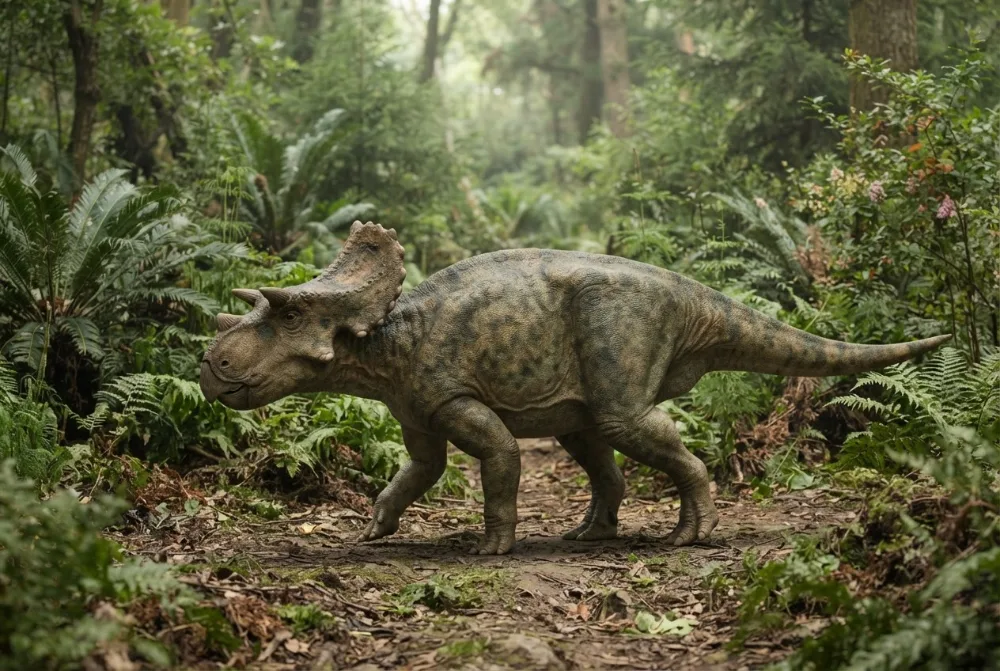
Mosaiceratops was a small, plant-eating dinosaur with a beak and a frill on its head. It lived in what is now China during the Late Cretaceous, about 93 to 72 million years ago. This little dinosaur is special because it had a mix of features from different horned dinosaurs, like a mosaic.12
Yaphila nini?
Yayinkulu kangakanani?
Yayinde kangakanani?
Yayiphakame kangakanani?
uqikelelo
Yayinzima kangakanani?
 inde njengeekati zasekhaya ezingama-2, impumlo ukuya emsileni🍌inde njengeebhanana ezingama-6 zilandelelana🍌inzima njengeebhanana ezingama-83🪑incinci ngokwaneleyo ukuba ihambe phantsi kwesitulo🏃ibinokubaleka iimitha ezili-100 ngemizuzwana engama-13 (oyena mntu ukhawulezayo udinga i-9,6)
Mosaiceratops wayemkhulu kangakanani xa ethelekiswa NAWE?
Yimathematika nje kwibhrawuza yakho. Akukho nto igcinwayo okanye ithunyelwe naphi na.
Yayikhawuleza kangakanani?


Iinyani ezimnandi
Mosaiceratops had a mix of features from different horned dinosaur groups, which is why it's named after a mosaic.1
It was one of the smallest horned dinosaurs, only about 1 meter (3.3 feet) long and weighing around 10 kilograms (22 pounds).1
Unlike many other horned dinosaurs, Mosaiceratops had no teeth in its premaxilla (the front part of its upper jaw).1
Its skeleton shows that it was a ground-dwelling, active animal that walked on four legs.2
Mosaiceratops lived in a time when the Earth was warmer and had different plants than today.2
Inyaniso ngeentsomi
Intsomi: Some people think Mosaiceratops is a type of Psittacosaurus because it has similar features.
Inyaniso: Scientists now think Mosaiceratops is a more primitive relative, and the similarities are due to convergent evolution, not direct ancestry.1
Kwiingcali zeedayinaso
- Igama lenzululwazi
- Mosaiceratops
- Inikwe igama ngu:
- Zheng et al. 20153
- Iqela
- Iidayinaso ezineempondo
- Usapho / iclade
- Neoceratopsia3
- Ukuhlelwa
- Ornithischia > Ceratopsia3
- Ubudala bamatye
- 94 ukuya ku-72 izigidi zeminyaka (Turonian / Campanian)3
- Izakhiwo zamatye
- Xiaguan3
- Amazwe
- iTshayina3
- Iirekhodi zeefosili
- 1 kwi-Paleobiology Database3
- Ukufunyanwa
- Mosaiceratops was named and described in 2015 by Zheng Wenjie, Jin Xingsheng, and Xu Xing. The fossil was found in the Xiaguan Formation in Henan Province, China.12
- Kusaxoxwa ngayo
- Scientists are still debating whether Mosaiceratops is the most primitive neoceratopsian or if it's more closely related to Psittacosaurus.1
Apho iinyani zivela khona
- Mosaiceratops (en.wikipedia.org)
- PBDB Taxon (paleobiodb.org)
- Mosaiceratops in The Paleobiology Database (CC BY 4.0): ubudala, iindawo, izakhiwo zamatye, ukuhlelwa.
Yonke inyani ekweli phepha inenombolo ebonisa umthombo wayo. Ukuba siphosisile, uxolo, sithanda iidayinaso, asiyojenali yenzululwazi. Sixelele apha: [email protected], siya kuyilungisa.
 URex ulambile! I-Dino Wiki yiprojekthi katata ukwenzela unyana wakhe othanda iidayinaso, isimahla, ayinazintengiso, ayinazilandeli. Abantu abadala banokuphakela uRex isidlwana ukuze incede ihlale kwi-intanethi.Phakela uRex
 Triceratops
 Protoceratops
 Ojoceratops
 Tatankaceratops
 Psittacosaurus
 Centrosaurus
 Tyrannosaurus
 Velociraptor
 Spinosaurus
 Ankylosaurus
 Parasaurolophus
 Pteranodon