 Uyiyiphi idayinaso? Ikwizi
 Idabi leedayinaso
 Ugqatso lweedayinaso
 Imidlalo emincinci yeedayinaso
 I-albhamu yezitikha
 Iilisti ze-TOP zeedayinaso
 Ndothuse!
Yaphila nini?

Yayinkulu kangakanani?
Yayinde kangakanani?
 inde njengezinja ezingama-4, impumlo ukuya emsileni🍌inde njengeebhanana ezingama-22 zilandelelana🏃ibinokubaleka iimitha ezili-100 ngemizuzwana engama-15 (oyena mntu ukhawulezayo udinga i-9,6)
Nipponosaurus wayemkhulu kangakanani xa ethelekiswa NAWE?
Yimathematika nje kwibhrawuza yakho. Akukho nto igcinwayo okanye ithunyelwe naphi na.
Yayikhawuleza kangakanani?


Iinyani ezimnandi
Nipponosaurus was the first dinosaur ever named from Japanese territory, though Sakhalin Island was later annexed by the Soviet Union.1
The only known skeleton is about 60% complete and belonged to a juvenile, not a full-grown adult.1
Scientists used bone histology (looking at thin slices of bone under a microscope) to confirm that the Nipponosaurus fossil was a youngster.1
Nipponosaurus lived near the coast, and its body was buried in marine sediments, meaning it probably died close to the shore.1
For many years, some scientists thought Nipponosaurus might be the same as other Asian duck-billed dinosaurs, but newer studies show it is a valid, distinct species.1
The fossil was discovered in 1934 by miners digging a hospital foundation on Sakhalin Island.1
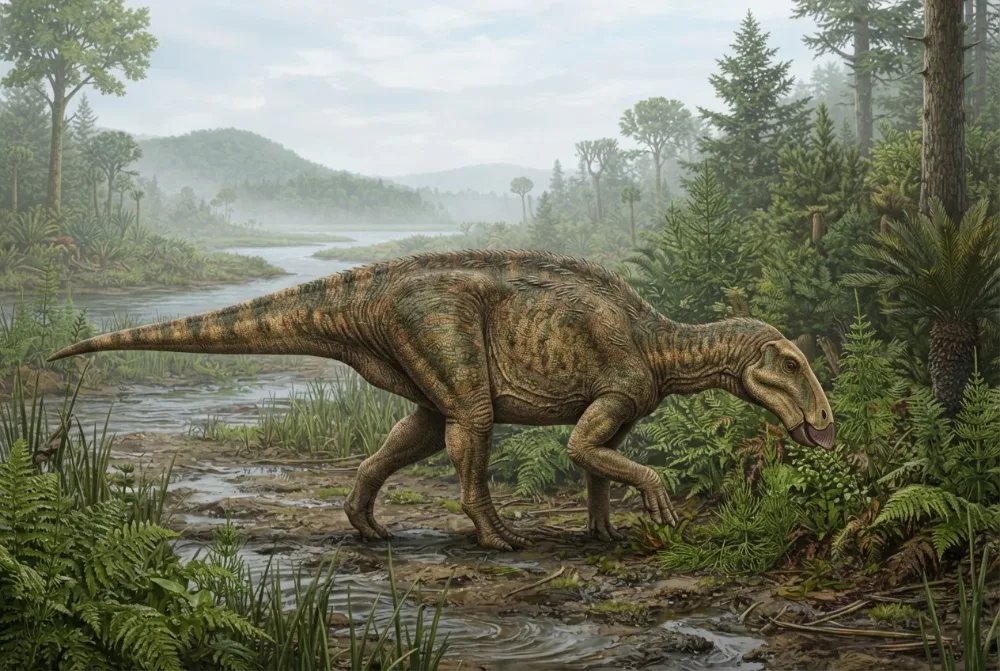
Eyona mibuzo ibuzwa kakhulu: Nipponosaurus
?How big was Nipponosaurus?
The only known skeleton is about 4 metres (13 feet) long, but it was a juvenile, so adults may have been bigger.1
?What did Nipponosaurus eat?
It was a herbivore, meaning it ate plants. It had a big, flat beak like a duck for cropping vegetation.2
?When did Nipponosaurus live?
It lived during the Late Cretaceous, about 89 to 84 million years ago, or around 80 million years ago according to some estimates.21
?Where was Nipponosaurus found?
Its fossil was found on Sakhalin Island, which is now part of Russia, but was Japanese territory when it was discovered in 1934.12
?Was Nipponosaurus a dinosaur?
Yes, it was a type of duck-billed dinosaur called a hadrosaur, specifically a lambeosaurine.2
Inyaniso ngeentsomi
Intsomi: Nipponosaurus was a full-grown adult when it died.
Inyaniso: The skeleton is from a juvenile, as shown by its small size and microscopic bone features.1
Kwiingcali zeedayinaso
- Igama lenzululwazi
- Nipponosaurus
- Inikwe igama ngu:
- Nagao 19363
- Iqela
- Imilomo-dada
- Usapho / iclade
- Hadrosauridae3
- Ukuhlelwa
- Ornithischia > Ornithopoda > Iguanodontia > Hadrosauridae3
- Ubudala bamatye
- 86 ukuya ku-72 izigidi zeminyaka (Santonian / Campanian)3
- Amazwe
- iRashiya3
- Iirekhodi zeefosili
- 1 kwi-Paleobiology Database3
- Ukufunyanwa
- Nipponosaurus was named in 1936 by Japanese paleontologist Takumi Nagao, based on a skeleton found in 1934 on Sakhalin Island.13
- Kusaxoxwa ngayo
- Scientists are not sure exactly how big a full-grown Nipponosaurus was, because only a juvenile skeleton has been found.1
Apho iinyani zivela khona
- Nipponosaurus (en.wikipedia.org)
- Nipponosaurus (nhm.ac.uk)
- Nipponosaurus in The Paleobiology Database (CC BY 4.0): ubudala, iindawo, izakhiwo zamatye, ukuhlelwa.
Yonke inyani ekweli phepha inenombolo ebonisa umthombo wayo. Ukuba siphosisile, uxolo, sithanda iidayinaso, asiyojenali yenzululwazi. Sixelele apha: [email protected], siya kuyilungisa.
 URex ulambile! I-Dino Wiki yiprojekthi katata ukwenzela unyana wakhe othanda iidayinaso, isimahla, ayinazintengiso, ayinazilandeli. Abantu abadala banokuphakela uRex isidlwana ukuze incede ihlale kwi-intanethi.Phakela uRex
 Parasaurolophus
 Edmontosaurus
 Saurolophus
 Hypacrosaurus
 Corythosaurus
 Kritosaurus
 Tyrannosaurus
 Triceratops
 Velociraptor
 Spinosaurus
 Ankylosaurus
 Pteranodon