 Uyiyiphi idayinaso? Ikwizi
 Idabi leedayinaso
 Ugqatso lweedayinaso
 Imidlalo emincinci yeedayinaso
 I-albhamu yezitikha
 Iilisti ze-TOP zeedayinaso
 Ndothuse!
Pentaceratops
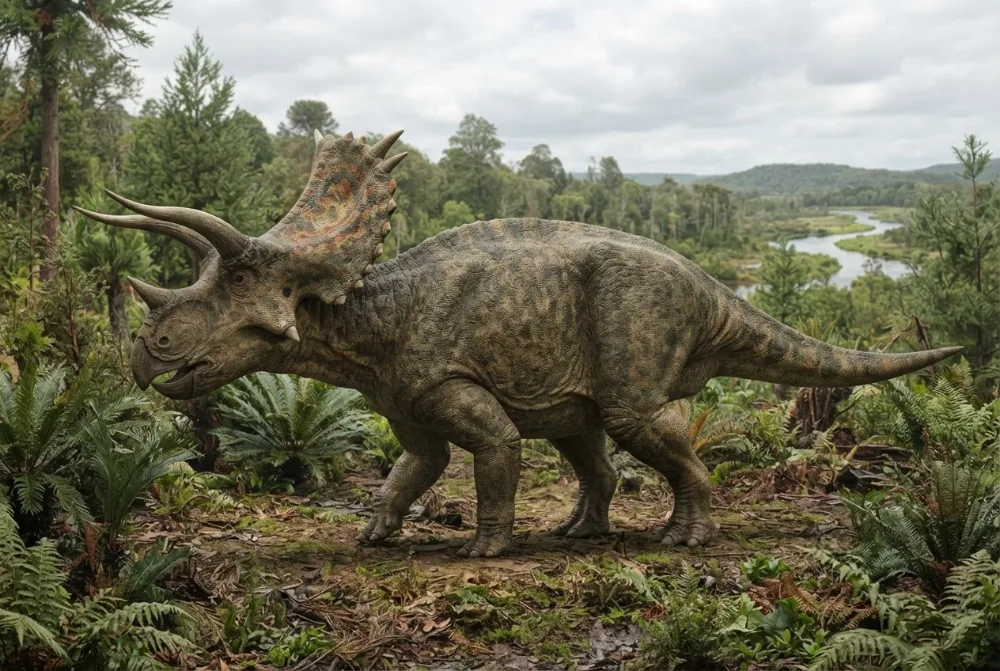
Pentaceratops was a plant-eating dinosaur that lived about 76 to 73 million years ago. It had a huge skull with five horns: two long ones above its eyes, a short one on its nose, and two long spikes sticking out from its cheeks. Its head frill was very long and had small triangular hornlets along the edge.1
Yaphila nini?
Yayinkulu kangakanani?
Yayinde kangakanani?
Yayiphakame kangakanani?
uqikelelo
Yayinzima kangakanani?

 inde njengezinja ezingama-6, impumlo ukuya emsileni🍌inde njengeebhanana ezingama-33 zilandelelanainzima njengezinja ezingama-120🍉inzima njengamavatala angama-500🎒inzima njengamagumbi okufundela apheleleyo abantwana angama-3🐻❄️inzima njengeebhere ezimhlophe ezingama-6🏃ibinokubaleka iimitha ezili-100 ngemizuzwana engama-12 (oyena mntu ukhawulezayo udinga i-9,6)
Pentaceratops wayemkhulu kangakanani xa ethelekiswa NAWE?
Yimathematika nje kwibhrawuza yakho. Akukho nto igcinwayo okanye ithunyelwe naphi na.
Yayikhawuleza kangakanani?


Iinyani ezimnandi
Pentaceratops means 'five-horned face' because it had five horns: two brow horns, one nose horn, and two long spikes on its cheekbones.1
Its skull could be over 2.3 meters (7.5 feet) long, making it one of the largest skulls of any land animal.1
Pentaceratops lived alongside the duck-billed dinosaur Parasaurolophus and the tyrannosaur Bistahieversor.1
The first fossils were found in 1921 by Charles Hazelius Sternberg in New Mexico. The dinosaur was named in 1923 by Henry Fairfield Osborn.1
One very large Pentaceratops skull was later renamed Titanoceratops because it looked more like Triceratops.1
Pentaceratops is used as a guide fossil: its appearance marks the start of the Kirtlandian land vertebrate age.1
Eyona mibuzo ibuzwa kakhulu: Pentaceratops
?How big was Pentaceratops?
Pentaceratops was about 5.5 to 6 meters (18 to 20 feet) long and weighed around 2.5 metric tons (2.8 short tons).1
?What did Pentaceratops eat?
Pentaceratops was an herbivore, meaning it ate plants. It likely fed on ferns, cycads, and conifers using its sharp beak and cheek teeth.1
?When did Pentaceratops live?
Pentaceratops lived during the Late Cretaceous Period, about 76 to 73 million years ago.1
?Where was Pentaceratops found?
Pentaceratops fossils have been found in the Kirtland Formation in the San Juan Basin of New Mexico, USA.1
?Did Pentaceratops have feathers?
No, Pentaceratops did not have feathers. It was a ceratopsian dinosaur with scaly skin, like other horned dinosaurs.1
?Was Pentaceratops bigger than Triceratops?
No, Pentaceratops was smaller than Triceratops. Pentaceratops was about 5.5 to 6 meters long, while Triceratops could reach up to 9 meters.1
?How many horns did Pentaceratops have?
Pentaceratops had five horns: two long brow horns, one short nose horn, and two long spikes on its cheekbones.1
?Could Pentaceratops swim?
Nobody knows for sure, but Pentaceratops was a land dinosaur with sturdy legs, so it probably did not swim often.1
Inyaniso ngeentsomi
Intsomi: Some people think Pentaceratops had five horns on its head like a crown.
Inyaniso: The 'fifth horn' is actually a long spike on each cheekbone (the jugal bone), not a true horn on the skull roof.1
Kwiingcali zeedayinaso
- Igama lenzululwazi
- Pentaceratops
- Inikwe igama ngu:
- Osborn 19232
- Iqela
- Iidayinaso ezineempondo
- Usapho / iclade
- Ceratopsidae2
- Ukuhlelwa
- Ornithischia > Ceratopsia > Ceratopsidae2
- Ubudala bamatye
- 84 ukuya ku-66 izigidi zeminyaka (Campanian / Maastrichtian)2
- Izakhiwo zamatye
- Fruitland, Kirtland, Williams Fork2
- Amazwe
- iUSA2
- Iirekhodi zeefosili
- 14 kwi-Paleobiology Database2
- Ukufunyanwa
- The first Pentaceratops fossils were collected in 1921 by Charles Hazelius Sternberg in the San Juan Basin of New Mexico. The species was named Pentaceratops sternbergii by Henry Fairfield Osborn in 1923, honoring Sternberg.1
- Kusaxoxwa ngayo
- Scientists debate whether the species Pentaceratops aquilonius from Canada really belongs to Pentaceratops or is a different dinosaur called Spiclypeus.1
Apho iinyani zivela khona
- Pentaceratops (en.wikipedia.org)
- Pentaceratops in The Paleobiology Database (CC BY 4.0): ubudala, iindawo, izakhiwo zamatye, ukuhlelwa.
Yonke inyani ekweli phepha inenombolo ebonisa umthombo wayo. Ukuba siphosisile, uxolo, sithanda iidayinaso, asiyojenali yenzululwazi. Sixelele apha: [email protected], siya kuyilungisa.
 URex ulambile! I-Dino Wiki yiprojekthi katata ukwenzela unyana wakhe othanda iidayinaso, isimahla, ayinazintengiso, ayinazilandeli. Abantu abadala banokuphakela uRex isidlwana ukuze incede ihlale kwi-intanethi.Phakela uRex
 Triceratops
 Protoceratops
 Ojoceratops
 Tatankaceratops
 Psittacosaurus
 Centrosaurus
 Tyrannosaurus
 Velociraptor
 Spinosaurus
 Ankylosaurus
 Parasaurolophus
 Pteranodon