 Uyiyiphi idayinaso? Ikwizi
 Idabi leedayinaso
 Ugqatso lweedayinaso
 Imidlalo emincinci yeedayinaso
 I-albhamu yezitikha
 Iilisti ze-TOP zeedayinaso
 Ndothuse!
Ptychotherates
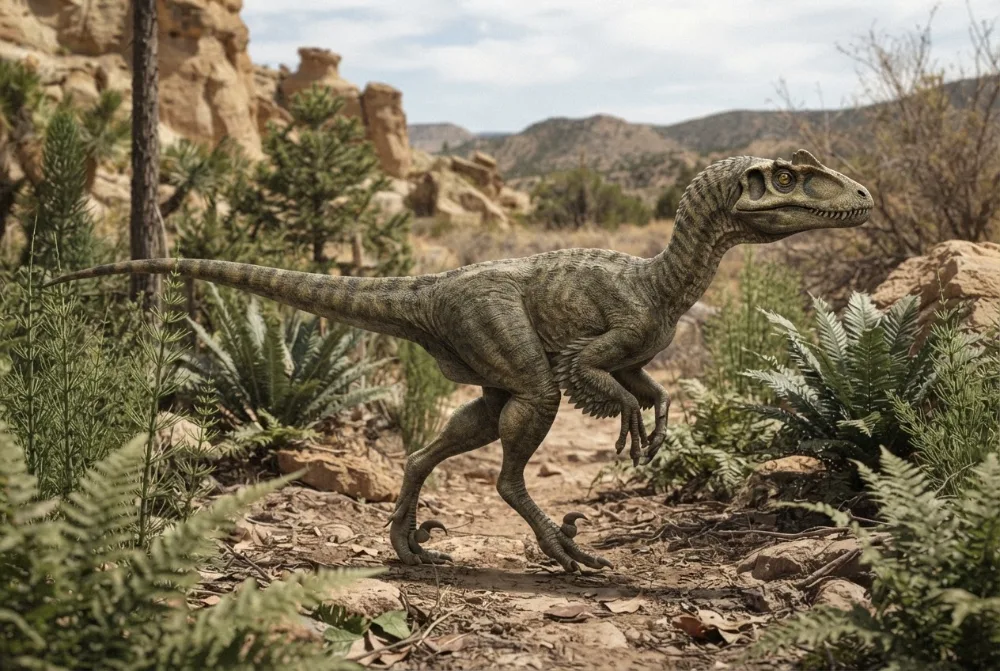
Ptychotherates was a meat-eating dinosaur that lived near the end of the Triassic Period. It had a very deep cheek bone, deeper than any other Triassic dinosaur. Only one skull has been found, but it tells us a lot about how early dinosaurs lived in what is now New Mexico, USA.1
Yaphila nini?
Yayikhawuleza kangakanani?


Iinyani ezimnandi
Ptychotherates is known from only one partial skull, which was found in a block of rock collected in 1982 by the Carnegie Museum of Natural History.1
Its cheek bone (the jugal) is the deepest known for any Triassic dinosaur, meaning it was very tall from top to bottom.21
Ptychotherates lived alongside the famous dinosaur Coelophysis, which is known from thousands of skeletons at the same quarry.1
It belongs to a group of early meat-eating dinosaurs called Morphoraptora, which includes Tawa and Chindesaurus.21
The name Ptychotherates means 'fold hunter' because the skull bones were twisted and hard to put back together.1
This dinosaur lived about 205 to 201 million years ago, near the very end of the Triassic Period.4
Ptychotherates shows that some early dinosaur groups survived longer at low latitudes (near the equator) than they did elsewhere.2
Eyona mibuzo ibuzwa kakhulu: Ptychotherates
?How big was Ptychotherates?
Nobody knows for sure because only one partial skull has been found. The skull is about 29 mm tall at the cheek bone, but the full size of the dinosaur is unknown.1
?What did Ptychotherates eat?
It was a meat-eater. Its name means 'fold hunter' because of its carnivorous habits inferred from its teeth.31
?When did Ptychotherates live?
It lived near the end of the Triassic Period, about 205 to 201 million years ago, during the Norian or Rhaetian ages.3
?Where was Ptychotherates found?
It was discovered in the Coelophysis Quarry at Ghost Ranch, New Mexico, USA, in rocks of the Chinle Formation.3
Kwiingcali zeedayinaso
- Igama lenzululwazi
- Ptychotherates
- Inikwe igama ngu:
- Srivastava and Nesbitt 20264
- Iqela
- Iidayinaso zokuqala
- Usapho / iclade
- Morphoraptora4
- Ubudala bamatye
- 206 ukuya ku-201 izigidi zeminyaka (Rhaetian)4
- Izakhiwo zamatye
- Chinle4
- Amazwe
- iUSA4
- Iirekhodi zeefosili
- 1 kwi-Paleobiology Database4
- Ukufunyanwa
- Ptychotherates was named in 2026 by scientists S. Srivastava and S. J. Nesbitt. The only fossil, a partial skull, came from the Coelophysis Quarry at Ghost Ranch, New Mexico, and was collected by the Carnegie Museum of Natural History in 1982.41
- Kusaxoxwa ngayo
- Scientists are not sure exactly how Ptychotherates is related to other early dinosaurs, because its skull has a mix of features from both herrerasaurians and neotheropods.1
Apho iinyani zivela khona
- A new taxon of saurischian dinosaur from the Coelophysis Quarry of New Mexico, USA (Triassic: latest Norian or Rhaetian) highlights herrerasaurian diversity in the latest Triassic (dinodata.de)
- A new taxon of saurischian dinosaur from the Coelophysis Quarry of New Mexico, USA (Triassic: latest Norian or Rhaetian) highlights herrerasaurian diversity in the latest Triassic | NSF Public Access Repository (par.nsf.gov)
- Ptychotherates (en.wikipedia.org)
- Ptychotherates in The Paleobiology Database (CC BY 4.0): ubudala, iindawo, izakhiwo zamatye, ukuhlelwa.
Yonke inyani ekweli phepha inenombolo ebonisa umthombo wayo. Ukuba siphosisile, uxolo, sithanda iidayinaso, asiyojenali yenzululwazi. Sixelele apha: [email protected], siya kuyilungisa.
 URex ulambile! I-Dino Wiki yiprojekthi katata ukwenzela unyana wakhe othanda iidayinaso, isimahla, ayinazintengiso, ayinazilandeli. Abantu abadala banokuphakela uRex isidlwana ukuze incede ihlale kwi-intanethi.Phakela uRex
 Herrerasaurus
 Tawa
Tawa Chindesaurus
 Nyasasaurus
 Staurikosaurus
 Alwalkeria
 Nothosaurus
 Massospondylus
 Plateosaurus
 Coelophysis
 Podokesaurus
 Simosaurus