 Uyiyiphi idayinaso? Ikwizi
 Idabi leedayinaso
 Ugqatso lweedayinaso
 Imidlalo emincinci yeedayinaso
 I-albhamu yezitikha
 Iilisti ze-TOP zeedayinaso
 Ndothuse!
Yaphila nini?

Yayinkulu kangakanani?
Yayinde kangakanani?
Yayiphakame kangakanani?
Yayinzima kangakanani?

 inde njengezinja ezingama-6, impumlo ukuya emsileni🍌inde njengeebhanana ezingama-31 zilandelelanainzima njengezinja ezingama-140🍉inzima njengamavatala angama-540🎒inzima njengamagumbi okufundela apheleleyo abantwana angama-3🐻❄️inzima njengeebhere ezimhlophe ezingama-6🏃ibinokubaleka iimitha ezili-100 ngemizuzwana engama-11 (oyena mntu ukhawulezayo udinga i-9,6)
Styracosaurus wayemkhulu kangakanani xa ethelekiswa NAWE?
Yimathematika nje kwibhrawuza yakho. Akukho nto igcinwayo okanye ithunyelwe naphi na.
Yayikhawuleza kangakanani?


Iinyani ezimnandi
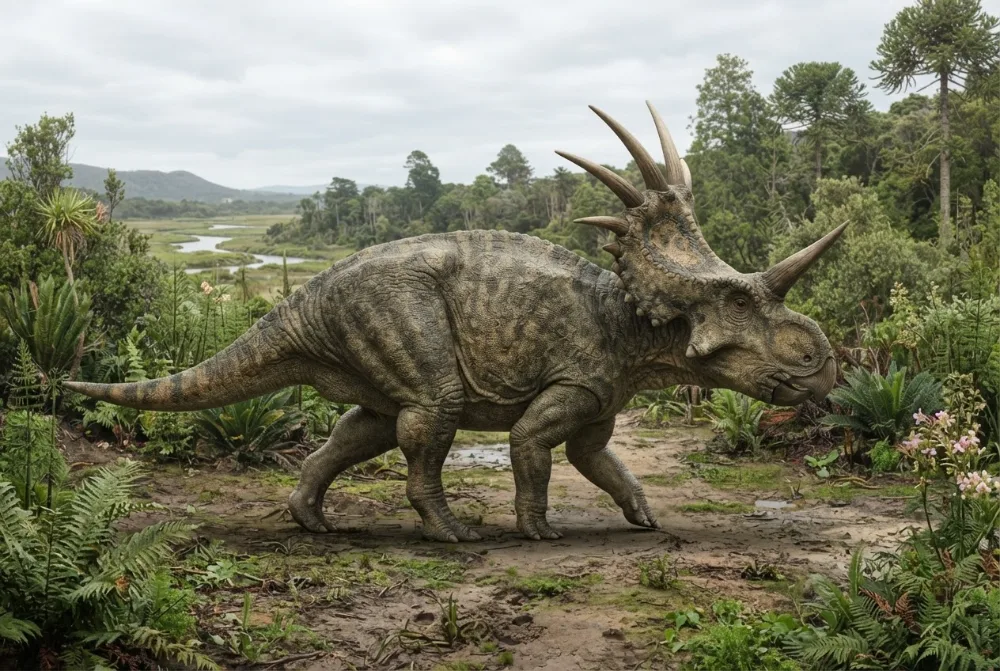
The nose horn of Styracosaurus could be up to 60 centimeters (2 feet) long and 15 centimeters (6 inches) wide.1
Its frill had four to six long spikes sticking out, which is why its name means 'spiked lizard'.1
Scientists have found a bone bed with many Styracosaurus skeletons together, which suggests they may have lived in herds.1
Styracosaurus lived alongside other famous dinosaurs like the horned Centrosaurus, the duck-billed Parasaurolophus, and the tyrannosaur Gorgosaurus.1
The first Styracosaurus fossil was a nearly complete skull found in 1913 by Charles H. Sternberg in what is now Dinosaur Provincial Park in Alberta, Canada.1
A nearly complete skeleton of the same individual was collected later, in 1935, and is now on display in Ottawa, Canada.1
Eyona mibuzo ibuzwa kakhulu: Styracosaurus
?How big was Styracosaurus?
About 5 to 5.5 metres long and weighed 1.8 to 2.7 metric tons. It stood about 1.8 metres tall.12
?What did Styracosaurus eat?
It was a plant-eater (herbivore) that ate low-growing plants. It had a parrot-like beak and rows of teeth for slicing tough vegetation.21
?How many horns did Styracosaurus have?
It had one big nose horn and four to six long spikes on its frill. The number of frill spikes varied between individuals.21
?Did Styracosaurus live in herds?
Yes, scientists think so. A bone bed with many Styracosaurus skeletons together suggests they may have lived and died in groups.21
?What predators did Styracosaurus have?
Large meat-eaters like Daspletosaurus, a relative of Tyrannosaurus, lived alongside it and probably hunted it.21
?How fast could Styracosaurus run?
It was very slow. It walked on four short legs and probably could not outrun predators.2
Inyaniso ngeentsomi
Intsomi: Some people think Styracosaurus used its frill spikes mainly for fighting predators.
Inyaniso: Scientists debate the function of the horns and frill, but they may have been used for display to attract mates, for species recognition, or for defense, not just for fighting.1
Kwiingcali zeedayinaso
- Igama lenzululwazi
- Styracosaurus
- Inikwe igama ngu:
- Lambe 19134
- Iqela
- Iidayinaso ezineempondo
- Usapho / iclade
- Ceratopsidae4
- Ukuhlelwa
- Ornithischia > Ceratopsia > Ceratopsidae4
- Ubudala bamatye
- 84 ukuya ku-72 izigidi zeminyaka (Campanian)4
- Izakhiwo zamatye
- Dinosaur Park4
- Amazwe
- iKhanada4
- Iirekhodi zeefosili
- 10 kwi-Paleobiology Database4
- Ukufunyanwa
- Styracosaurus was named by Canadian paleontologist Lawrence Lambe in 1913, based on a skull found by Charles H. Sternberg in Alberta, Canada.13
- Kusaxoxwa ngayo
- Scientists still debate whether another species, Styracosaurus ovatus, should be its own genus (Rubeosaurus) or just a different specimen of Styracosaurus albertensis.1
Apho iinyani zivela khona
- Styracosaurus (en.wikipedia.org)
- Styracosaurus | Natural History Museum (nhm.ac.uk)
- PBDB Taxon (paleobiodb.org)
- Styracosaurus in The Paleobiology Database (CC BY 4.0): ubudala, iindawo, izakhiwo zamatye, ukuhlelwa.
Yonke inyani ekweli phepha inenombolo ebonisa umthombo wayo. Ukuba siphosisile, uxolo, sithanda iidayinaso, asiyojenali yenzululwazi. Sixelele apha: [email protected], siya kuyilungisa.
 URex ulambile! I-Dino Wiki yiprojekthi katata ukwenzela unyana wakhe othanda iidayinaso, isimahla, ayinazintengiso, ayinazilandeli. Abantu abadala banokuphakela uRex isidlwana ukuze incede ihlale kwi-intanethi.Phakela uRex
 Triceratops
 Protoceratops
 Ojoceratops
 Tatankaceratops
 Psittacosaurus
 Centrosaurus
 Tyrannosaurus
 Velociraptor
 Spinosaurus
 Ankylosaurus
 Parasaurolophus
 Pteranodon