 Uyiyiphi idayinaso? Ikwizi
 Idabi leedayinaso
 Ugqatso lweedayinaso
 Imidlalo emincinci yeedayinaso
 I-albhamu yezitikha
 Iilisti ze-TOP zeedayinaso
 Ndothuse!
Syntarsus
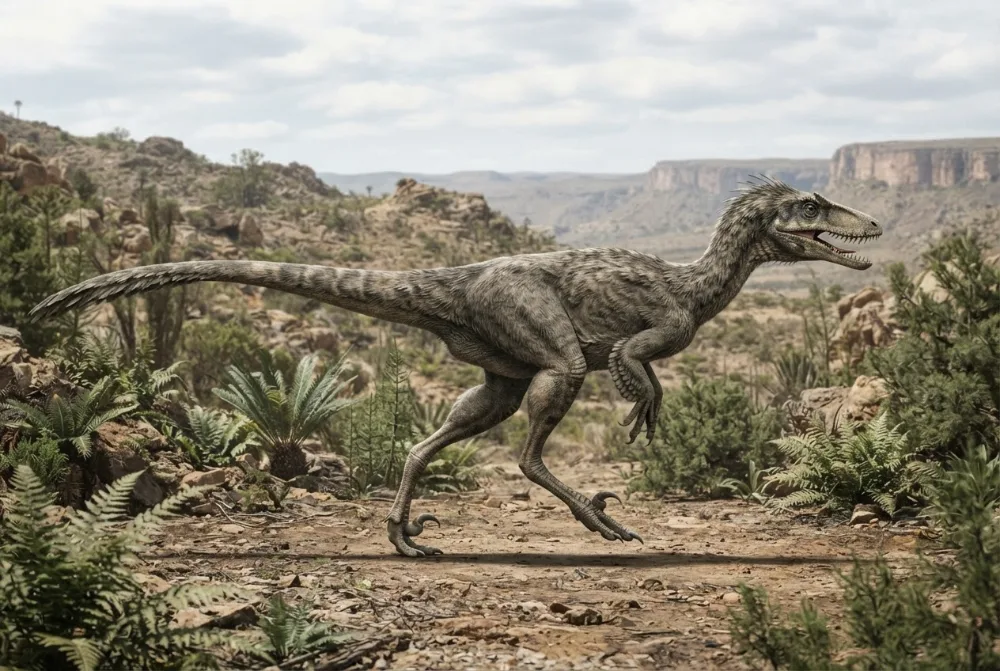
Syntarsus was a fast, meat-eating dinosaur that lived about 200 million years ago. It was a relative of Coelophysis and used its sharp teeth and long legs to chase down small prey. Some fossils show that it might have lived in groups.2
Yaphila nini?
Yayinkulu kangakanani?
Yayinde kangakanani?
Yayiphakame kangakanani?
Yayinzima kangakanani?

 inde njengezinja ezingama-3, impumlo ukuya emsileni🍌inde njengeebhanana ezingama-17 zilandelelana🍉inzima njengamavatala angama-6🏃ibinokubaleka iimitha ezili-100 ngemizuzwana engama-8.6 (oyena mntu ukhawulezayo udinga i-9,6)
Syntarsus wayemkhulu kangakanani xa ethelekiswa NAWE?
Yimathematika nje kwibhrawuza yakho. Akukho nto igcinwayo okanye ithunyelwe naphi na.
Yayikhawuleza kangakanani?


Iinyani ezimnandi
Syntarsus had a long, slim body and a tail that helped it keep balance while running fast.2
Fossils of Syntarsus have been found in Arizona in the Kayenta Formation and in South Africa in the Elliot Formation.22
The species Syntarsus kayentakatae was named by Timothy Rowe in 1989 from a partial skeleton found in Arizona.21
Syntarsus lived during the Early Jurassic, about 199 to 183 million years ago, in what is now the southwestern United States and southern Africa.2
Scientists think Syntarsus was a fast and agile hunter, using its long legs to chase after lizards and small dinosaurs.2
The name Syntarsus was first used by Michael Raath in 1969 for fossils found in Rhodesia (now Zimbabwe).2
Kwiingcali zeedayinaso
- Igama lenzululwazi
- Syntarsus
- Inikwe igama ngu:
- Raath 19692
- Iqela
- Iidayinaso ezitya inyama
- Usapho / iclade
- Coelophysoidea2
- Ukuhlelwa
- Theropoda > Coelophysoidea2
- Ubudala bamatye
- 206 ukuya ku-184 izigidi zeminyaka (Rhaetian / Pliensbachian)2
- Izakhiwo zamatye
- Kayenta, Elliot, Moenave2
- Amazwe
- iUSA, uMzantsi Afrika2
- Iirekhodi zeefosili
- 11 kwi-Paleobiology Database2
- Ukufunyanwa
- The first Syntarsus fossils were found in the Forest Sandstone of Rhodesia (now Zimbabwe) and named by Michael Raath in 1969. Another species, Syntarsus kayentakatae, was named by Timothy Rowe in 1989 from the Kayenta Formation in Arizona.221
- Kusaxoxwa ngayo
- Scientists still debate whether Syntarsus should be called a separate genus or classified as a type of Coelophysis. Some researchers suggest the name Megapnosaurus instead.22
Apho iinyani zivela khona
- : Rowe 1989 | Publication Details | MCZbase (mczbase.mcz.harvard.edu)
- Syntarsus in The Paleobiology Database (CC BY 4.0): ubudala, iindawo, izakhiwo zamatye, ukuhlelwa.
Yonke inyani ekweli phepha inenombolo ebonisa umthombo wayo. Ukuba siphosisile, uxolo, sithanda iidayinaso, asiyojenali yenzululwazi. Sixelele apha: [email protected], siya kuyilungisa.
 URex ulambile! I-Dino Wiki yiprojekthi katata ukwenzela unyana wakhe othanda iidayinaso, isimahla, ayinazintengiso, ayinazilandeli. Abantu abadala banokuphakela uRex isidlwana ukuze incede ihlale kwi-intanethi.Phakela uRex
 Allosaurus
 Carnotaurus
 Dilophosaurus
 Giganotosaurus
 Compsognathus
 Paronychodon
 Stenopterygius
 Dorygnathus
 Lufengosaurus
 Scutellosaurus
 Yunnanosaurus
 Temnodontosaurus