 Uyiyiphi idayinaso? Ikwizi
 Idabi leedayinaso
 Ugqatso lweedayinaso
 Imidlalo emincinci yeedayinaso
 I-albhamu yezitikha
 Iilisti ze-TOP zeedayinaso
 Ndothuse!
Taleta
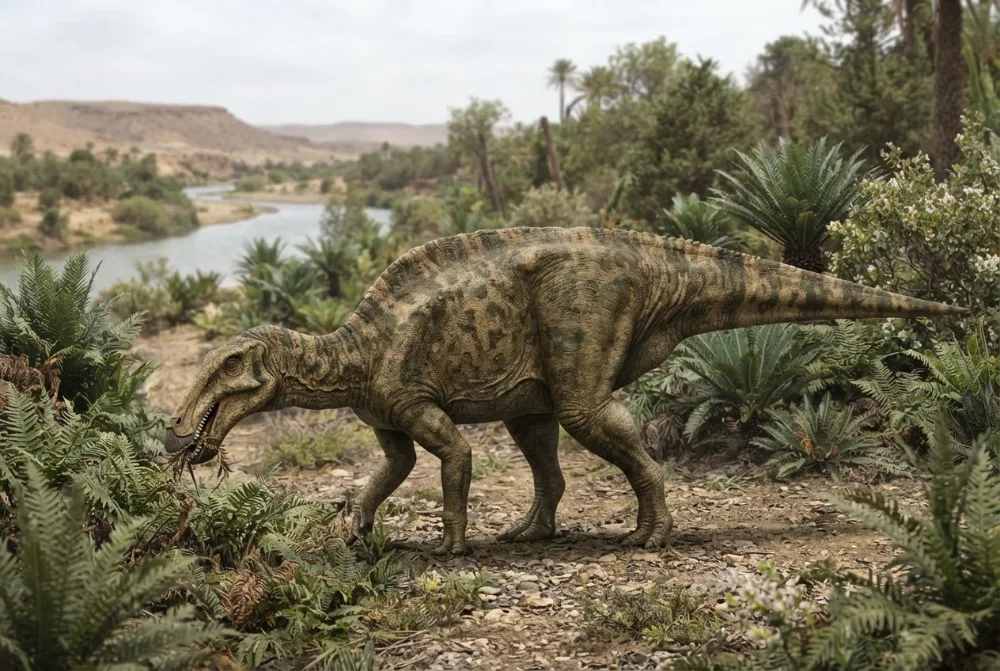
Taleta was a small duck-billed dinosaur that lived in what is now Morocco. It had huge, blade-like teeth that gave it a wicked grin. This dinosaur was one of several duckbills that crossed the ocean to reach Africa and then quickly evolved into many different species.1
Yaphila nini?
Yayinkulu kangakanani?
Yayinde kangakanani?
Yayiphakame kangakanani?
uqikelelo
Yayinzima kangakanani?
 inde njengezinja ezingama-6, impumlo ukuya emsileni🍌inde njengeebhanana ezingama-31 zilandelelana🍉inzima njengamavatala angama-100🧸inzima njengabantwana basenkulisa abangama-26🎒inzima njengabantwana besikolo abangama-16🏃ibinokubaleka iimitha ezili-100 ngemizuzwana engama-9.2 (oyena mntu ukhawulezayo udinga i-9,6)
Taleta wayemkhulu kangakanani xa ethelekiswa NAWE?
Yimathematika nje kwibhrawuza yakho. Akukho nto igcinwayo okanye ithunyelwe naphi na.
Yayikhawuleza kangakanani?


Iinyani ezimnandi
Taleta is known from only two upper jaw bones (maxillae).2
Its teeth were huge for such a small animal, with tall, blade-like ridges on the crown.1
Unlike most duckbills, Taleta had only one tooth per tooth socket instead of several teeth stacked together.1
Taleta belonged to a group of lambeosaurine duckbills called Arenysaurini, which spread from Europe to Africa.62
It lived about 70 to 66 million years ago, near the very end of the Age of Dinosaurs.6
Eyona mibuzo ibuzwa kakhulu: Taleta
?How big was Taleta?
Taleta was a small duck-billed dinosaur, about the size of a pony. It was similar in size to Minqaria, which has been estimated at 3.5 metres long.31
?What did Taleta eat?
Taleta was a plant-eater. Like other duck-billed dinosaurs, it used its wide beak and rows of teeth to chew tough plants.3
?Did Taleta have feathers?
Nobody knows for sure. Duck-billed dinosaurs like Taleta are not usually shown with feathers in fossils, but some related dinosaurs had simple feathers, so it is possible.3
Kwiingcali zeedayinaso
- Igama lenzululwazi
- Taleta
- Inikwe igama ngu:
- Longrich et al. 20256
- Iqela
- Imilomo-dada
- Usapho / iclade
- Hadrosauridae6
- Ukuhlelwa
- Ornithischia > Ornithopoda > Iguanodontia > Hadrosauridae6
- Ubudala bamatye
- 72 ukuya ku-66 izigidi zeminyaka (Maastrichtian)6
- Izakhiwo zamatye
- Couche III6
- Amazwe
- iMorocco6
- Iirekhodi zeefosili
- 1 kwi-Paleobiology Database6
- Ukufunyanwa
- Taleta was named in 2025 by Nick Longrich and colleagues. It was discovered in the phosphate mines of Morocco, where the bones were first mistaken for fish remains.61
- Kusaxoxwa ngayo
- Scientists are not sure how many species of duckbills lived in Africa. Limb bones hint at a fourth, larger species that has not yet been named.1
Apho iinyani zivela khona
- Nick Longrich - Blog (nicklongrich.com)
- A new hadrosaurid dinosaur from the late Maastrichtian Phosphates of Morocco provides evidence for an African radiation of lambeosaurines - the University of Bath's research portal (researchportal.bath.ac.uk)
- Taleta (en.wikipedia.org)
- Taleta taleta | Dinosaur Database by DinoAnimals.com (dinoanimals.com)
- Nick Longrich - Blog (nicklongrich.com)
- Taleta in The Paleobiology Database (CC BY 4.0): ubudala, iindawo, izakhiwo zamatye, ukuhlelwa.
Yonke inyani ekweli phepha inenombolo ebonisa umthombo wayo. Ukuba siphosisile, uxolo, sithanda iidayinaso, asiyojenali yenzululwazi. Sixelele apha: [email protected], siya kuyilungisa.
 URex ulambile! I-Dino Wiki yiprojekthi katata ukwenzela unyana wakhe othanda iidayinaso, isimahla, ayinazintengiso, ayinazilandeli. Abantu abadala banokuphakela uRex isidlwana ukuze incede ihlale kwi-intanethi.Phakela uRex
 Parasaurolophus
 Edmontosaurus
 Saurolophus
 Hypacrosaurus
 Corythosaurus
 Kritosaurus
 Tyrannosaurus
 Triceratops
 Velociraptor
 Spinosaurus
 Ankylosaurus
 Pteranodon