 Uyiyiphi idayinaso? Ikwizi
 Idabi leedayinaso
 Ugqatso lweedayinaso
 Imidlalo emincinci yeedayinaso
 I-albhamu yezitikha
 Iilisti ze-TOP zeedayinaso
 Ndothuse!
Yaphila nini?

Yayinkulu kangakanani?
Yayinde kangakanani?
Yayinzima kangakanani?
 inde njengeemoto ezingama-2 zipakwe zilandelelana🍌inde njengeebhanana ezingama-56 zilandelelana
 inzima njengeendlovu ezingama-1.5🍉inzima njengamavatala angama-2000🎒inzima njengamagumbi okufundela apheleleyo abantwana angama-12🐻❄️inzima njengeebhere ezimhlophe ezingama-22🏃ibinokubaleka iimitha ezili-100 ngemizuzwana engama-17 (oyena mntu ukhawulezayo udinga i-9,6)
Vitakridrinda wayemkhulu kangakanani xa ethelekiswa NAWE?
Yimathematika nje kwibhrawuza yakho. Akukho nto igcinwayo okanye ithunyelwe naphi na.
Yayikhawuleza kangakanani?


Iinyani ezimnandi
Vitakridrinda was named by Pakistani paleontologist M. Sadiq Malkani in 2004.1
Its fossils were found in the Vitakri Member of the Pab Formation, which is about 72 to 66 million years old.13
A rostrum (snout) of Vitakridrinda was discovered with bite marks, punctures, and even a tooth embedded in it, showing it fought with another dinosaur.2
The snout of Vitakridrinda had pits and grooves on its surface, a feature that links it to the abelisaurid group of theropods.2
Vitakridrinda lived alongside titanosaur sauropods, and scientists think it may have scavenged or preyed on them.2
This dinosaur is part of a group called Vitakrisauridae, which includes other dinosaurs from Pakistan.1
The fossils of Vitakridrinda were found in red, maroon, and greenish-grey mudstones, which were deposited in a river environment.3
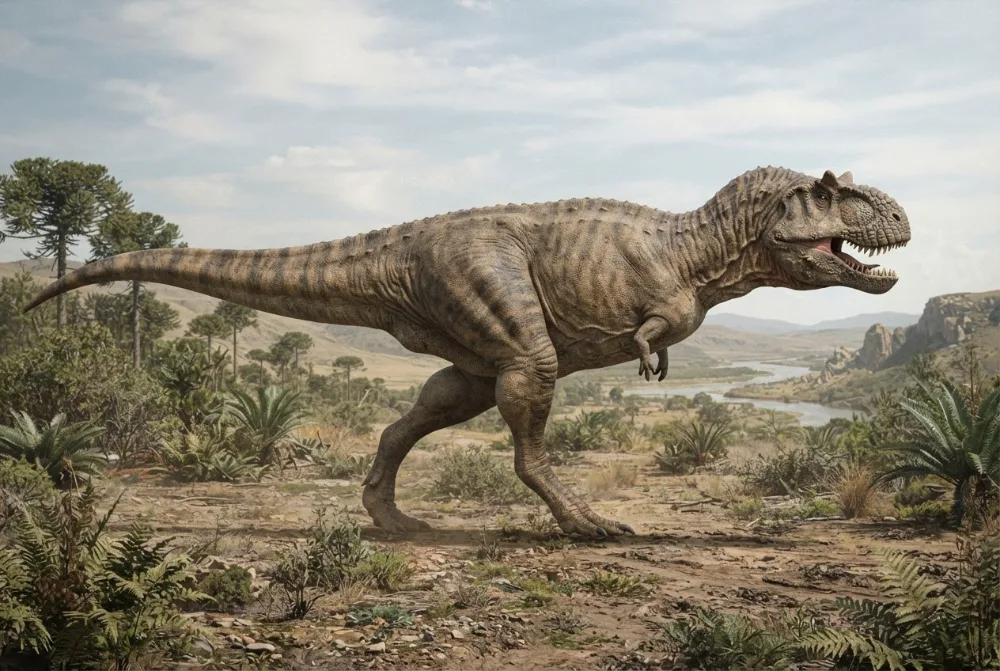
Eyona mibuzo ibuzwa kakhulu: Vitakridrinda
?How big was Vitakridrinda?
Nobody knows for sure because only a few bones are known. The fossils suggest it was a large-bodied theropod, but no exact size estimate has been published.56
?What did Vitakridrinda eat?
Vitakridrinda was a meat-eater, as shown by its sharp teeth and the fact that it is classified as a theropod. It likely hunted or scavenged titanosaurs, since its fossils were found with them.62
?Did Vitakridrinda fight with other dinosaurs?
Yes. Its snout has bite marks, punctures, and even a tooth embedded in it, showing it fought with another dinosaur, possibly of the same species.25
?Why did Vitakridrinda have pits and grooves on its snout?
The pits and grooves are a feature of abelisaurid theropods, but scientists don't know exactly what they were for. They might have been for display or for supporting a tough covering.2
?When did Vitakridrinda live?
Vitakridrinda lived during the latest Cretaceous, about 72 to 66 million years ago, in the Maastrichtian age.6
?Where was Vitakridrinda found?
Its fossils were found in the Vitakri Member of the Pab Formation in Balochistan, Pakistan.26
?Is Vitakridrinda a dinosaur?
Yes, Vitakridrinda is a theropod dinosaur, a meat-eating dinosaur that walked on two legs.6
?What does the name Vitakridrinda mean?
The name Vitakridrinda comes from the Vitakri Member where it was found, and 'drinda' may relate to a local word. It was named by paleontologist M. Sadiq Malkani in 2004.6
Kwiingcali zeedayinaso
- Igama lenzululwazi
- Vitakridrinda
- Inikwe igama ngu:
- Malkani 20046
- Iqela
- Iidayinaso ezitya inyama
- Usapho / iclade
- Vitakrisauridae6
- Ukuhlelwa
- Theropoda > Ceratosauria6
- Ubudala bamatye
- 72 ukuya ku-66 izigidi zeminyaka (Maastrichtian)6
- Izakhiwo zamatye
- Vitakri6
- Amazwe
- iPakistan6
- Iirekhodi zeefosili
- 8 kwi-Paleobiology Database6
- Ukufunyanwa
- Vitakridrinda was named by M. Sadiq Malkani in 2004 based on fossils found in the Vitakri area of Balochistan, Pakistan. The first rostrum (snout) was discovered later in the Alam Kali Kakor locality.12
- Kusaxoxwa ngayo
- Scientists are not sure exactly how big Vitakridrinda was, because only partial fossils like a snout and leg bones have been found.12
Apho iinyani zivela khona
- PBDB Taxon (paleobiodb.org)
- First rostrum of carnivorous Vitakridrinda (Abelisaurid Theropod Dinosaur) found from the latest Cretaceous Dinosaur Beds (Vitakri) Member of PAB formation, Alam Kali Kakor Locality of Vitakri area, Barkhan District, Balochistan, Pakistan (sujo.usindh.edu.pk)
- PBDB Collection (paleobiodb.org)
- Theropods, Mesoeucrocodiles and Pterosaurs Found from the Latest Maastrichtian Vitakri Formation of Balochistan, Pakistan; Description with Large Photographs and Comparison with Coeval Taxa from Indo-Pakistan Subcontinent (scirp.net)
- Vitakridrinda (Vitakrisauridae, Theropoda) from the latest Cretaceous of Pakistan | Journal of Earth Science | Springer Nature Link (link.springer.com)
- Vitakridrinda in The Paleobiology Database (CC BY 4.0): ubudala, iindawo, izakhiwo zamatye, ukuhlelwa.
Yonke inyani ekweli phepha inenombolo ebonisa umthombo wayo. Ukuba siphosisile, uxolo, sithanda iidayinaso, asiyojenali yenzululwazi. Sixelele apha: [email protected], siya kuyilungisa.
 URex ulambile! I-Dino Wiki yiprojekthi katata ukwenzela unyana wakhe othanda iidayinaso, isimahla, ayinazintengiso, ayinazilandeli. Abantu abadala banokuphakela uRex isidlwana ukuze incede ihlale kwi-intanethi.Phakela uRex
 Allosaurus
 Carnotaurus
 Dilophosaurus
 Giganotosaurus
 Compsognathus
 Paronychodon
 Tyrannosaurus
 Triceratops
 Velociraptor
 Spinosaurus
 Ankylosaurus
 Parasaurolophus