 Uyiyiphi idayinaso? Ikwizi
 Idabi leedayinaso
 Ugqatso lweedayinaso
 Imidlalo emincinci yeedayinaso
 I-albhamu yezitikha
 Iilisti ze-TOP zeedayinaso
 Ndothuse!
Yaphila nini?

Yayinkulu kangakanani?
Yayinde kangakanani?
Yayiphakame kangakanani?
uqikelelo
Yayinzima kangakanani?
 inde njengeekati zasekhaya ezingama-3, impumlo ukuya emsileni🍌inde njengeebhanana ezingama-9 zilandelelanamalunga nobunzima bekati yasekhaya🍌inzima njengeebhanana ezingama-46🏃ibinokubaleka iimitha ezili-100 ngemizuzwana engama-11 (oyena mntu ukhawulezayo udinga i-9,6)
Vitakrisaurus wayemkhulu kangakanani xa ethelekiswa NAWE?
Yimathematika nje kwibhrawuza yakho. Akukho nto igcinwayo okanye ithunyelwe naphi na.
Yayikhawuleza kangakanani?


Iinyani ezimnandi
Vitakrisaurus was named by scientist Muhammad Sadiq Malkani in 2010.2
Its fossils include hand bones like carpals, metacarpals, and claws, which are rare for theropods from this region.1
This dinosaur lived during the very end of the Cretaceous Period, about 67 to 66 million years ago.1
Vitakrisaurus is known from the Vitakri Lameta Formation in central Pakistan.1
It belongs to a group of theropods called abelisauroids, which were common in the southern continents.1
The species name saraiki honors the Saraiki language spoken by people living near where the fossils were found.1
Eyona mibuzo ibuzwa kakhulu: Vitakrisaurus
?How big was Vitakrisaurus?
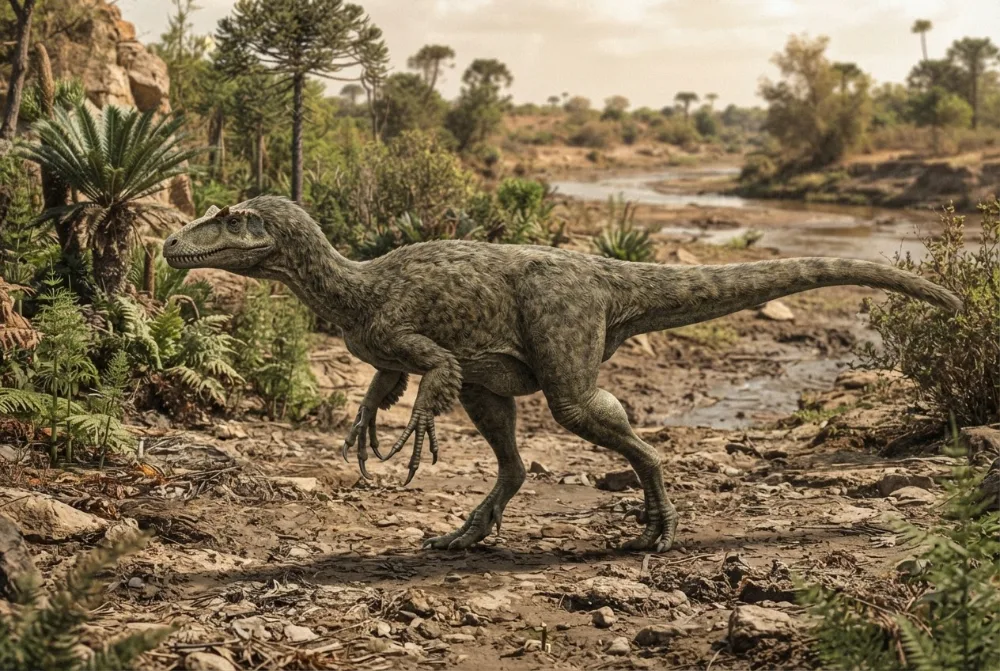
It was a medium sized theropod, about 10 metres long. That is roughly the length of a school bus.4
?What did Vitakrisaurus eat?
It was a carnivore, meaning it ate meat. It used its strong hands and claws to catch prey.4
?When did Vitakrisaurus live?
It lived at the very end of the Cretaceous Period, about 67 to 66 million years ago.4
?Where was Vitakrisaurus found?
Its fossils were found in the Vitakri Lameta Formation in Balochistan, central Pakistan.14
?Is Vitakrisaurus a dinosaur?
Yes, it is a dinosaur. It belongs to the group Theropoda, which includes meat-eating dinosaurs like T. rex.4
?Did Vitakrisaurus have feathers?
Scientists do not know for sure. No feathers have been found with its fossils, but many theropods related to it may have had feathers.1
?How fast could Vitakrisaurus run?
Nobody knows for sure. As a medium-sized theropod, it was probably a fast runner, but no speed estimates have been published.4
?Why is it called Vitakrisaurus?
Its name honors the Vitakri locality where it was found, and 'saurus' means lizard. The species name saraiki honors the Saraiki language of Pakistan.1
Kwiingcali zeedayinaso
- Igama lenzululwazi
- Vitakrisaurus
- Inikwe igama ngu:
- Malkani 20104
- Iqela
- Iidayinaso ezitya inyama
- Usapho / iclade
- Vitakrisauridae4
- Ukuhlelwa
- Theropoda > Ceratosauria4
- Ubudala bamatye
- 72 ukuya ku-66 izigidi zeminyaka (Maastrichtian)4
- Izakhiwo zamatye
- Vitakri4
- Amazwe
- iPakistan4
- Iirekhodi zeefosili
- 3 kwi-Paleobiology Database4
- Ukufunyanwa
- Vitakrisaurus was named by Muhammad Sadiq Malkani in 2010 based on fossils from the mid Bor 2 locality in the Barkhan district of Balochistan, Pakistan.21
- Kusaxoxwa ngayo
- Scientists are not sure exactly how big Vitakrisaurus grew, because only a few bones have been found.1
Apho iinyani zivela khona
- Vitakrisaurus saraiki Theropod from South Asia (scirp.org)
- PBDB Taxon (paleobiodb.org)
- Vitakrisaurus saraiki | Dinosaur Database by DinoAnimals.com (dinoanimals.com)
- Vitakrisaurus in The Paleobiology Database (CC BY 4.0): ubudala, iindawo, izakhiwo zamatye, ukuhlelwa.
Yonke inyani ekweli phepha inenombolo ebonisa umthombo wayo. Ukuba siphosisile, uxolo, sithanda iidayinaso, asiyojenali yenzululwazi. Sixelele apha: [email protected], siya kuyilungisa.
 URex ulambile! I-Dino Wiki yiprojekthi katata ukwenzela unyana wakhe othanda iidayinaso, isimahla, ayinazintengiso, ayinazilandeli. Abantu abadala banokuphakela uRex isidlwana ukuze incede ihlale kwi-intanethi.Phakela uRex
 Allosaurus
 Carnotaurus
 Dilophosaurus
 Giganotosaurus
 Compsognathus
 Paronychodon
 Tyrannosaurus
 Triceratops
 Velociraptor
 Spinosaurus
 Ankylosaurus
 Parasaurolophus