 你是哪種恐龍?測驗
 恐龍對決
恐龍對決 恐龍賽跑
恐龍賽跑 恐龍小遊戲
恐龍小遊戲 貼紙簿
貼紙簿 恐龍 TOP 排行榜
 給我驚喜!
給我驚喜!
Aristonectes
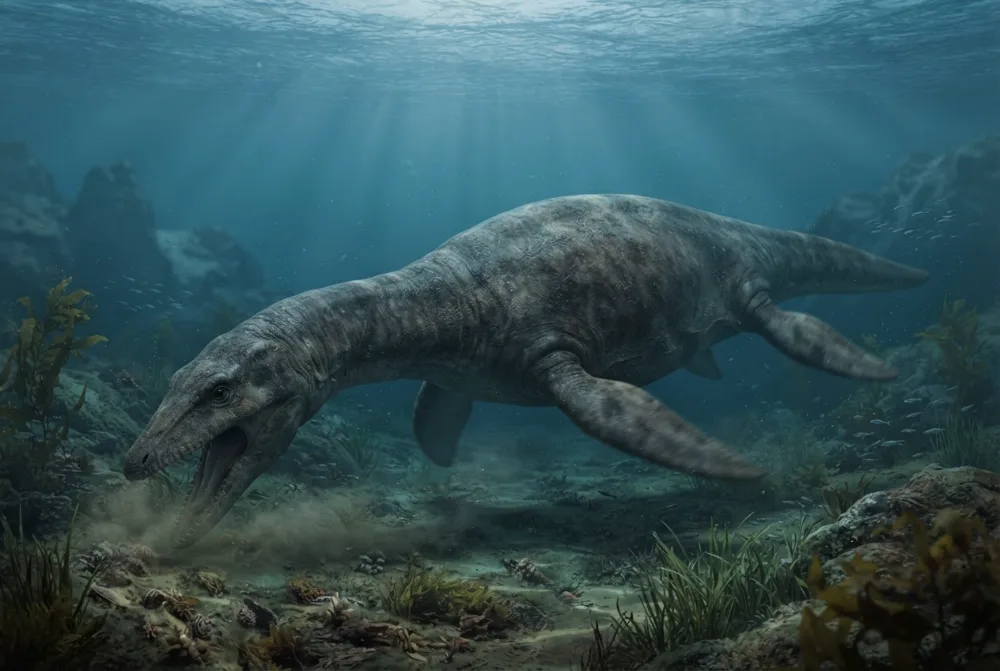
Aristonectes was a huge marine reptile that swam in the seas near Antarctica and South America at the end of the Age of Dinosaurs. It had a big head, a short neck, and a body shaped a bit like a whale. It used its wide mouth to suck up food from the seafloor, just like a gray whale does today.1
牠生活在什麼時候?
牠有多大?
牠有多長?
牠有多重?

 跟 2.5 台汽車排成一排一樣長🍌跟 66 根香蕉頭尾相接一樣長跟 9 台汽車一樣重🍉跟 2700 顆西瓜一樣重🎒跟 17 整班小學生一樣重🐻❄️跟 30 隻北極熊一樣重🏊能在 8.6 秒內游完一座大泳池(50 公尺)
Aristonectes 跟「你」比起來有多大?
只是在你的瀏覽器裡算算數學。什麼都不會被儲存或傳送出去。
牠有多快?


趣味知識
Aristonectes is one of the biggest and heaviest plesiosaurs ever found. One Antarctic specimen may have weighed as much as 13.5 metric tons (about 15 tons), as heavy as a large school bus.1
Unlike most plesiosaurs, which had very long necks, Aristonectes had a short neck and a big, bulky skull. Scientists put it in a special group called Aristonectinae because of this.1
Aristonectes probably migrated between Patagonia and Antarctica, just like many whales do today. Its fossils are found in both places.1
The first fossils of Aristonectes were discovered in Argentina in 1941, but scientists had a hard time studying them because the bones were not well prepared. It took decades to figure out what kind of plesiosaur it was.1
Aristonectes had a mouth that could open very wide, letting it gulp a huge amount of water and food at once. It fed by mixing prey with sediment from the seafloor, a method called benthic suction feeding.1
Like other plesiosaurs, Aristonectes probably swallowed stones called gastroliths. These may have helped grind up food in its stomach or helped control its buoyancy in the water.1
關於 Aristonectes 最常被問的問題
?How big was Aristonectes?
Aristonectes was huge, measuring more than 10 metres (33 feet) long. One Antarctic specimen may have reached 11 to 11.9 metres (36 to 39 feet) and weighed 10.7 to 13.5 metric tons (11.8 to 14.9 short tons).12
?What did Aristonectes eat?
Aristonectes likely ate crustaceans and small fish, based on its small teeth. It fed by sucking up prey and sediment from the seafloor, like a gray whale.13
?Was Aristonectes a dinosaur?
No, Aristonectes was a plesiosaur, a marine reptile that lived alongside the dinosaurs. It was not a dinosaur.1
?Where did Aristonectes live?
Aristonectes lived in the seas near Patagonia and Antarctica during the Late Cretaceous. Its fossils have been found in Chile, Argentina, and Antarctica.1
?Could Aristonectes swim?
Yes, Aristonectes was a strong swimmer, using its large paddle-like limbs to move through the water. Its name means 'best swimmer'.1
給恐龍專家
- 學名
- Aristonectes
- 命名者
- Cabrera 19414
- 類群
- 蛇頸龍類
- 科 / 演化支
- Elasmosauridae4
- 分類
- Plesiosauria > Elasmosauridae > Sauropterygia4
- 岩石的年代
- 84 到 66 百萬年 (Campanian / Maastrichtian)4
- 岩層
- Quiriquina, López de Bertodano, Lopez de Bertodano4
- 國家
- 智利, 南極洲, 阿根廷4
- 化石紀錄
- The Paleobiology Database 收錄 12 筆4
- 又名
- Turneria (舊名稱現在也算作同一種動物)4
- 發現
- Aristonectes was named by Argentine paleontologist Ángel Cabrera in 1941, based on fossils found in Chubut, Argentina. The first species named was Aristonectes parvidens.14
- 仍有爭議
- Scientists are still debating exactly how Aristonectes is related to other plesiosaurs. For a long time it was thought to be a cryptoclidid, but now most agree it is an elasmosaurid.1
知識從哪裡來
- Aristonectes (en.wikipedia.org)
- A giant elasmosaurid (Sauropterygia; Plesiosauria) from Antarctica: New information on elasmosaurid body size diversity and aristonectine evolutionary scenarios (sciencedirect.com)
- Fossil 'sea monster' found in Antarctica was the heaviest of its kind | National Geographic (nationalgeographic.com)
- Aristonectes in The Paleobiology Database (CC BY 4.0): 年代、地點、岩層、分類。
這一頁的每個知識都有一個編號,指向它的出處。如果我們有哪裡寫錯了,很抱歉,我們是恐龍迷,不是科學期刊。寫信到 [email protected] 告訴我們,我們會修正。
 Rex 肚子餓了! Dino Wiki 是一位爸爸為了熱愛恐龍的兒子做的網站,免費、沒有廣告也沒有追蹤器。大人可以請 Rex 吃點心,幫忙讓網站繼續上線。餵 Rex
 Elasmosaurus
 Pliosaurus
 Plesiosaurus
 Cimoliasaurus
 Colymbosaurus
 Trinacromerum
 Tyrannosaurus
 Triceratops
 Velociraptor
 Spinosaurus
 Ankylosaurus
 Parasaurolophus