 你是哪種恐龍?測驗
 恐龍對決
恐龍對決 恐龍賽跑
恐龍賽跑 恐龍小遊戲
恐龍小遊戲 貼紙簿
貼紙簿 恐龍 TOP 排行榜
 給我驚喜!
給我驚喜!
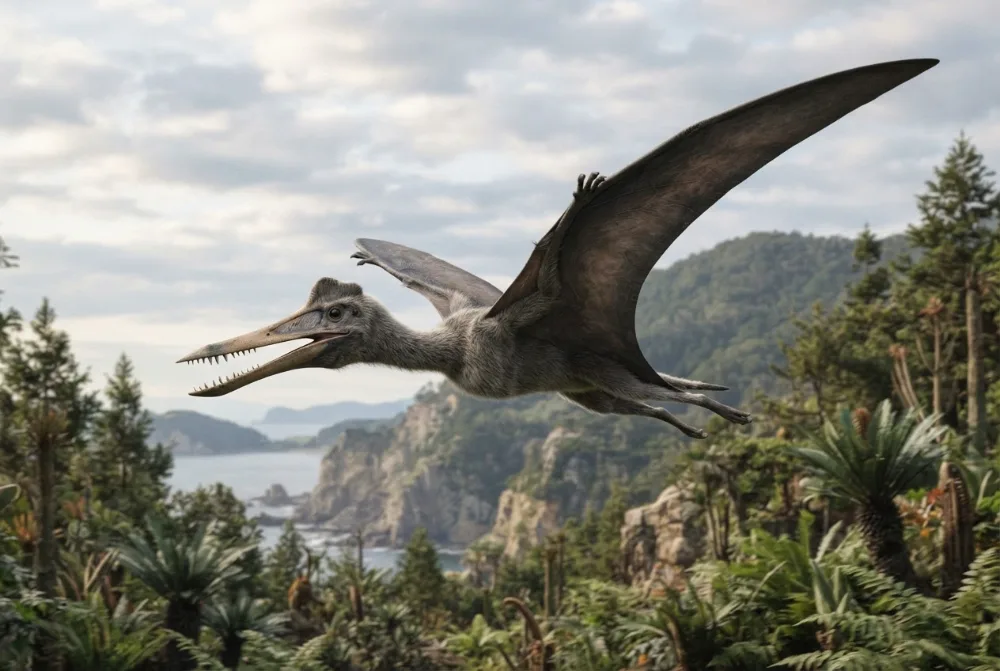
Dsungaripterus
Dsungaripterus was a flying reptile with long, narrow, upturned jaws that worked like tweezers. It used its toothless beak tip to poke into cracks and grab hard-shelled prey, then crushed them with flat, knobbly teeth at the back of its mouth.12
牠生活在什麼時候?
牠有多大?
牠的翅膀有多寬?
 翅膀跟 2 台腳踏車排成一排一樣寬⚽能在 6.4 秒內飛越一整座足球場
Dsungaripterus 跟「你」比起來有多大?
只是在你的瀏覽器裡算算數學。什麼都不會被儲存或傳送出去。
牠有多快?


趣味知識
Dsungaripterus had a skull over 46 centimeters (18 inches) long, and its head and neck together were almost 1 meter (3.3 feet) long.1
Its jaws curved upward at the tip, and the front part had no teeth, probably covered by a horny sheath.2
It had bulbous, flat teeth at the back of its jaws, perfect for crushing the armor of shellfish.1
The bones of Dsungaripterus were thick-walled and sturdy, suggesting it spent a lot of time walking on the ground.1
It likely landed abruptly and flapped a lot, rather than soaring for long distances.1
Dsungaripterus had a low bony crest on top of its skull, running from the base of the skull to halfway to the beak.1
Fossils show grooves on the jaws that might have held a horny covering, protecting the beak while it probed for food.2
關於 Dsungaripterus 最常被問的問題
?How big was Dsungaripterus?
Dsungaripterus had a wingspan of 3 to 3.5 metres (9.8 to 11.5 feet). Its skull was over 46 centimetres (18 inches) long, and its head and neck together were almost 1 metre (3.3 feet) long.1
?What did Dsungaripterus eat?
It ate hard-shelled prey like shellfish. It used its toothless, upturned beak tip to poke into cracks and grab food, then crushed shells with its flat, knobbly back teeth.12
?Was Dsungaripterus a dinosaur?
No, Dsungaripterus was a pterosaur, a flying reptile, not a dinosaur. Pterosaurs were the first vertebrates to evolve powered flight.3
?Why did Dsungaripterus have an upturned beak?
The upturned, toothless beak tip was probably used to probe and remove prey from cracks in rocks or sandy, muddy environments. It may have been covered by a horny sheath for protection.12
?Could Dsungaripterus walk on the ground?
Yes, its thick-walled, sturdy bones suggest it was mostly terrestrial and spent a lot of time walking on the ground. Pterosaurs could walk on all four limbs.13
?When did Dsungaripterus live?
Dsungaripterus lived during the Early Cretaceous period, about 145 to 100 million years ago. Its fossils were found in China and possibly South Korea.1
迷思破解王
迷思: Dsungaripterus is often called a dinosaur.
真相: It was actually a pterosaur, a flying reptile that lived alongside dinosaurs but is not a dinosaur.1
給恐龍專家
- 學名
- Dsungaripterus
- 命名者
- Young 19644
- 類群
- 飛行爬蟲類
- 科 / 演化支
- Dsungaripteridae4
- 分類
- Pterosauria > Pterodactyloidea4
- 岩石的年代
- 137 到 121 百萬年 (Valanginian / Barremian)4
- 岩層
- Lianmuqin, Tsagaantsav, Hutubihe4
- 國家
- 中國, 蒙古4
- 化石紀錄
- The Paleobiology Database 收錄 4 筆4
- 發現
- Dsungaripterus was named by Yang Zhongjian in 1964, based on a partial skull and skeleton from the Lianmuqin Formation in China. The species name weii honors paleontologist C.M. Wei.1
- 仍有爭議
- Scientists are still debating whether Dsungaripterus and Noripterus lived in the same place at the same time, or in different layers.2
知識從哪裡來
- Dsungaripterus (en.wikipedia.org)
- New anatomical information on Dsungaripterus weii Young, 1964 with focus on the palatal region (pmc.ncbi.nlm.nih.gov)
- Pterosaurs: The truth about these ‘flying dinosaurs’ | Natural History Museum (nhm.ac.uk)
- Dsungaripterus in The Paleobiology Database (CC BY 4.0): 年代、地點、岩層、分類。
這一頁的每個知識都有一個編號,指向它的出處。如果我們有哪裡寫錯了,很抱歉,我們是恐龍迷,不是科學期刊。寫信到 [email protected] 告訴我們,我們會修正。
 Rex 肚子餓了! Dino Wiki 是一位爸爸為了熱愛恐龍的兒子做的網站,免費、沒有廣告也沒有追蹤器。大人可以請 Rex 吃點心,幫忙讓網站繼續上線。餵 Rex
 Pteranodon
 Quetzalcoatlus
 Dorygnathus
 Rhamphorhynchus
 Anhanguera
 Pterodactylus
 Stegosaurus
 Iguanodon
 Archaeopteryx
 Giganotosaurus
 Microraptor
 Deinonychus