 Watter dino is jy? Kwis
 Dinogeveg
 Dinoresies
 Dino-minispeletjies
 Plakkeralbum
 Dino TOP-lyste
 Verras my!
Austriadactylus
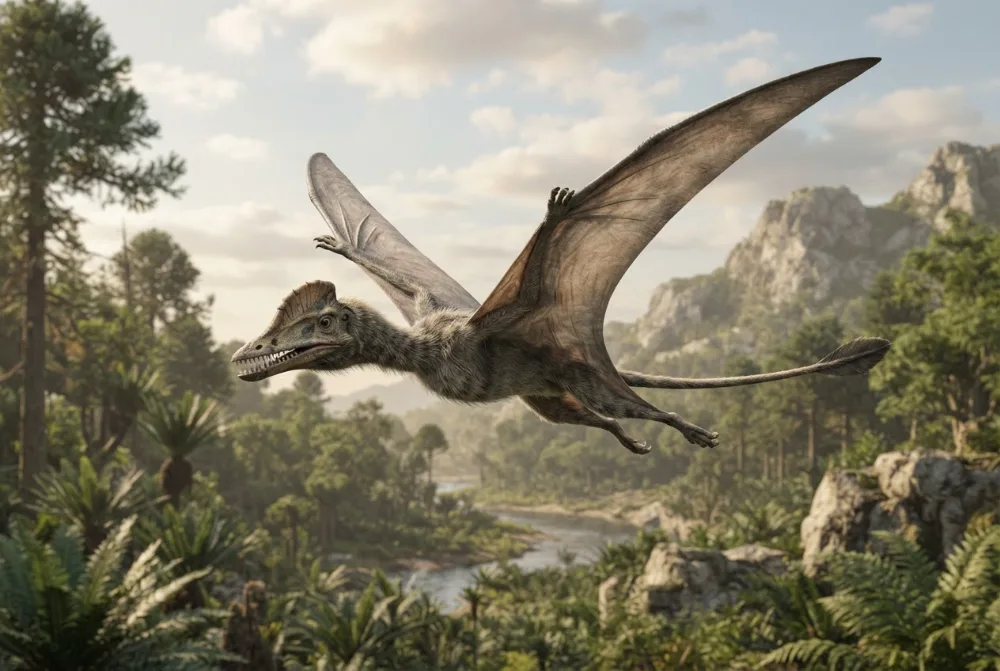
Austriadactylus was an early flying reptile with a long tail and a crest on its head. It lived about 215 million years ago in what is now Austria and Italy. This pterosaur had many different kinds of teeth, perfect for crunching hard-shelled bugs.12
Wanneer het dit geleef?
Hoe groot was dit?
Hoe wyd was sy vlerke?
 so lank soos 2,5 huiskatte van neus tot stert⚽kon in 9,7 sekondes oor 'n hele sokkerveld vlieg
Hoe groot was Austriadactylus vergeleke met JOU?
Net wiskunde in jou blaaier. Niks word gestoor of êrens heen gestuur nie.
Hoe vinnig was dit?


Prettige feite
Austriadactylus had a bony crest on its head that started at the tip of its snout and went back to above its eye. The crest was about 2 cm tall.21
Its teeth were very different from each other. It had tall, pointed teeth at the front, blade-like teeth with tiny serrations in the middle, and triangular teeth with up to 12 small points at the back.2
Unlike many other long-tailed pterosaurs, Austriadactylus had a flexible tail without stiff rods made of bone.21
The only known fossil of Austriadactylus was found in an abandoned mine near Ankerschlag in Tyrol, Austria.21
Austriadactylus lived during the Late Triassic period, about 215 million years ago, in a shallow sea environment with islands.12
The name Austriadactylus cristatus means 'crested Austrian finger', referring to the wing finger and the crest on its head.1
Mees gevraagde vrae oor Austriadactylus
?What did Austriadactylus eat?
It mostly ate hard-shelled bugs. Scientists can tell from the tiny scratches on its teeth that it crunched hard invertebrates.1
?How big was Austriadactylus?
Its wingspan was about 120 cm (47 inches), and its skull was 11 cm long. It was about the size of a crow.1
?Did Austriadactylus have a crest?
Yes, it had a bony crest on its head that started at the tip of its snout and went back to above its eye. The crest was about 2 cm tall.1
?Is Austriadactylus a dinosaur?
No, it is a pterosaur, which is a flying reptile that lived at the same time as dinosaurs but is not a dinosaur.1
Vir dino-kenners
- Wetenskaplike naam
- Austriadactylus
- Benoem deur
- Dalla Vecchia et al. 20023
- Groep
- Vlieënde reptiele
- Familie / klade
- Pterosauria3
- Klassifikasie
- Pterosauria3
- Ouderdom van die rotse
- 215 tot 206 miljoen jaar (Norian)3
- Rotsformasies
- Seefelder Schichten, Dolomia di Forni3
- Lande
- Oostenryk, Italië3
- Fossielrekords
- 2 in The Paleobiology Database3
- Ontdekking
- Austriadactylus was named in 2002 by Fabio Marco Dalla Vecchia and colleagues. The fossil was found in an abandoned mine in Tyrol, Austria, and is stored at the State Museum of Natural History in Stuttgart, Germany.31
- Steeds omstrede
- Scientists are not sure if Austriadactylus is a close relative of Eudimorphodon or if it belongs to a different group. Some think it might even be the same animal as Eudimorphodon.1
Waar die feite vandaan kom
- Austriadactylus (en.wikipedia.org)
- vrpa_22_124.196_199.tp (doc.rero.ch)
- Austriadactylus in The Paleobiology Database (CC BY 4.0): ouderdom, plekke, rotsformasies, klassifikasie.
Elke feit op hierdie bladsy het 'n nommer wat na sy bron wys. As ons iets verkeerd het, jammer, ons is dino-aanhangers, nie 'n wetenskapjoernaal nie. Laat weet ons by [email protected] en ons maak dit reg.
 Rex is honger! Dino Wiki is 'n pa se projek vir sy seun wat mal is oor dino's, gratis met geen advertensies en geen spoorsnyers nie. Grootmense kan vir Rex 'n peuselhappie gee om te help om dit aanlyn te hou.Voer Rex
 Pteranodon
 Quetzalcoatlus
 Dorygnathus
 Rhamphorhynchus
 Anhanguera
 Pterodactylus
 Nothosaurus
 Massospondylus
 Plateosaurus
 Coelophysis
 Podokesaurus
 Simosaurus