 Watter dino is jy? Kwis
 Dinogeveg
 Dinoresies
 Dino-minispeletjies
 Plakkeralbum
 Dino TOP-lyste
 Verras my!
Caelestiventus
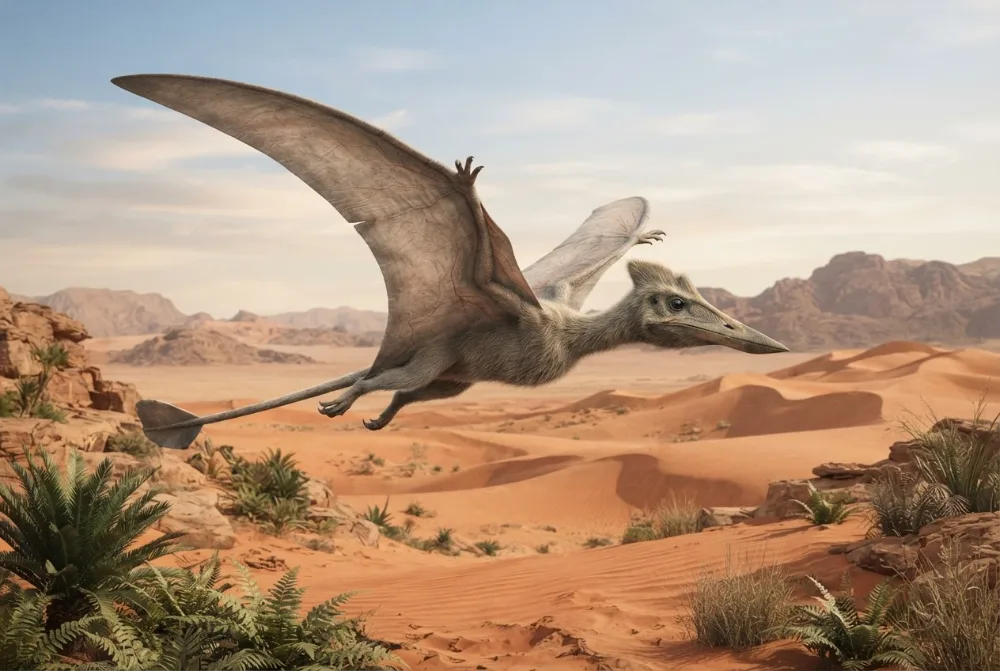
Caelestiventus was a flying reptile that lived in a hot desert during the Late Triassic, about 205 million years ago. It was one of the biggest pterosaurs of its time, with a wingspan over 1.5 meters (5 feet). Unlike most early pterosaurs, which are found in marine rocks, this one lived among sand dunes.21
Wanneer het dit geleef?
Hoe groot was dit?
Hoe wyd was sy vlerke?
 so lank soos 3 huiskatte van neus tot stert⚽kon in 7,3 sekondes oor 'n hele sokkerveld vlieg
Hoe groot was Caelestiventus vergeleke met JOU?
Net wiskunde in jou blaaier. Niks word gestoor of êrens heen gestuur nie.
Hoe vinnig was dit?


Prettige feite
Caelestiventus is the only known desert-dwelling non-pterodactyloid pterosaur, and it is 65 million years older than any other desert pterosaur.21
Its skull was 17.8 centimeters (7 inches) long, and most of the skull bones were preserved in three dimensions, not squashed flat like most Triassic pterosaur fossils.1
The lower jaw of Caelestiventus was hollow and air-filled, with large openings that may have helped reduce weight for flight.1
It had three different kinds of teeth: long fang-like spikes at the front, large leaf-shaped blades, and tiny blades further back.1
The only known fossil includes most of the skull and the last finger bone of the wing, which supported the wingtip.1
Caelestiventus is closely related to Dimorphodon, a pterosaur from the Early Jurassic of Britain.21
The quarry where it was found also contained bones of crocodile-like reptiles, lizards, and small meat-eating dinosaurs.1
Mees gevraagde vrae oor Caelestiventus
?Was Caelestiventus a dinosaur?
No, Caelestiventus was a pterosaur, a flying reptile, not a dinosaur.13
?How big was Caelestiventus?
It had a wingspan of at least 1.5 meters (4.9 feet) and a skull 17.8 centimeters (7 inches) long. It was one of the largest Triassic pterosaurs, and the only known specimen was not fully grown.1
?What did Caelestiventus eat?
Scientists are not sure, but its three kinds of teeth (fang-like spikes, leaf-shaped blades, and tiny blades) suggest it ate different foods, possibly insects or small animals.1
?Did Caelestiventus have feathers?
No, it did not have feathers. Like most pterosaurs, it was covered in small hair-like structures called pycnofibers.3
?When did Caelestiventus live?
It lived during the Late Triassic Period, about 205 million years ago.1
?Where was Caelestiventus found?
It was discovered in the Saints & Sinners Quarry in northeastern Utah, USA, in fossilized sand dunes.1
Vir dino-kenners
- Wetenskaplike naam
- Caelestiventus
- Benoem deur
- Britt et al. 20184
- Groep
- Vlieënde reptiele
- Familie / klade
- Dimorphodontidae4
- Klassifikasie
- Pterosauria4
- Ouderdom van die rotse
- 237 tot 175 miljoen jaar (Carnian / Toarcian)4
- Rotsformasies
- Nugget Sandstone4
- Lande
- VSA4
- Fossielrekords
- 1 in The Paleobiology Database4
- Ontdekking
- The fossil was discovered in 2007 by Dan Chure and George Engelmann in the Nugget Sandstone of Utah. It was named in 2018 by Britt and colleagues, honoring Robin Hansen, a geologist who helped with the excavation.14
- Steeds omstrede
- Scientists are not sure if the hollow spaces in its skull and jaw were used for storing food, for making sounds, or for display.1
Waar die feite vandaan kom
- Caelestiventus (en.wikipedia.org)
- Caelestiventus hanseni gen. et sp. nov. extends the desert-dwelling pterosaur record back 65 million years | Nature Ecology & Evolution (nature.com)
- Caelestiventus hanseni - BYU Geology (geology.byu.edu)
- Caelestiventus in The Paleobiology Database (CC BY 4.0): ouderdom, plekke, rotsformasies, klassifikasie.
Elke feit op hierdie bladsy het 'n nommer wat na sy bron wys. As ons iets verkeerd het, jammer, ons is dino-aanhangers, nie 'n wetenskapjoernaal nie. Laat weet ons by [email protected] en ons maak dit reg.
 Rex is honger! Dino Wiki is 'n pa se projek vir sy seun wat mal is oor dino's, gratis met geen advertensies en geen spoorsnyers nie. Grootmense kan vir Rex 'n peuselhappie gee om te help om dit aanlyn te hou.Voer Rex
 Pteranodon
 Quetzalcoatlus
 Dorygnathus
 Rhamphorhynchus
 Anhanguera
 Pterodactylus
 Nothosaurus
 Massospondylus
 Plateosaurus
 Coelophysis
 Podokesaurus
 Simosaurus