 Watter dino is jy? Kwis
 Dinogeveg
 Dinoresies
 Dino-minispeletjies
 Plakkeralbum
 Dino TOP-lyste
 Verras my!
Fruitadens
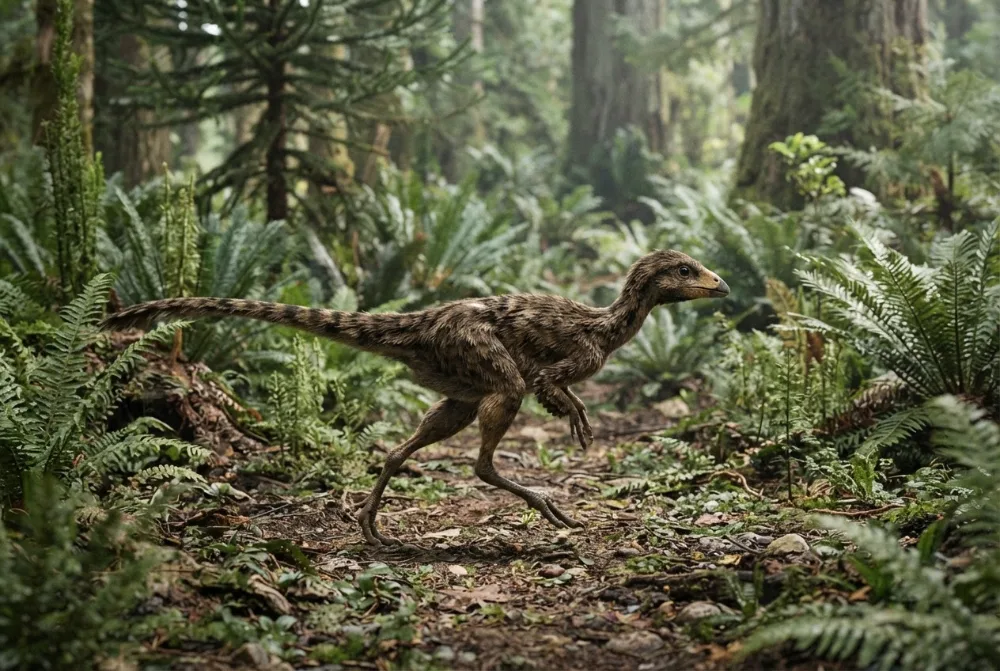
Fruitadens was one of the tiniest plant-eating dinosaurs ever found. It was only as long as a big cat and weighed less than a bag of sugar. This little dinosaur lived in what is now the western United States during the Late Jurassic period.12
Wanneer het dit geleef?
Hoe groot was dit?
Hoe lank was dit?
Hoe hoog was dit?
skatting
Hoe swaar was dit?
Hoe groot was Fruitadens vergeleke met JOU?
Net wiskunde in jou blaaier. Niks word gestoor of êrens heen gestuur nie.
Hoe vinnig was dit?


Prettige feite
Fruitadens is the smallest known ornithischian dinosaur, a group that includes many plant-eaters.12
Its lower jaw had an enlarged canine-like tooth, with a gap in the upper jaw for it to fit.1
Unlike many other dinosaurs, Fruitadens had replacement teeth growing in its jaws, like modern mammals.1
The fossils were first found in the 1970s and 1980s by teams from the Natural History Museum of Los Angeles County.1
Fruitadens lived alongside snails, clams, turtles, and early mammals in a floodplain environment.1
Its leg bones were hollow, like those of small meat-eating dinosaurs, which helped keep it light.1
Mees gevraagde vrae oor Fruitadens
?How big was Fruitadens?
Fruitadens was very small, about 65 to 75 cm long and weighed 0.5 to 0.75 kg. That is about as long as a large house cat and lighter than a bag of sugar.12
?What did Fruitadens eat?
Fruitadens was an omnivore, meaning it ate both plants and small animals. Scientists think it ate select plant material and possibly insects or other invertebrates.13
?When did Fruitadens live?
Fruitadens lived during the Late Jurassic period, about 150 million years ago. Its fossils were found in rocks that are around 150.3 to 150.2 million years old.1
?Where was Fruitadens found?
Fruitadens fossils were found in Colorado, USA, in an area called the Fruita Paleontological Area. The name Fruitadens means 'Fruita teeth' after the town of Fruita.1
?Did Fruitadens have teeth?
Yes, Fruitadens had teeth, including an enlarged canine-like tooth in its lower jaw and a small peg-like tooth in front of it. Unlike many other dinosaurs, it could replace its teeth like modern mammals.1
Vir dino-kenners
- Wetenskaplike naam
- Fruitadens
- Benoem deur
- Butler et al. 20104
- Groep
- Plantvreters met snawels
- Familie / klade
- Heterodontosauridae4
- Klassifikasie
- Ornithischia > Heterodontosauridae4
- Ouderdom van die rotse
- 149 tot 143 miljoen jaar (Tithonian)4
- Rotsformasies
- Morrison4
- Lande
- VSA4
- Fossielrekords
- 4 in The Paleobiology Database4
- Ontdekking
- Fruitadens was named in 2010 by Richard Butler and colleagues. The fossils were found in the Fruita Paleontological Area of Colorado, USA, in rocks about 150 million years old.14
- Steeds omstrede
- Scientists are still debating exactly what Fruitadens ate, though it likely ate both plants and small animals.12
Waar die feite vandaan kom
- Fruitadens (en.wikipedia.org)
- Lower limits of ornithischian dinosaur body size inferred from a new Upper Jurassic heterodontosaurid from North America | Proceedings B | The Royal Society (royalsocietypublishing.org)
- Small-Bodied Dinosaur Fruitadens haagarorum from the (journals.plos.org)
- Fruitadens in The Paleobiology Database (CC BY 4.0): ouderdom, plekke, rotsformasies, klassifikasie.
Elke feit op hierdie bladsy het 'n nommer wat na sy bron wys. As ons iets verkeerd het, jammer, ons is dino-aanhangers, nie 'n wetenskapjoernaal nie. Laat weet ons by [email protected] en ons maak dit reg.
 Rex is honger! Dino Wiki is 'n pa se projek vir sy seun wat mal is oor dino's, gratis met geen advertensies en geen spoorsnyers nie. Grootmense kan vir Rex 'n peuselhappie gee om te help om dit aanlyn te hou.Voer Rex
 Iguanodon
 Tenontosaurus
 Thescelosaurus
 Zalmoxes
 Camptosaurus
 Rhabdodon
 Brachiosaurus
 Diplodocus
 Allosaurus
 Brontosaurus
 Compsognathus
 Camarasaurus