 Watter dino is jy? Kwis
 Dinogeveg
 Dinoresies
 Dino-minispeletjies
 Plakkeralbum
 Dino TOP-lyste
 Verras my!
Wanneer het dit geleef?

Hoe groot was dit?
Hoe lank was dit?
Hoe hoog was dit?
Hoe swaar was dit?
 so lank soos 6 honde van neus tot stert🍌so lank soos 33 piesangs punt aan punt🍉so swaar soos 98 waatlemoene🧸so swaar soos 26 kleuterskoolkinders🎒so swaar soos 15 skoolkinders🏃kon 100 meter in 6,4 sekondes hardloop (die vinnigste mens het 9,6 nodig)
Hoe groot was Gallimimus vergeleke met JOU?
Net wiskunde in jou blaaier. Niks word gestoor of êrens heen gestuur nie.
Hoe vinnig was dit?


Prettige feite
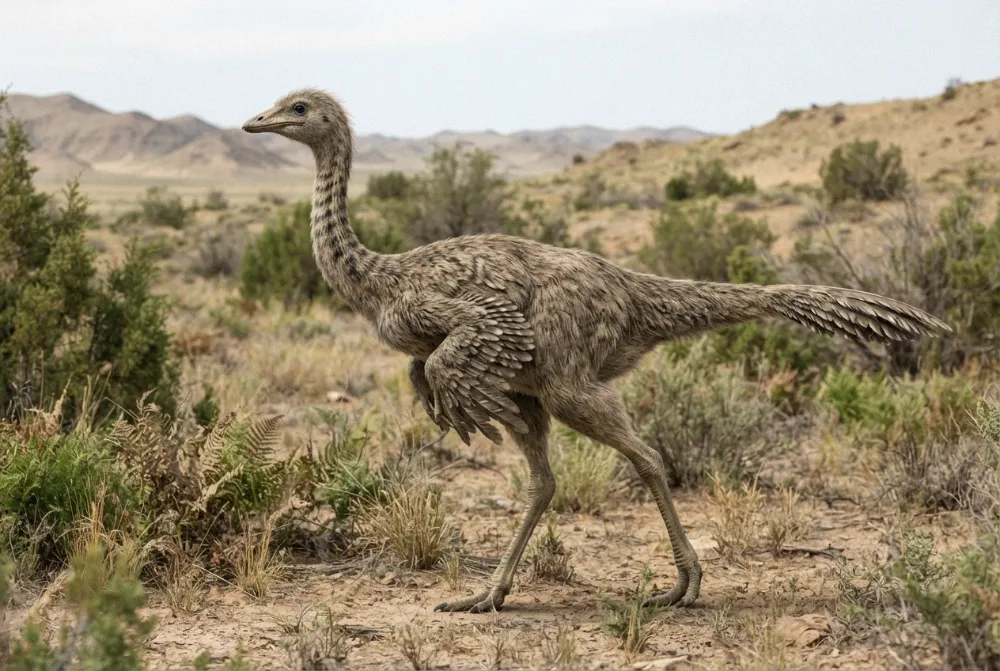
Gallimimus is the largest known ornithomimid, or ostrich dinosaur. Adults were about 6 meters (20 feet) long and weighed up to 490 kilograms (1,080 pounds).1
Its name means 'chicken mimic' because the bones in its neck look like those of chickens and other galliform birds.1
Gallimimus could run at speeds of 42 to 56 kilometers per hour (29 to 34 miles per hour), making it one of the fastest dinosaurs.1
Scientists think Gallimimus may have had feathers, like its relative Ornithomimus.1
Several Gallimimus skeletons were found together in a bone bed, which suggests they might have lived in groups.1
Gallimimus appeared in the movie Jurassic Park, running across a field in a famous scene that helped show dinosaurs as bird-like animals.1
Mees gevraagde vrae oor Gallimimus
?What did Gallimimus eat?
Gallimimus was probably an omnivore, eating both plants and small animals. It had a toothless beak and may have used it to filter food from water or to eat tough plants.21
?Did Gallimimus have feathers?
Yes, scientists are confident Gallimimus had feathers. There is no direct evidence on Gallimimus itself, but its close relative Ornithomimus had feathers, so it is highly likely.21
?How fast could Gallimimus run?
Gallimimus could run at speeds of 42 to 56 kilometers per hour (26 to 35 miles per hour). That is more than twice as fast as a fit human, but slower than a modern ostrich.21
?When did Gallimimus live?
Gallimimus lived during the Late Cretaceous period, about 70 million years ago.21
?Where was Gallimimus found?
Gallimimus fossils were found in the Gobi Desert of Mongolia. They were discovered by Polish-Mongolian expeditions in the 1960s.1
?How big was Gallimimus?
Gallimimus was about 6 meters (20 feet) long, 1.9 meters (6 feet) tall at the hip, and weighed around 400 to 490 kilograms (880 to 1,080 pounds). It was the largest known ornithomimid.21
Mite-breker
Mite: Gallimimus used its beak to filter small animals from water, like a flamingo.
Waarheid: The ridges in its beak were more like those of plant-eating animals. Scientists now think Gallimimus was a herbivore that ate tough plants, not a filter-feeder.1
Vir dino-kenners
- Wetenskaplike naam
- Gallimimus
- Benoem deur
- Osmólska et al. 19723
- Groep
- Volstruisdino's
- Familie / klade
- Ornithomimidae3
- Klassifikasie
- Theropoda > Ornithomimosauria3
- Ouderdom van die rotse
- 94 tot 66 miljoen jaar (Turonian / Maastrichtian)3
- Rotsformasies
- Nemegt, Baruungoyot, Bissekty3
- Lande
- Mongolië, Oesbekistan3
- Fossielrekords
- 30 in The Paleobiology Database3
- Ontdekking
- Polish and Mongolian scientists found several Gallimimus skeletons in the Gobi Desert during the 1960s. The dinosaur was named Gallimimus bullatus in 1972 by Halszka Osmólska, Ewa Roniewicz, and Rinchen Barsbold.13
- Steeds omstrede
- Scientists still debate what Gallimimus ate. Some think it was an omnivore that ate small animals and plants, while others believe it was mainly a plant-eater.1
Waar die feite vandaan kom
- Gallimimus (en.wikipedia.org)
- Gallimimus | Natural History Museum (nhm.ac.uk)
- Gallimimus in The Paleobiology Database (CC BY 4.0): ouderdom, plekke, rotsformasies, klassifikasie.
Elke feit op hierdie bladsy het 'n nommer wat na sy bron wys. As ons iets verkeerd het, jammer, ons is dino-aanhangers, nie 'n wetenskapjoernaal nie. Laat weet ons by [email protected] en ons maak dit reg.
 Rex is honger! Dino Wiki is 'n pa se projek vir sy seun wat mal is oor dino's, gratis met geen advertensies en geen spoorsnyers nie. Grootmense kan vir Rex 'n peuselhappie gee om te help om dit aanlyn te hou.Voer Rex
 Ornithomimus
 Struthiomimus
 Deinocheirus
 Dromiceiomimus
 Archaeornithomimus
 Anserimimus
 Tyrannosaurus
 Triceratops
 Velociraptor
 Spinosaurus
 Ankylosaurus
 Parasaurolophus