 Watter dino is jy? Kwis
 Dinogeveg
 Dinoresies
 Dino-minispeletjies
 Plakkeralbum
 Dino TOP-lyste
 Verras my!
Ornithomimus
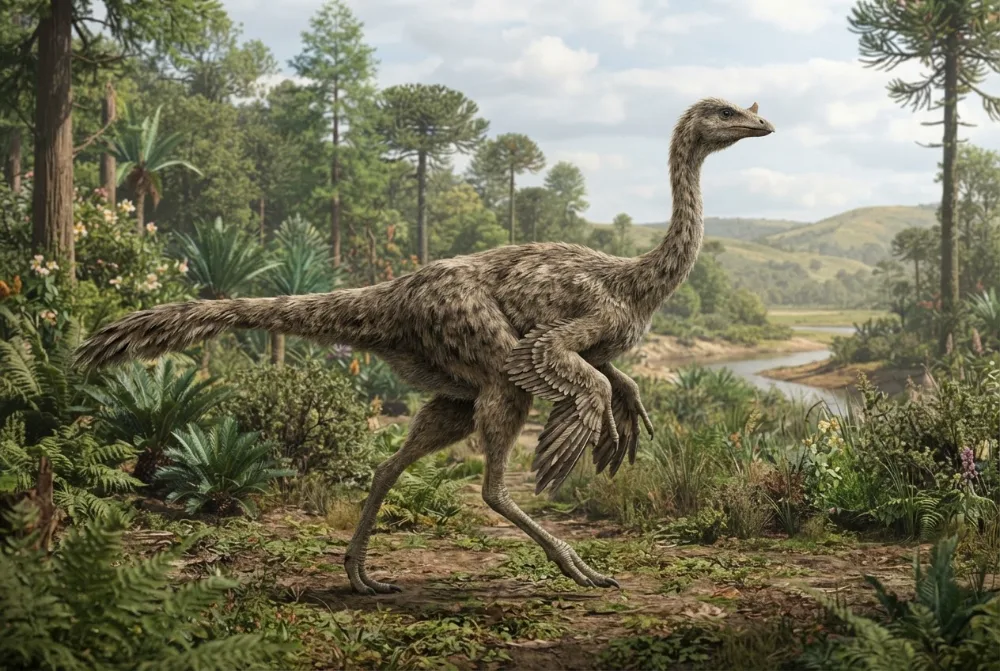
Ornithomimus was a fast, ostrich-like dinosaur that lived in North America during the Late Cretaceous. It had a small toothless beak, long legs, and was covered in downy feathers. Adults even had wings on their arms, which they probably used for showing off to mates.12
Wanneer het dit geleef?
Hoe groot was dit?
Hoe lank was dit?
Hoe hoog was dit?
Hoe swaar was dit?
 so lank soos 4 honde van neus tot stert🍌so lank soos 21 piesangs punt aan punt🍉so swaar soos 34 waatlemoene🧸so swaar soos 9 kleuterskoolkinders🎒so swaar soos 5 skoolkinders🏃kon 100 meter in 5,1 sekondes hardloop (die vinnigste mens het 9,6 nodig)
Hoe groot was Ornithomimus vergeleke met JOU?
Net wiskunde in jou blaaier. Niks word gestoor of êrens heen gestuur nie.
Hoe vinnig was dit?


Prettige feite
Ornithomimus was one of the first feathered dinosaurs found in the Western Hemisphere. Paleontologist François Therrien discovered the feathers in 2008.2
Its brain was small and its sense of smell was poor, so it probably relied on its big eyes and good eyesight to find food and avoid danger.2
Young Ornithomimus did not have wings on their arms. Only adults grew the long, stiff feathers that formed wings, which they used for courtship displays.2
Ornithomimus could run very fast thanks to its long, powerful legs and big leg muscles. It probably escaped predators by sprinting away.2
Its fingers had long, straight claws that might have helped it grab branches or dig for food.2
The name Ornithomimus means 'bird mimic' because its feet looked a lot like a bird's feet.1
Mees gevraagde vrae oor Ornithomimus
?How big was Ornithomimus?
Ornithomimus measured up to about 4 metres (13 feet) long and weighed up to 170 kilograms (375 pounds).45
?What did Ornithomimus eat?
Ornithomimus was probably an omnivore or plant-eater. It had a toothless beak and may have swallowed stones (gastroliths) to help grind up plants, like many birds do.15
?Did Ornithomimus have feathers?
Yes, Ornithomimus was covered in downy feathers. Adults also had long, stiff feathers on their arms that formed wings, used for display and courtship.15
?How fast could Ornithomimus run?
Ornithomimus could run very fast, probably between 30 and 60 km/h (19 to 37 mph), and maybe even up to 80 km/h (50 mph), as fast as an ostrich.5
?When did Ornithomimus live?
Ornithomimus lived during the Late Cretaceous period, about 74 to 66 million years ago.4
?Where was Ornithomimus found?
Fossils of Ornithomimus have been found in Canada (especially Alberta) and the United States (Colorado, Montana, Wyoming).14
Mite-breker
Mite: Many people think Ornithomimus was a meat-eater like most other theropod dinosaurs.
Waarheid: Ornithomimus had no teeth and a beak, so scientists think it was a plant-eater or an omnivore, not a carnivore.2
Vir dino-kenners
- Wetenskaplike naam
- Ornithomimus
- Benoem deur
- Marsh 18906
- Groep
- Volstruisdino's
- Familie / klade
- Ornithomimidae6
- Klassifikasie
- Theropoda > Ornithomimosauria6
- Ouderdom van die rotse
- 84 tot 66 miljoen jaar (Campanian / Maastrichtian)6
- Rotsformasies
- Lance, Horseshoe Canyon, Denver6
- Lande
- VSA, Kanada6
- Fossielrekords
- 35 in The Paleobiology Database6
- Ontdekking
- The first Ornithomimus fossils were found in Colorado in 1889 by George Lyman Cannon. The famous paleontologist Othniel Charles Marsh named the dinosaur Ornithomimus velox in 1890.1
- Steeds omstrede
- Scientists are still debating what Ornithomimus ate. Some think it was a plant-eater, others think it ate insects, small animals, and maybe fruit too.12
Waar die feite vandaan kom
- Ornithomimus (en.wikipedia.org)
- Ornithomimus | The Canadian Encyclopedia (thecanadianencyclopedia.ca)
- Ornithomimus — size, diet & habitat | DinoLifePedia (dinolifepedia.com)
- Ornithomimus | Natural History Museum (nhm.ac.uk)
- Ornithomimus | The Canadian Encyclopedia (thecanadianencyclopedia.ca)
- Ornithomimus in The Paleobiology Database (CC BY 4.0): ouderdom, plekke, rotsformasies, klassifikasie.
Elke feit op hierdie bladsy het 'n nommer wat na sy bron wys. As ons iets verkeerd het, jammer, ons is dino-aanhangers, nie 'n wetenskapjoernaal nie. Laat weet ons by [email protected] en ons maak dit reg.
 Rex is honger! Dino Wiki is 'n pa se projek vir sy seun wat mal is oor dino's, gratis met geen advertensies en geen spoorsnyers nie. Grootmense kan vir Rex 'n peuselhappie gee om te help om dit aanlyn te hou.Voer Rex
 Gallimimus
 Struthiomimus
 Deinocheirus
 Dromiceiomimus
 Archaeornithomimus
 Anserimimus
 Tyrannosaurus
 Triceratops
 Velociraptor
 Spinosaurus
 Ankylosaurus
 Parasaurolophus