 Watter dino is jy? Kwis
 Dinogeveg
 Dinoresies
 Dino-minispeletjies
 Plakkeralbum
 Dino TOP-lyste
 Verras my!
Hagryphus
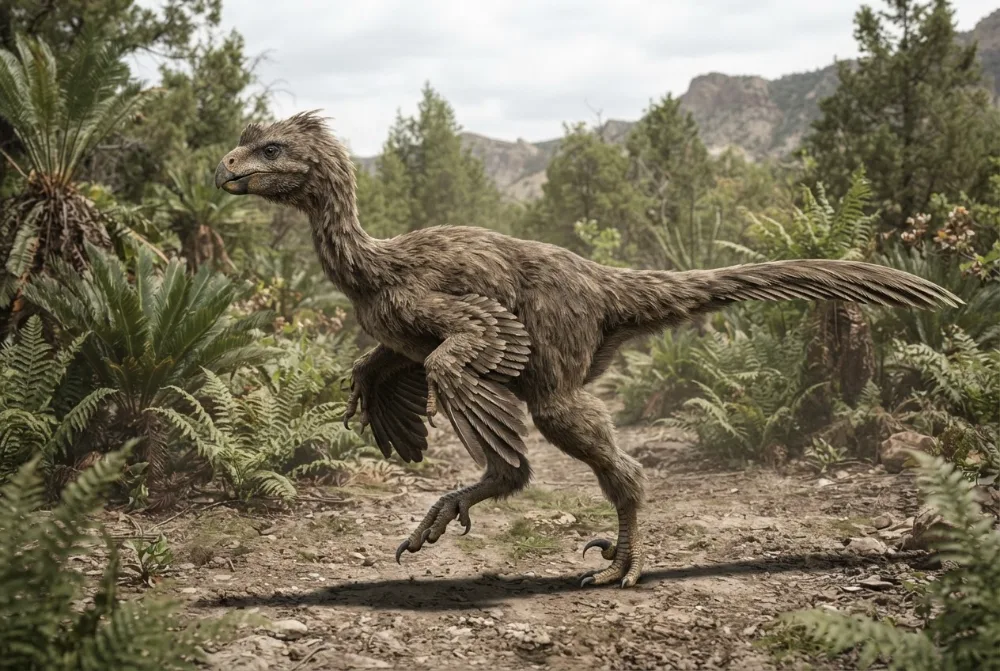
Hagryphus was a big, feathered dinosaur that lived in what is now Utah, USA, about 76 million years ago. It was one of the largest oviraptorosaurs in North America, and it probably used its toothless beak to eat plants and small animals.12
Wanneer het dit geleef?
Hoe groot was dit?
Hoe lank was dit?
Hoe hoog was dit?
skatting
Hoe swaar was dit?
 so lank soos 3 honde van neus tot stert🍌so lank soos 17 piesangs punt aan punt
 so swaar soos 12 huiskatte🍉so swaar soos 10 waatlemoene🧸so swaar soos 2,5 kleuterskoolkinders🎒so swaar soos 1,5 skoolkinders🏃kon 100 meter in 7,7 sekondes hardloop (die vinnigste mens het 9,6 nodig)
Hoe groot was Hagryphus vergeleke met JOU?
Net wiskunde in jou blaaier. Niks word gestoor of êrens heen gestuur nie.
Hoe vinnig was dit?


Prettige feite
Hagryphus was about 30 to 40 percent larger than the next largest North American oviraptorosaur, Chirostenotes.1
The only known fossil includes a nearly complete left hand, which was about a foot long, and some foot bones.1
Hagryphus lived near the shore of a huge inland sea called the Western Interior Seaway, in a wet, humid environment with swamps and lakes.1
It was probably covered in feathers, like other oviraptorosaurs, and some scientists think it might have been a true bird.1
The hand of Hagryphus had a very robust first finger, with a claw that was especially thick and strong.1
Mees gevraagde vrae oor Hagryphus
?How big was Hagryphus?
About 2.4 to 3 metres long and weighed around 50 kilograms.1
?Did Hagryphus have feathers?
Yes, evidence suggests it was feathered, like other oviraptorosaurs.1
?What did Hagryphus eat?
It had a toothless beak and probably ate plants or small animals, not just eggs.1
?When did Hagryphus live?
It lived about 76 million years ago, during the Late Cretaceous period.1
Mite-breker
Mite: Some people think Hagryphus ate only eggs because it had no teeth.
Waarheid: Scientists now think it likely ate plants and small vertebrates, not just eggs.1
Vir dino-kenners
- Wetenskaplike naam
- Hagryphus
- Benoem deur
- Zanno and Sampson 20052
- Groep
- Snaakse dino's met vere
- Familie / klade
- Caenagnathidae2
- Klassifikasie
- Theropoda > Oviraptorosauria2
- Ouderdom van die rotse
- 84 tot 72 miljoen jaar (Campanian)2
- Rotsformasies
- Kaiparowits2
- Lande
- VSA2
- Fossielrekords
- 1 in The Paleobiology Database2
- Ontdekking
- The fossil was found in 2002 by Michael Getty in southern Utah, and it was named Hagryphus giganteus by Lindsay Zanno and Scott Sampson in 2005.1
- Steeds omstrede
- Scientists still debate whether Hagryphus was a member of the Caenagnathidae family or a more general oviraptorosaur, and whether it was a bird.1
Waar die feite vandaan kom
- Hagryphus (en.wikipedia.org)
- Hagryphus in The Paleobiology Database (CC BY 4.0): ouderdom, plekke, rotsformasies, klassifikasie.
Elke feit op hierdie bladsy het 'n nommer wat na sy bron wys. As ons iets verkeerd het, jammer, ons is dino-aanhangers, nie 'n wetenskapjoernaal nie. Laat weet ons by [email protected] en ons maak dit reg.
 Rex is honger! Dino Wiki is 'n pa se projek vir sy seun wat mal is oor dino's, gratis met geen advertensies en geen spoorsnyers nie. Grootmense kan vir Rex 'n peuselhappie gee om te help om dit aanlyn te hou.Voer Rex
 Therizinosaurus
 Oviraptor
 Chirostenotes
 Citipes
 Leptorhynchos
 Avimimus
 Tyrannosaurus
 Triceratops
 Velociraptor
 Spinosaurus
 Ankylosaurus
 Parasaurolophus