 Watter dino is jy? Kwis
 Dinogeveg
 Dinoresies
 Dino-minispeletjies
 Plakkeralbum
 Dino TOP-lyste
 Verras my!
Himeoolithus
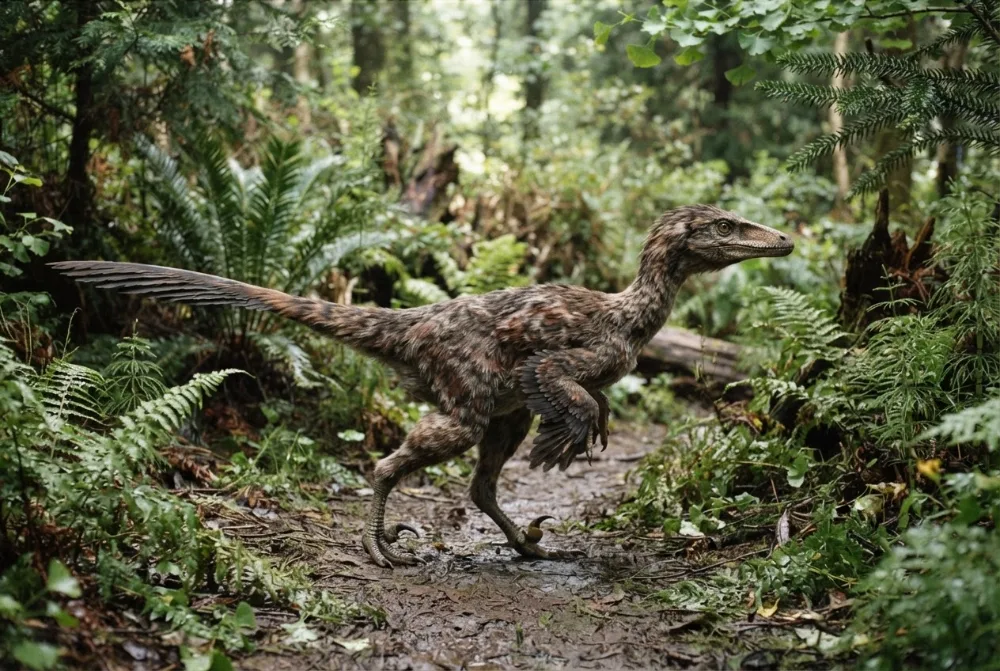
Himeoolithus was a tiny meat-eating dinosaur that lived in what is now Japan about 110 million years ago. It is known from its eggs, which are some of the smallest theropod eggs ever found, about the size of a quail egg. These eggs show that small dinosaurs lived alongside the giants!2
Wanneer het dit geleef?
Hoe vinnig was dit?


Prettige feite
Himeoolithus eggs are the smallest non-avian theropod eggs known, with an estimated mass of only 9.9 grams, about the size of a modern quail egg.1
The eggs are unusually elongated for their size, with a length-to-width ratio of 2.25, which is more typical of larger theropod eggs.1
The nest was found in place, not moved by water or wind, because most eggshell fragments were positioned concave-up, which happens when they break in place.2
Over 1,300 eggshell fragments from Himeoolithus were found at the Kamitaki Egg Quarry, along with other small theropod eggs.2
The high diversity of small theropod eggs at this site makes it one of the most diverse Early Cretaceous egg localities known.2
Mite-breker
Mite: Some people think all dinosaurs were huge, but Himeoolithus shows that many were small.
Waarheid: Himeoolithus eggs are tiny, and the dinosaur that laid them was likely small, showing that dinosaurs came in many sizes.2
Vir dino-kenners
- Wetenskaplike naam
- Himeoolithus
- Benoem deur
- Tanaka et al. 20203
- Groep
- Vleisvretende dino's
- Familie / klade
- Theropoda3
- Klassifikasie
- Theropoda3
- Ouderdom van die rotse
- 113 tot 110 miljoen jaar (Albian)3
- Rotsformasies
- Ohyamashimo3
- Lande
- Japan3
- Fossielrekords
- 1 in The Paleobiology Database3
- Ontdekking
- The eggs were first discovered in 2015 at the Kamitaki Egg Quarry in Japan, and the species was named by Tanaka and colleagues in 2020.23
- Steeds omstrede
- Scientists are not sure exactly which theropod dinosaur laid the eggs, since no bones of the adult have been found yet.2
Waar die feite vandaan kom
- Exceptionally small theropod eggs from the Lower Cretaceous Ohyamashimo Formation of Tamba, Hyogo Prefecture, Japan (sciencedirect.com)
- Tiny Japanese Dinosaur Eggs Help Unscramble Cretaceous Ecosystem | Research News - University of Tsukuba (tsukuba.ac.jp)
- Himeoolithus in The Paleobiology Database (CC BY 4.0): ouderdom, plekke, rotsformasies, klassifikasie.
Elke feit op hierdie bladsy het 'n nommer wat na sy bron wys. As ons iets verkeerd het, jammer, ons is dino-aanhangers, nie 'n wetenskapjoernaal nie. Laat weet ons by [email protected] en ons maak dit reg.
 Rex is honger! Dino Wiki is 'n pa se projek vir sy seun wat mal is oor dino's, gratis met geen advertensies en geen spoorsnyers nie. Grootmense kan vir Rex 'n peuselhappie gee om te help om dit aanlyn te hou.Voer Rex
 Allosaurus
 Carnotaurus
 Dilophosaurus
 Giganotosaurus
 Compsognathus
 Paronychodon
 Stegosaurus
 Iguanodon
 Archaeopteryx
 Microraptor
 Deinonychus
 Baryonyx