 Watter dino is jy? Kwis
 Dinogeveg
 Dinoresies
 Dino-minispeletjies
 Plakkeralbum
 Dino TOP-lyste
 Verras my!
Wanneer het dit geleef?

Hoe groot was dit?
Hoe lank was dit?
Hoe hoog was dit?
Hoe groot was Ichthyornis vergeleke met JOU?
Net wiskunde in jou blaaier. Niks word gestoor of êrens heen gestuur nie.
Hoe vinnig was dit?


Prettige feite
Ichthyornis was one of the first prehistoric birds discovered with teeth, and Charles Darwin said it was important for understanding evolution.1
Its backbone bones were shaped like a fish's, which is why it got the name 'fish bird'.1
The beak of Ichthyornis was made of several separate plates, like an albatross's beak, not a single piece like most modern birds.1
Ichthyornis lived between about 93 and 83.5 million years ago, during the Late Cretaceous Period.1
Over time, Ichthyornis grew larger: older fossils have a wing bone about 58 mm long, while younger ones have a wing bone about 71.5 mm long.1
Its teeth were curved backward and set in a groove, similar to those of marine reptiles like mosasaurs.1
Ichthyornis is one of the closest extinct relatives of modern birds, helping scientists learn how today's birds evolved.1
Mees gevraagde vrae oor Ichthyornis
?How big was Ichthyornis?
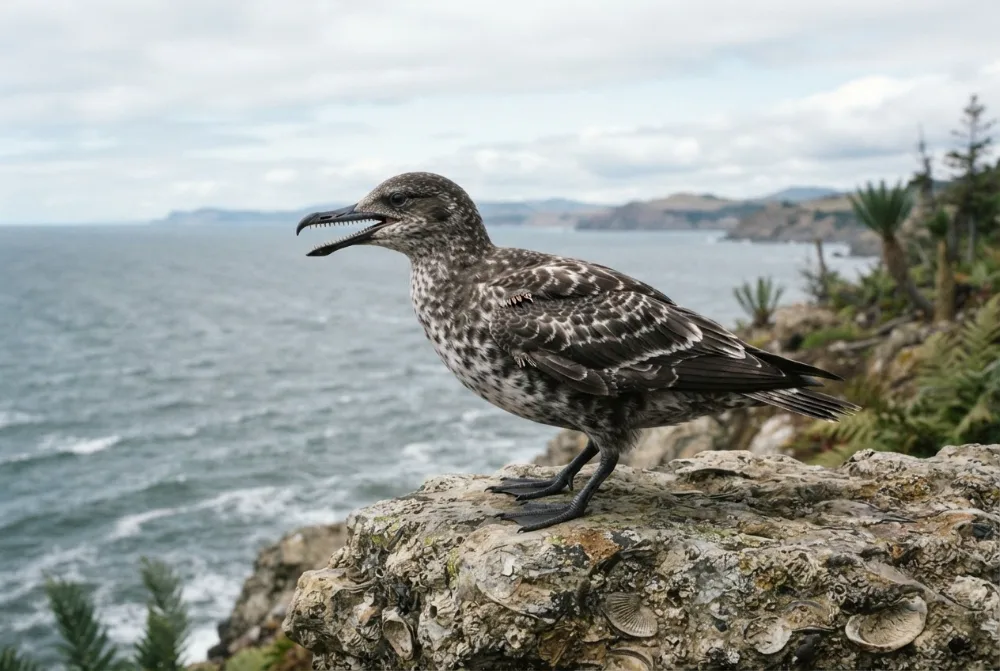
About 24 centimetres (9.4 inches) long, with a skeletal wingspan of around 43 centimetres (17 inches). That is about the size of a pigeon.1
?Did Ichthyornis have teeth?
Yes, it had sharp, backward-curved teeth in the middle part of its jaws. The tips of its jaws had no teeth and were covered by a beak.1
?Could Ichthyornis fly?
Yes, it was a strong flier. Its wings and breastbone looked very modern, similar to birds that fly well today.1
?What did Ichthyornis eat?
It probably ate fish and other small sea animals, like modern gulls and terns. Its teeth helped it grab slippery prey.2
?When did Ichthyornis live?
It lived during the Late Cretaceous Period, from about 93 million to 83.5 million years ago.1
?Where did Ichthyornis live?
It lived along the coasts of the huge inland sea that covered the middle of North America. Its fossils have been found in Kansas, Texas, Alberta, and other places.1
?Is Ichthyornis a dinosaur?
Yes, birds evolved from dinosaurs, so Ichthyornis is a type of dinosaur called an avialan. But it is not a non-avian dinosaur like T. rex.1
Mite-breker
Mite: Ichthyornis is sometimes thought to be a dinosaur like T. rex.
Waarheid: Ichthyornis is a bird, not a non-avian dinosaur. It belongs to the group Avialae, which includes modern birds and their extinct relatives.1
Vir dino-kenners
- Wetenskaplike naam
- Ichthyornis
- Benoem deur
- Marsh 18724
- Groep
- Vroeë voëls
- Familie / klade
- Ichthyornithes4
- Klassifikasie
- Theropoda > Avialae4
- Ouderdom van die rotse
- 100 tot 72 miljoen jaar (Cenomanian / Campanian)4
- Rotsformasies
- Niobrara, Mooreville Chalk, Belle Fourche4
- Lande
- VSA, Kanada, Oesbekistan, Meksiko4
- Fossielrekords
- 33 in The Paleobiology Database4
- Ook bekend as
- Angelinornis, Colonosaurus, Plegadornis (ouer name tel nou as dieselfde dier)4
- Ontdekking
- Ichthyornis was named by American paleontologist Othniel Charles Marsh in 1872. At first, Marsh thought the toothed jaws belonged to a marine reptile, but later in 1873 he realized they were part of the bird.12
- Steeds omstrede
- Scientists still debate whether the species should be called Ichthyornis dispar or Ichthyornis anceps, because of naming rules.1
Waar die feite vandaan kom
- Ichthyornis (en.wikipedia.org)
- Ichthyornis | Cretaceous period, seabird, toothed beak (britannica.com)
- A New Specimen of the Late Cretaceous Bird, cf.Ichthyornissp., from the Cenomanian of Central Kansas, with Comments on the Size Distribution ofIchthyornisin North America (exa.ai)
- Ichthyornis in The Paleobiology Database (CC BY 4.0): ouderdom, plekke, rotsformasies, klassifikasie.
Elke feit op hierdie bladsy het 'n nommer wat na sy bron wys. As ons iets verkeerd het, jammer, ons is dino-aanhangers, nie 'n wetenskapjoernaal nie. Laat weet ons by [email protected] en ons maak dit reg.
 Rex is honger! Dino Wiki is 'n pa se projek vir sy seun wat mal is oor dino's, gratis met geen advertensies en geen spoorsnyers nie. Grootmense kan vir Rex 'n peuselhappie gee om te help om dit aanlyn te hou.Voer Rex
 Archaeopteryx
 Hesperornis
 Baptornis
 Jurapteryx
 Gobipteryx
 Martinavis
 Tyrannosaurus
 Triceratops
 Velociraptor
 Spinosaurus
 Ankylosaurus
 Parasaurolophus