 Watter dino is jy? Kwis
 Dinogeveg
 Dinoresies
 Dino-minispeletjies
 Plakkeralbum
 Dino TOP-lyste
 Verras my!
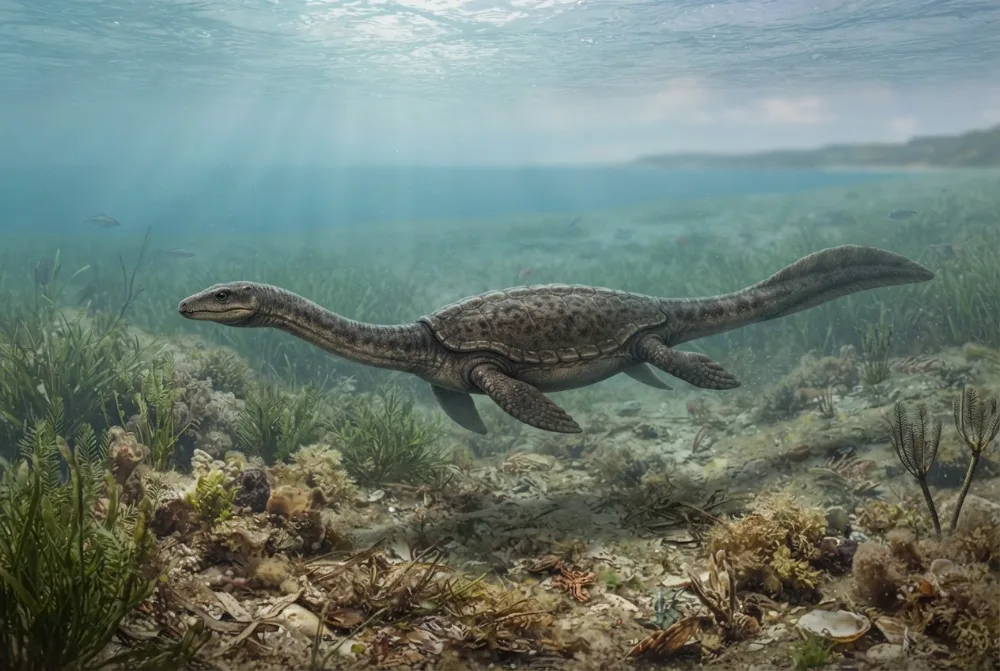
Paludidraco
Paludidraco was a strange marine reptile that lived in shallow seas over 200 million years ago. It had a very heavy, dense skeleton that helped it stay underwater without swimming much, like a manatee. Its jaws were weak and filled with many tiny teeth, so it probably sucked up soft plants or small animals from the seafloor.2
Wanneer het dit geleef?
Hoe groot was dit?
Hoe lank was dit?
 so lank soos 2,5 honde van neus tot stert🍌so lank soos 14 piesangs punt aan punt🏊kon die lengte van 'n groot swembad (50 m) in 8,6 sekondes swem
Hoe groot was Paludidraco vergeleke met JOU?
Net wiskunde in jou blaaier. Niks word gestoor of êrens heen gestuur nie.
Hoe vinnig was dit?


Prettige feite
Paludidraco had an extremely heavy, pachyostotic skeleton, meaning its bones were very thick and dense. This helped it float at shallow depths without using much energy, just like modern manatees.2
Its jaws were very slender and weak, and its teeth were small, curved, and set in a groove (pleurodont implantation). This is very different from most other marine reptiles of its time.1
Paludidraco had more than 15 teeth in its premaxilla (the front part of the upper jaw), which is a unique feature among its family, Simosauridae.1
Scientists think Paludidraco was not an active predator. Its weak jaws could not catch struggling prey, and its heavy body made it slow and not very maneuverable.1
The name Paludidraco comes from Latin words meaning 'marshy dragon', because its fossils were found near a reservoir called El Atance in Spain.1
Paludidraco lived during the Late Triassic period, about 237 to 205 million years ago, in what is now central Spain.4
Vir dino-kenners
- Wetenskaplike naam
- Paludidraco
- Benoem deur
- de Miguel Chaves et al. 20184
- Groep
- Seereptiele
- Familie / klade
- Simosauridae4
- Klassifikasie
- Nothosauria > Sauropterygia4
- Ouderdom van die rotse
- 237 tot 206 miljoen jaar (Carnian / Norian)4
- Rotsformasies
- Keuper4
- Lande
- Spanje4
- Fossielrekords
- 1 in The Paleobiology Database4
- Ontdekking
- Paludidraco multidentatus was named in 2018 by scientists de Miguel Chaves, Ortega, and Pérez-García. They described it from two well-preserved skeletons found at the El Atance site in central Spain.41
- Steeds omstrede
- Scientists are not sure whether Paludidraco was a true filter feeder like some whales, or if it used its comb-like teeth to scrape soft plants from the seafloor. Its skull lacks some features seen in modern filter feeders.1
Waar die feite vandaan kom
- New highly pachyostotic nothosauroid interpreted as a filter ... (pmc.ncbi.nlm.nih.gov)
- New highly pachyostotic nothosauroid interpreted as a filter-feeding Triassic (royalsocietypublishing.org)
- Paludidraco (en.wikipedia.org)
- Paludidraco in The Paleobiology Database (CC BY 4.0): ouderdom, plekke, rotsformasies, klassifikasie.
Elke feit op hierdie bladsy het 'n nommer wat na sy bron wys. As ons iets verkeerd het, jammer, ons is dino-aanhangers, nie 'n wetenskapjoernaal nie. Laat weet ons by [email protected] en ons maak dit reg.
 Rex is honger! Dino Wiki is 'n pa se projek vir sy seun wat mal is oor dino's, gratis met geen advertensies en geen spoorsnyers nie. Grootmense kan vir Rex 'n peuselhappie gee om te help om dit aanlyn te hou.Voer Rex
 Nothosaurus
 Placodus
 Lariosaurus
 Cyamodus
 Cymatosaurus
 Proneusticosaurus
 Massospondylus
 Plateosaurus
 Coelophysis
 Podokesaurus
 Thecodontosaurus
 Eudimorphodon