 Watter dino is jy? Kwis
 Dinogeveg
 Dinoresies
 Dino-minispeletjies
 Plakkeralbum
 Dino TOP-lyste
 Verras my!
Plioplatecarpus
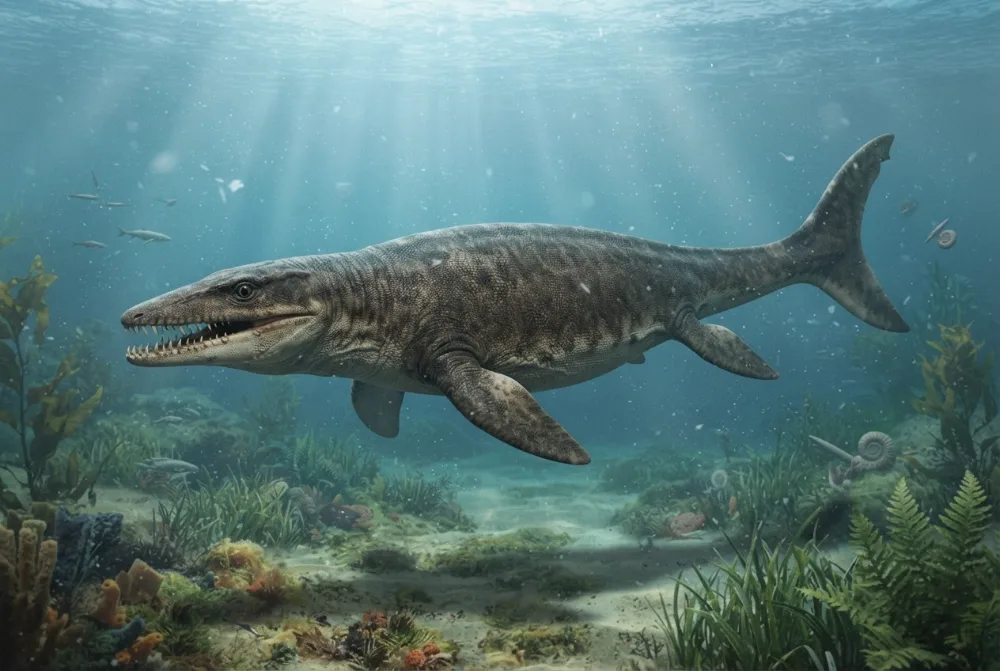
Plioplatecarpus was a medium-sized mosasaur, a giant marine lizard that lived in the late Cretaceous seas. It had big eyes and fewer, sharply curved teeth than other mosasaurs, perfect for grabbing small, slippery prey. Fossils of this ocean hunter have been found all over the world, from North America to Europe and even Antarctica.14
Wanneer het dit geleef?
Hoe groot was dit?
Hoe lank was dit?
 so lank soos 6 honde van neus tot stert🍌so lank soos 33 piesangs punt aan punt🏊kon die lengte van 'n groot swembad (50 m) in 4,7 sekondes swem
Hoe groot was Plioplatecarpus vergeleke met JOU?
Net wiskunde in jou blaaier. Niks word gestoor of êrens heen gestuur nie.
Hoe vinnig was dit?


Prettige feite
Plioplatecarpus had bigger eyes than most other mosasaurs, which may have helped it see in dark, deep water.1
Its teeth were fewer but strongly curved backward, so it could grab small prey very precisely.1
Some scientists think Plioplatecarpus could swim into rivers and estuaries, not just the open ocean.1
Plioplatecarpus used its front flippers for underwater flight, like a bird flaps its wings, to move through weedy or coral reef areas.2
The first Plioplatecarpus fossil was found in Belgium and named by Louis Dollo in 1882.1
Plioplatecarpus lived about 82 to 66 million years ago, during the late Cretaceous period.1
Mees gevraagde vrae oor Plioplatecarpus
?How big was Plioplatecarpus?
About 5.5 to 6 metres long, depending on the species.1
?What did Plioplatecarpus eat?
It ate small, slippery prey like fish and squid, grabbing them with its sharply curved teeth.13
?Could Plioplatecarpus swim in freshwater?
Some scientists think it could, because a fossil was found in a non-marine deposit, suggesting it entered rivers and estuaries.1
?When did Plioplatecarpus live?
It lived in the late Cretaceous period, about 82 to 68 million years ago.1
Mite-breker
Mite: Plioplatecarpus was a dinosaur.
Waarheid: Plioplatecarpus was a mosasaur, a type of marine lizard that lived in the sea, not a dinosaur.1
Vir dino-kenners
- Wetenskaplike naam
- Plioplatecarpus
- Benoem deur
- Dollo 18824
- Groep
- Mosasourusse
- Familie / klade
- Mosasauridae4
- Klassifikasie
- Mosasauroidea4
- Ouderdom van die rotse
- 100 tot 62 miljoen jaar (Cenomanian / Danian)4
- Rotsformasies
- Bearpaw Shale, Pierre Shale, Fox Hills4
- Lande
- VSA, Kanada, Antarktika, Swede, Denemarke, Rusland4
- Fossielrekords
- 28 in The Paleobiology Database4
- Ontdekking
- The first Plioplatecarpus fossil was found in Belgium and named by paleontologist Louis Dollo in 1882. Later, fossils from North America that were first called Mosasaurus were reclassified as Plioplatecarpus.1
- Steeds omstrede
- Scientists still debate whether some North American Plioplatecarpus fossils belong to separate species or are just variations of the same species found in Europe.2
Waar die feite vandaan kom
- Plioplatecarpus (en.wikipedia.org)
- Plioplatecarpus (Reptilia, Mosasauridae) from the Upper (biblio.naturalsciences.be)
- Plioplatecarpus (prehistoric-wildlife.com)
- Plioplatecarpus in The Paleobiology Database (CC BY 4.0): ouderdom, plekke, rotsformasies, klassifikasie.
Elke feit op hierdie bladsy het 'n nommer wat na sy bron wys. As ons iets verkeerd het, jammer, ons is dino-aanhangers, nie 'n wetenskapjoernaal nie. Laat weet ons by [email protected] en ons maak dit reg.
 Rex is honger! Dino Wiki is 'n pa se projek vir sy seun wat mal is oor dino's, gratis met geen advertensies en geen spoorsnyers nie. Grootmense kan vir Rex 'n peuselhappie gee om te help om dit aanlyn te hou.Voer Rex
 Mosasaurus
 Prognathodon
 Tylosaurus
 Platecarpus
 Clidastes
 Globidens
 Tyrannosaurus
 Triceratops
 Velociraptor
 Spinosaurus
 Ankylosaurus
 Parasaurolophus