 Watter dino is jy? Kwis
 Dinogeveg
 Dinoresies
 Dino-minispeletjies
 Plakkeralbum
 Dino TOP-lyste
 Verras my!
Suzhousaurus
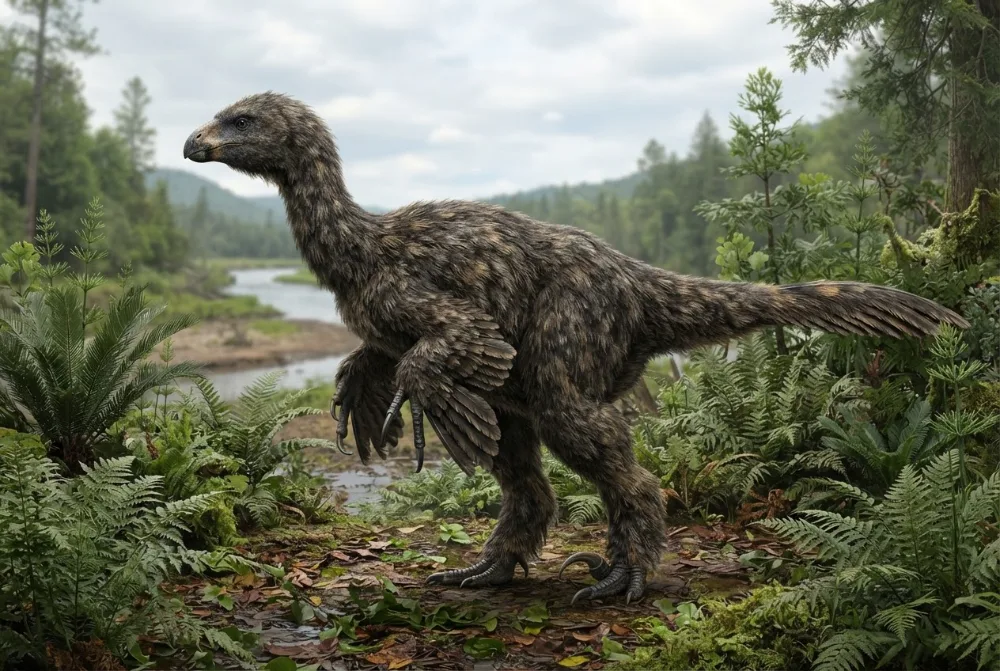
Suzhousaurus was a huge, plant-eating dinosaur with a big belly, strong legs, and long claws. It lived in China during the Early Cretaceous, about 124 to 113 million years ago. It probably had feathers, just like its close relatives!1
Wanneer het dit geleef?
Hoe groot was dit?
Hoe lank was dit?
Hoe hoog was dit?
skatting
Hoe swaar was dit?

 so lank soos 6 honde van neus tot stert🍌so lank soos 33 piesangs punt aan puntso swaar soos 160 honde🍉so swaar soos 620 waatlemoene🎒so swaar soos 4 hele skoolklasse vol kinders🐻❄️so swaar soos 7 ysbere🏃kon 100 meter in 22 sekondes hardloop (die vinnigste mens het 9,6 nodig)
Hoe groot was Suzhousaurus vergeleke met JOU?
Net wiskunde in jou blaaier. Niks word gestoor of êrens heen gestuur nie.
Hoe vinnig was dit?


Prettige feite
Suzhousaurus was one of the largest Early Cretaceous therizinosauroids, reaching about 6 metres (20 feet) long and weighing around 3.1 tonnes (3,100 kilograms).1
Its upper arm bone (humerus) had very expanded ends and a big entepicondyle, which helped scientists identify it as a therizinosauroid.3
Unlike more advanced therizinosaurids, Suzhousaurus's backbone was not highly pneumatized, meaning it had fewer air spaces in its vertebrae.1
Its pelvis was opisthopubic, a feature that is typical of therizinosaurids, even though Suzhousaurus was a more basal member of the group.1
Suzhousaurus had a large belly and a reduced tail, which helped it balance its heavy body.1
Feather impressions from the related Beipiaosaurus suggest that Suzhousaurus was probably at least partially feathered.1
The first specimen, FRDC-GSJB-99, was found in 1999 and includes a right humerus, shoulder bones, ten back vertebrae, and part of the pelvis, but no skull.1
A second, more complete skeleton found in 2004 includes the sacrum, tail vertebrae, a nearly complete pelvis, and both thigh bones.1
Mees gevraagde vrae oor Suzhousaurus
?How big was Suzhousaurus?
Suzhousaurus was about 6 metres (20 feet) long and weighed around 3.1 tonnes (3,100 kilograms). That makes it one of the largest Early Cretaceous therizinosauroids.1
?What did Suzhousaurus eat?
It was a plant-eater. It had a big belly, strong legs, and long claws for browsing on plants.1
?Did Suzhousaurus have feathers?
Probably yes. Feather impressions from its close relative Beipiaosaurus suggest that Suzhousaurus was at least partially feathered.1
?When did Suzhousaurus live?
It lived during the Early Cretaceous, about 124 to 113 million years ago, in what is now China.1
?Was Suzhousaurus a dinosaur?
Yes, it was a theropod dinosaur, specifically a therizinosauroid.1
?Why did Suzhousaurus have long claws?
Its long claws were probably used for pulling down branches and leaves to eat, like other therizinosauroids.1
Vir dino-kenners
- Wetenskaplike naam
- Suzhousaurus
- Benoem deur
- Li et al. 20074
- Groep
- Snaakse dino's met vere
- Familie / klade
- Therizinosauridae4
- Klassifikasie
- Theropoda > Therizinosauria4
- Ouderdom van die rotse
- 121 tot 110 miljoen jaar (Aptian / Albian)4
- Rotsformasies
- Xiagou, Zhonggou4
- Lande
- China4
- Fossielrekords
- 2 in The Paleobiology Database4
- Ontdekking
- The first Suzhousaurus fossil was found in 1999 in the Yujingzi Basin, China. Scientists named it Suzhousaurus megatherioides in 2007, and the name means 'Suzhou lizard' after the old name for the Jiuquan area.1
- Steeds omstrede
- Scientists are not sure if Suzhousaurus is the same animal as another therizinosauroid called 'Nanshiungosaurus' bohlini, because the fossils do not overlap and the original specimen is lost.1
Waar die feite vandaan kom
- Suzhousaurus (en.wikipedia.org)
- PBDB Taxon (paleobiodb.org)
- A Large Therizinosauroid (Dinosauria: Theropoda) from the Early Cretaceous of Northwestern China (onlinelibrary.wiley.com)
- Suzhousaurus in The Paleobiology Database (CC BY 4.0): ouderdom, plekke, rotsformasies, klassifikasie.
Elke feit op hierdie bladsy het 'n nommer wat na sy bron wys. As ons iets verkeerd het, jammer, ons is dino-aanhangers, nie 'n wetenskapjoernaal nie. Laat weet ons by [email protected] en ons maak dit reg.
 Rex is honger! Dino Wiki is 'n pa se projek vir sy seun wat mal is oor dino's, gratis met geen advertensies en geen spoorsnyers nie. Grootmense kan vir Rex 'n peuselhappie gee om te help om dit aanlyn te hou.Voer Rex
 Therizinosaurus
 Oviraptor
 Chirostenotes
 Citipes
 Leptorhynchos
 Avimimus
 Stegosaurus
 Iguanodon
 Archaeopteryx
 Giganotosaurus
 Microraptor
 Deinonychus