 Watter dino is jy? Kwis
 Dinogeveg
 Dinoresies
 Dino-minispeletjies
 Plakkeralbum
 Dino TOP-lyste
 Verras my!
Taniwhasaurus
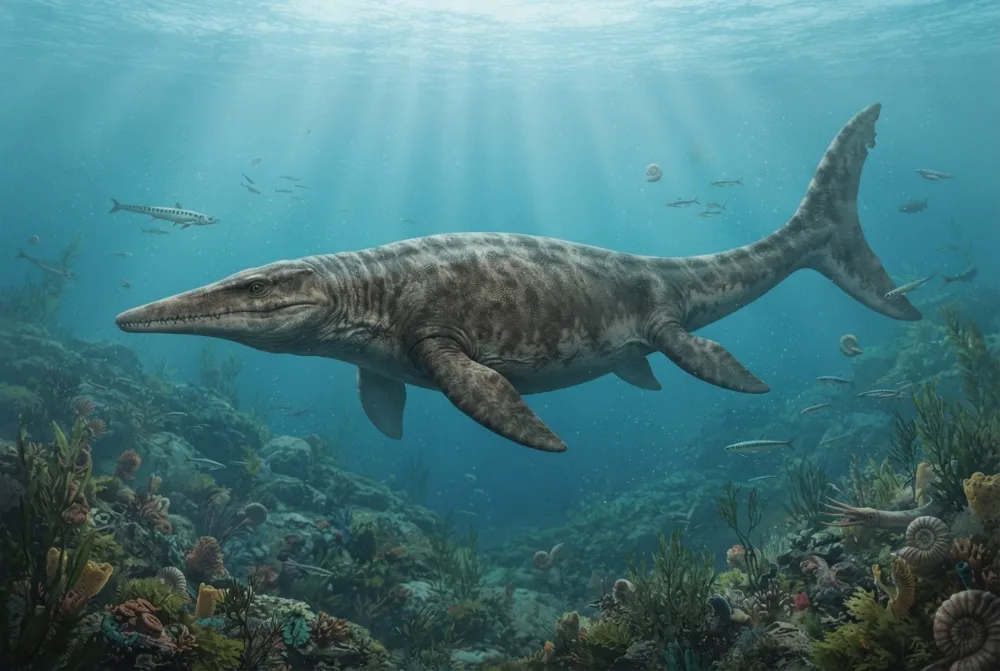
Taniwhasaurus was a fierce marine lizard that swam in the oceans during the time of dinosaurs. It had a long, toothless snout like a spear and used it to hunt fish and other sea creatures. This mosasaur lived near New Zealand, Antarctica, Japan, and South Africa.12
Wanneer het dit geleef?
Hoe groot was dit?
Hoe lank was dit?
 so lank soos 7 honde van neus tot stert🍌so lank soos 37 piesangs punt aan punt🏊kon die lengte van 'n groot swembad (50 m) in 4,9 sekondes swem
Hoe groot was Taniwhasaurus vergeleke met JOU?
Net wiskunde in jou blaaier. Niks word gestoor of êrens heen gestuur nie.
Hoe vinnig was dit?


Prettige feite
Taniwhasaurus belongs to a group called tylosaurines, which had a long, toothless tip on their upper jaw like a bony spear.1
The first fossils of Taniwhasaurus were found in the 1860s at Haumuri Bluff in New Zealand, and named by James Hector in 1874.1
One species, Taniwhasaurus antarcticus, was originally named Lakumasaurus after a sea spirit from the mythology of the Yahgan people of South America.1
A nearly complete skull of Taniwhasaurus antarcticus was discovered on James Ross Island in Antarctica in 2000, measuring 72 centimeters (28 inches) long.1
Taniwhasaurus lived between about 86 and 66 million years ago, during the Late Cretaceous period.2
The species Taniwhasaurus oweni was named in honor of the famous paleontologist Richard Owen, who first described marine reptiles from New Zealand.1
Taniwhasaurus fossils have been found in marine rocks that were once part of ancient seabeds, alongside ammonites, sharks, and other mosasaurs.1
Mees gevraagde vrae oor Taniwhasaurus
?How big was Taniwhasaurus?
It was a medium-sized mosasaur, reaching about 6.7 metres (22 feet) long.1
?Could Taniwhasaurus swim?
Yes. Its powerful paddles and flexible spine helped it swim, and its tail gave the main push forward.1
?What did Taniwhasaurus eat?
It hunted fish and other sea creatures. It may have used an electro-sensitive snout to find prey.1
?Is Taniwhasaurus a dinosaur?
No, it is a mosasaur, which is a group of extinct marine lizards that lived alongside dinosaurs.1
?When did Taniwhasaurus go extinct?
It lived during the Late Cretaceous period and died out about 66 million years ago.1
Mite-breker
Mite: Some people think Taniwhasaurus was a dinosaur.
Waarheid: Taniwhasaurus was a mosasaur, a type of marine lizard, not a dinosaur. Mosasaurs are reptiles that lived in the sea and are more closely related to modern snakes and monitor lizards.1
Vir dino-kenners
- Wetenskaplike naam
- Taniwhasaurus
- Benoem deur
- Hector 18743
- Groep
- Mosasourusse
- Familie / klade
- Mosasauridae3
- Klassifikasie
- Mosasauroidea3
- Ouderdom van die rotse
- 86 tot 66 miljoen jaar (Coniacian / Maastrichtian)3
- Rotsformasies
- Conway, Snow Hill Island, Conway Siltstone3
- Lande
- Nieu-Seeland, Antarktika, Japan, Suid-Afrika3
- Fossielrekords
- 11 in The Paleobiology Database3
- Ontdekking
- The first fossils of Taniwhasaurus were found in the 1860s at Haumuri Bluff, New Zealand. Scottish naturalist James Hector named the genus in 1874, calling it Taniwhasaurus oweni after the Māori taniwha and honoring Richard Owen.1
- Steeds omstrede
- Scientists are not sure if the species Taniwhasaurus mikasaensis from Japan is really a separate species, because its fossils are very incomplete.1
Waar die feite vandaan kom
- Taniwhasaurus (en.wikipedia.org)
- PBDB Taxon (paleobiodb.org)
- Taniwhasaurus in The Paleobiology Database (CC BY 4.0): ouderdom, plekke, rotsformasies, klassifikasie.
Elke feit op hierdie bladsy het 'n nommer wat na sy bron wys. As ons iets verkeerd het, jammer, ons is dino-aanhangers, nie 'n wetenskapjoernaal nie. Laat weet ons by [email protected] en ons maak dit reg.
 Rex is honger! Dino Wiki is 'n pa se projek vir sy seun wat mal is oor dino's, gratis met geen advertensies en geen spoorsnyers nie. Grootmense kan vir Rex 'n peuselhappie gee om te help om dit aanlyn te hou.Voer Rex
 Mosasaurus
 Prognathodon
 Tylosaurus
 Platecarpus
 Clidastes
 Globidens
 Tyrannosaurus
 Triceratops
 Velociraptor
 Spinosaurus
 Ankylosaurus
 Parasaurolophus