 Woyɛ dino bɛn? Nsɛmmisa agoro
 Dino ko
 Dino mmirikatuo
 Dino agodie nketewa
 Stika nwoma
 Dino TOP nhyehyɛeɛ
 Ma me nwanwa!
Berɛ bɛn na ɛtenaa ase?

Na ne kɛseɛ yɛ sɛn?
Na ne tenten yɛ sɛn?
Na ne korɔn yɛ sɛn?
nsusuiɛ
Na ne mu yɛ duru sɛn?
Natovenator kɛseɛ yɛ sɛn sɛ wode toto WO ho a?
Akontaa nko ara wɔ wo browser mu. Yɛnkora biribiara so, na yɛmmfa biribiara nkɔ baabiara.
Na ɛyɛ ntɛm sɛn?


Nsɛm a ɛyɛ anigye
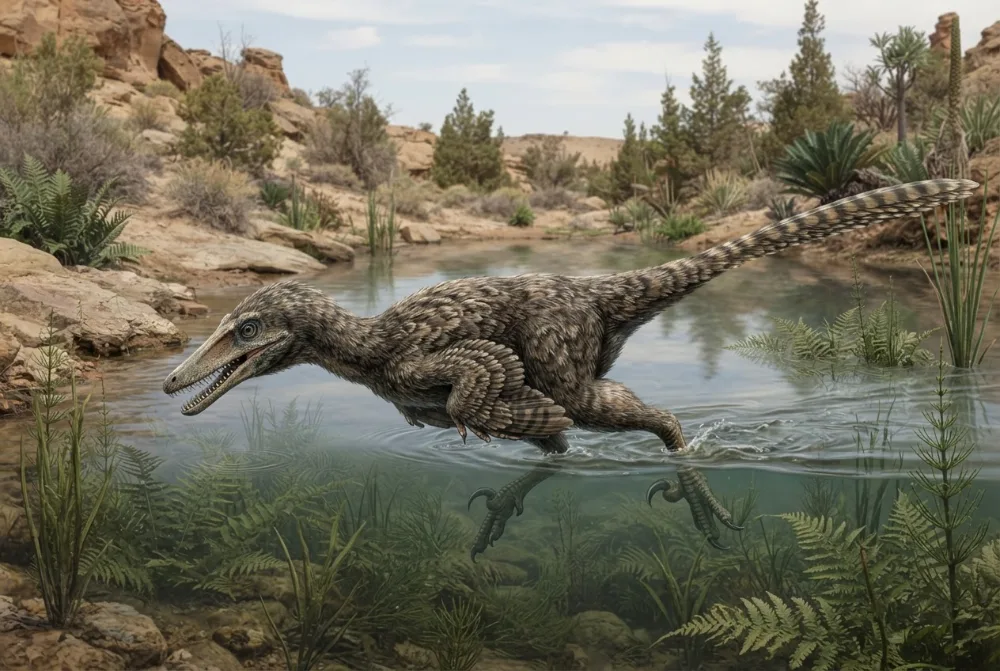
Natovenator had a streamlined body, which is very rare for non-avian dinosaurs. Its ribs pointed backwards to make it more hydrodynamic, just like diving birds and mosasaurs.21
It had 13 teeth in its premaxilla (the front of the upper jaw), which is an unusually high number for a dromaeosaurid.21
Its snout was long and full of many small holes (neurovascular foramina), which may have helped it sense movement in the water.21
Natovenator belongs to a group called Halszkaraptorinae, which are dromaeosaurids that may have been semi-aquatic. This group includes Halszkaraptor from Mongolia.13
Its neck was long, like many diving birds today, which helped it catch fish quickly.1
The name Natovenator means 'swimming hunter' in Latin, because scientists think it was a good swimmer that hunted in water.1
Nsɛm a wɔbisa bebree fa Natovenator ho
?How big was Natovenator?
About 0.7 metres (2.3 feet) long and weighed around 0.3 kilograms (0.66 pounds). That is roughly the size of a duck.1
?Could Natovenator swim?
Yes, scientists think it was a good swimmer. Its ribs pointed backwards to make its body streamlined like a diving bird, and its long neck helped it catch fish.21
?What did Natovenator eat?
It likely ate fish and other small prey in the water. Its many sharp teeth and long snout were good for catching slippery food.12
?When did Natovenator live?
It lived during the Late Cretaceous, about 72 to 83 million years ago, in what is now the Gobi Desert of Mongolia.1
Ma dino ho animdefoɔ
- Nyansahu din
- Natovenator
- Obi a ɔtoo din
- Lee et al. 20224
- Kuo
- Raptɔ
- Abusua / kuo kɛseɛ
- Dromaeosauridae4
- Nkyekyɛmu
- Theropoda > Dromaeosauridae4
- Abotan no mfeɛ
- mfeɛ ɔpepem 84 kɔsi 72 (Campanian)4
- Abotan nhyehyɛeɛ
- Baruungoyot4
- Aman
- Mongolia4
- Fɔsil nkyerɛwee
- 1 wɔ The Paleobiology Database mu4
- Nhunumu
- Natovenator was named in 2022 by Sungjin Lee and colleagues based on a nearly complete skeleton found in Mongolia. The fossil was first mentioned in a 2019 abstract.12
- Wɔda so gye ho akyinnye
- Scientists are still debating whether all halszkaraptorines were semi-aquatic, or if some were more terrestrial. Natovenator's streamlined body supports the swimming idea, but more fossils are needed to be sure.12
Baabi a nsɛm no firi
- Natovenator (en.wikipedia.org)
- A non-avian dinosaur with a streamlined body exhibits potential adaptations for swimming | Communications Biology (preview-www.nature.com)
- PBDB Taxon (paleobiodb.org)
- Natovenator in The Paleobiology Database (CC BY 4.0): mfeɛ, mmeaeɛ, abotan nhyehyɛeɛ, nkyekyɛmu.
Asɛm biara a ɛwɔ krataafa yi so wɔ nɔma a ɛkyerɛ baabi a ɛfiri. Sɛ yɛfom biribi a, kafra, yɛyɛ dino dɔfoɔ, yɛnyɛ nyansahu nsɛmma krataa. Ka kyerɛ yɛn wɔ [email protected] na yɛbɛsiesie.
 Ɔkɔm de Rex! Dino Wiki yɛ agya bi adwuma a ɔyɛɛ maa ne babarima a ɔdɔ dino. Ɛyɛ kwa, dawurubɔ biara nni mu, akyidifoɔ biara nni mu. Mpanimfoɔ bɛtumi ama Rex aduane kakra, na aboa ama Dino Wiki atena intanɛt so.Ma Rex aduane
 Velociraptor
 Microraptor
 Deinonychus
 Asiamericana
 Richardoestesia
 Saurornitholestes
 Tyrannosaurus
 Triceratops
 Spinosaurus
 Ankylosaurus
 Parasaurolophus
 Pteranodon